Tag: Starchild

  • No on AB 63 – An Authoritarian State Bill to Re-criminalize People for Loitering

    No on AB 63 – An Authoritarian State Bill to Re-criminalize People for Loitering

    There’s an authoritarian move afoot to re-criminalize “loitering with intent to commit prostitution”, by reimposing Section 653.22 of the California penal code, which was eliminated several years ago in decriminalization legislation sponsored by state senator Scott Wiener (D-San Francisco) and signed by governor Gavin Newsom.

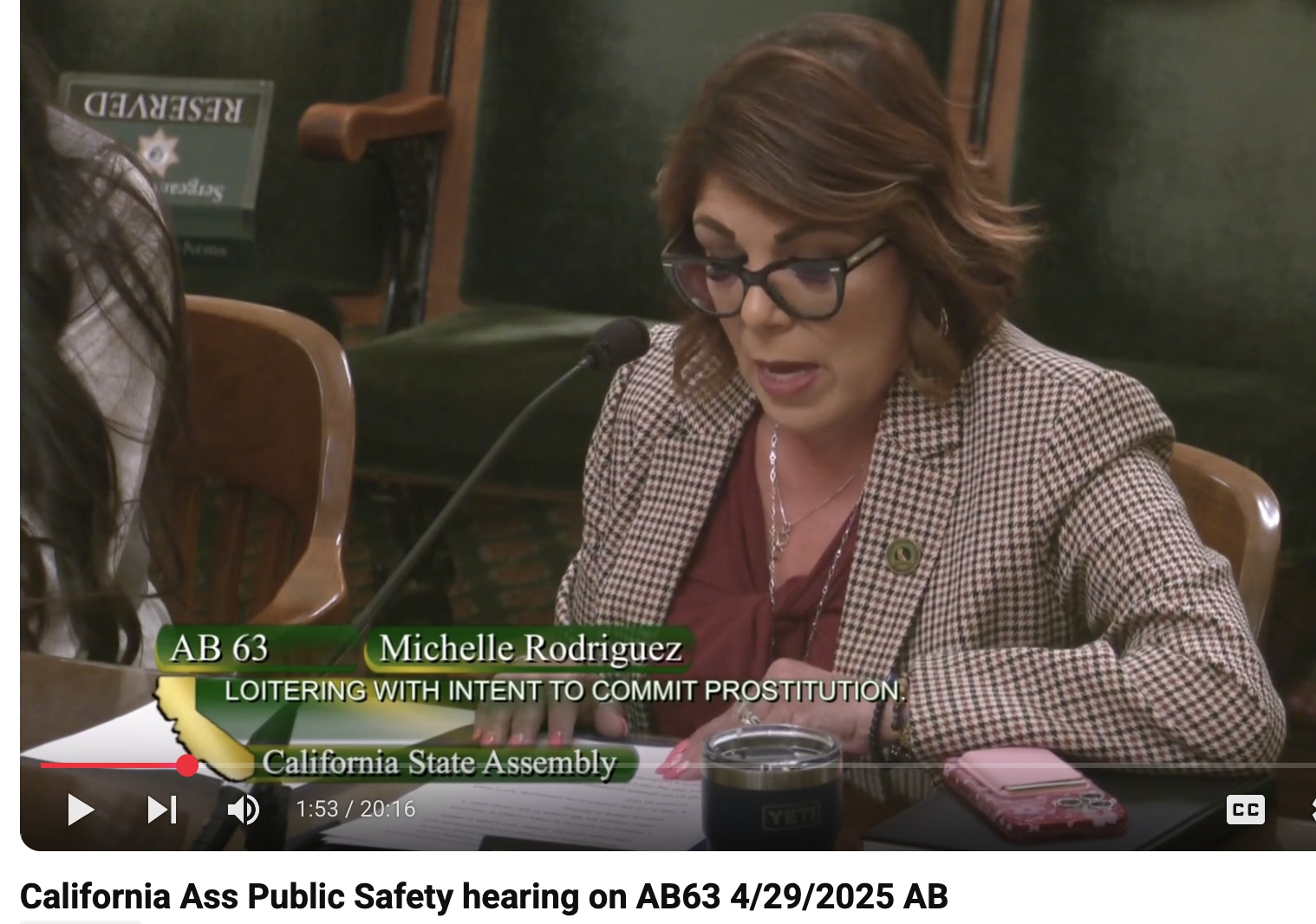
    Now another Democrat, Michelle Rodriguez (D-Ontario), has put forward Assembly Bill 63 in an attempt to recriminalize this vague “offense” (how police officers are supposed to read the minds of persons on the street to determine what their “intent” is, has never been truly explained).

    Laws against loitering (like laws against nudity) are arguably among the most absurd, senseless, and offensive laws on the books, because they subject people to arrest, criminal records, and possible incarceration and prosecution for literally doing nothing.
    Sex work rights advocates posted this 20 minute video clip of the State Assembly Public Safety Committee’s hearing on AB 63 today. It’s worth watching, not only to hear what the proponents and opponents of this particular authoritarian bill are saying, but as a glimpse into how the legislative process in Sacramento typically works:
    Each side has a parade of people present to testify, many of them employees of government agencies, most probably there on the taxpayers’ dime. Even many of those not directly employed by government, work for non-profits that are probably receiving taxpayer funding, and again are likely being paid to be there.
    This is not to denigrate the staffers at Public Defenders offices, representatives of the ACLU, workers with sex work rights non-profits, and others who took the time to show up and speak against AB 63. We should appreciate them being there and speaking out against the expansion of government at the expense of civil liberties – if they are being paid in part with your stolen money, such harm reduction efforts are certainly among the least objectionable uses of taxpayer funds.
    Nevertheless, it is telling and notable that of the dozens who testified today, not one appeared to be simply a member of the general public, unconnected to any organization with an institutional interest in the matter. This is sadly typical, and a recurring feature of Big Government statism – few ordinary people have the time, resources, etc., to follow and weigh in on all the endless crap being generated in the governmental chambers of Sacramento, Washington, or even locally here in San Francisco.
    All the more reason why it does help to speak out as an ordinary person against bad bills like AB 63. Fewer people do so in a state of ~39 million residents than you might think. This bill was not passed out of the Public Safety Committee, but is on a 2-year track and will be taken up by the committee again, probably later this year following a committee hearing in Assemblymember Rodriguez’s district.
    Here are the email addresses of some of the staffers for members of the committee. I encourage you to take a minute to write to them (probably most effective to copy and past what you write into a separate email for each recipient, and not list your location unless you happen to live in their district), and let them know you oppose people being criminalized for doing nothing, and OPPOSE AB 63:
    Chair Asm. Nick Schultz
    Asm. Mark Gonzalez
    Asm. Matt Haney*
    Asm. John Harabedian
    Asm. Stephanie Nguyen
    Asm. Dr. LaShae Sharp-Collins
    *Represents District 17, encompassing eastern San Francisco (see https://a17.asmdc.org/district-map)
    If you want some talking points for your letter, or just dare to see a bit of how the sausage gets made, here again is the link to the short video clip from today’s hearing:
    If a phone call is more your style than a written letter, you can call and leave a message for members of the Public Safety Committee urging a NO vote on AB 63 by calling (916) 319-3744.
    Or if you want to go the extra mile for liberty, you can find the contact information (phone and email addresses) for all members of the State Assembly, and look up your representative, here – https://www.assembly.ca.gov/assemblymembers.
    Hopefully this anti-libertarian garbage will die in committee, but in case it doesn’t, and just to communicate how the public feels about their resources being wasted on this kind of nonsense fueling mass incarceration and the destruction of civil liberties, it doesn’t hurt to let “your” representative know how you feel about AB 63 even if they aren’t on the committee themselves.
    Love & Liberty,
    ((( starchild )))
    Chair, Libertarian Party of San Francisco
    (415) 573-7997
  • How Now, Ocean Beach Park?

    How Now, Ocean Beach Park?


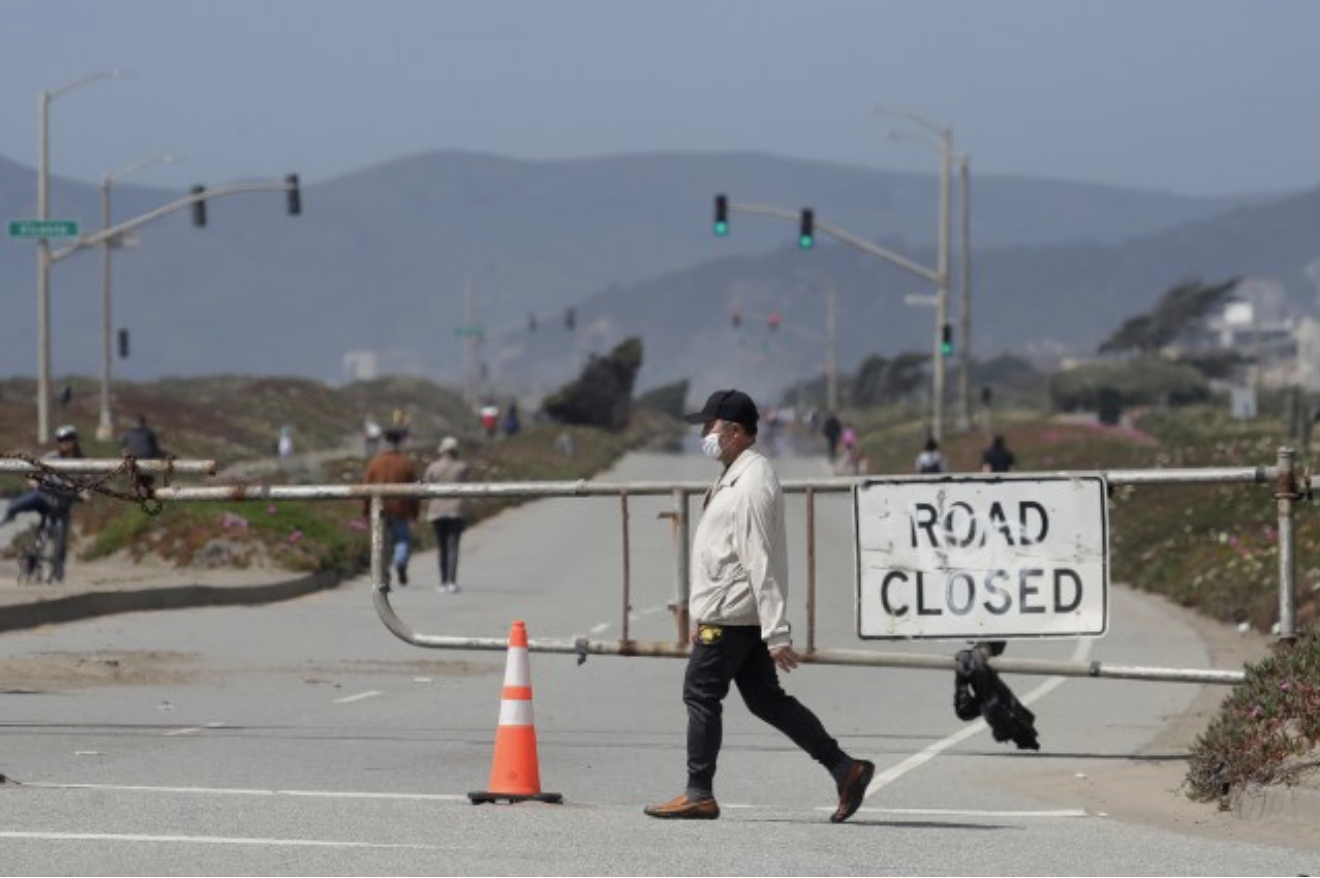
    So, Proposition K won. I didn’t vote for it, nor did most westside residents apparently, but it passed. The ballot measure promised to replace the stretch of the Great Highway from Fulton to Lincoln with a park. But it didn’t say what kind of park. So let’s think about this!

    San Francisco today suffers from a lack of imagination. Sure, people still do creative work here – the AI revolution bears witness to that. But when it comes to civic projects, we’ve gotten so used to letting government clog everything up with masses of regulatory red tape that we’ve forgotten how to dream big.

    This town used to be called “The City That Knows How” because they got things done. The improbable birth of “Baghdad by the Bay” in the first place – who could have dreamt, in 1845, that the Gold Rush would turn a barren, windswept peninsula of little more than 1,000 residents into the most important city west of the Mississippi? Later, San Francisco magnificently rebuilt itself, rising like a glorious phoenix from the ashes of the 1906 earthquake and fire. In 1915 and 1939, the city hosted two world fairs. They built two bridges and Treasure Island, along with a bunch of gorgeous buildings that shouldn’t have been torn down. But back then nobody cared – the thinking was, we’ll build something even better.

    So what are some creative possibilities for Ocean Beach Park?

    RV Park

    Let’s start modestly. There’s virtually nowhere to legally park a recreational vehicle in San Francisco. This is wrong. Many if not most of the RVs you see are inhabited by people who are one step from being homeless, having only their vehicles to live in. Yet the city harasses RV owners with tickets and tows if they don’t regularly burn the gas to pointlessly move them around. This summer, dozens of vehicles were “evicted” from two locations near the San Francisco Zoo. Why not let them park on this section of road that won’t be used any more? Let people build tiny homes there too, and invite food truck operators who are also made unwelcome in many locations, to create a mixed use residential and commercial RV park.

    Medical Enterprise Zone

    If they can build a platform off the coast of Gaza to unload relief supplies, why not off the coast of San Francisco? The sea lions would love it. Let the Mexican cartels do something more helpful than importing fentanyl. Give them a legal (or just decriminalized) place to dock their speedboats bringing in the good stuff: Magic mushrooms from Oaxaca, ayahuasca from Columbia, cheaper prescription drugs from Tijuana. You probably know someone who’s traveled abroad to buy drugs or obtain more affordable transgender surgery or other medical care. Those things could be provided in a special tax-free zone here, creating local jobs. Let the Great Highway be reborn as a medical business park and drug emporium.

    Playland 2.0

    As longtime residents know, there was once a full-on amusement park across from Ocean Beach north of Golden Gate Park. Playland at the Beach could be reopened with a Santa Cruz style boardwalk. We could even underground the highway and let cars travel beneath the park, like Tunnel Tops in the Presidio. While we’re at it, let’s give tourists more reason to come by rebuilding the old Victorian version of the Cliff House and reopening the Sutro Baths. Supervisors are finally getting serious (knock on wood) about bringing bathhouses back – doesn’t restoring the most famous one make sense?

    Worst case scenario?

    Ah yes, funding. City Hall has a whopping deficit, and the federal money spigot’s about to be turned off. So what better time for SF to re-learn how to accomplish things without State assistance? What’s the alternative, kiss Donald Trump’s orange you-know-what enough to get the gravy flowing again? (Actually his rear is undoubtedly white, not orange – not even the edges of his face are orange, if you look carefully.) But it’s kind of become his trademark color. What might politicians be tempted to do to make the Orange One forgive all? Rename the Golden Gate Bridge after him? It’s already orange, and he’d love-love-love having his name attached to such a world-famous landmark. His antipathy toward San Francisco would melt away like fog on a sunny day in the Mission district. There’s clear precedent, too – naming SF General Hospital after Meta mogul Mark Zuckerberg. If our gag reflexes can stomach that, maybe… But no. No! The “Donald J. Trump Golden Gate Bridge”? No subsidy would be worth such humiliation. Better a big, all-volunteer, Habitat for Humanity style community building project, am I right?

    Okay, maybe the practical solution is to forget all this and just put another proposition on the ballot to overturn Prop. K. And restore the iconic 49 Mile Scenic Drive by reopening the southern portion of the Great Highway for good measure. The way that’s being discussed is frankly embarrassing: “Oh well, coastal erosion is happening, nothing we can do, guess we’ve just gotta permanently close that stretch of road.” Nonsense. Look at Devil’s Slide in San Mateo county. Highway 1 is built into the side of a sheer cliff! Yet every time the road there washes out, they manage to get it reopened. Why can’t we figure out how to do the same where the land is relatively flat?

    But if we’re not going to do the sober, responsible thing, let’s have an Ocean Beach Park with a purpose. Get government out of the way, and as the fairies say, glitt’er done!

  • The Value of Libertarian Activism

    The Value of Libertarian Activism

    If you’ve spent any significant time engaged in libertarian activism, or even if you haven’t, you’ve probably heard people say things like, “Well, I have a life, I don’t have time to play activist”, or “those people are losers without real jobs or responsibilities”, etc. I can’t count how many times I’ve heard non-activists make comments like these in an effort to dismiss activists and their efforts. Living in the SF Bay Area where most people are politically on the left, I most often hear such complaints voiced against left-wing activists (often by right-wingers who are quite statist and not necessarily contributing much of meaning to society themselves), but it sounds much the same when they are voiced by statists against libertarians.

    If you are a freedom activist, those stuck in authoritarian mindsets, or who have a perceived financial or other vested interest in maintaining statist oppression, will naturally tend to resent your efforts. So when they attempt to diminish those efforts, or discourage you, this should come as no surprise, and there’s no reason to let it affect you. Know them for what they are, and let their words be like the wind whistling through a porcupine’s quills.

    Whether you experience your activism as work or play, as a moral duty or a rewarding activity, or as some combination of these things, does not determine the value of what you do. So the value of that activism certainly isn’t determined by the mere words of some resentful critic who doesn’t grok the importance of the struggle for freedom.

    The reality is that except to the extent we are under the compulsion of government or some other external aggressor(s), we each have exactly the same amount of time, 24 hours in each day. Maybe you have health limitations that limit how you use some of this time, but aside from that, it is up to you.

    If someone chooses to spend their time working at a job that does not advance the cause of freedom, so that they can have more money to buy things for themselves and live a comfortable life, or to support a small circle of those who depend on them, that is a valid choice. But it’s not a choice that makes them more noble, worthy, or rational than those who choose to dedicate time and effort to the struggle for freedom. Krishnamurti said that it is not a sign of good health to be well adjusted to a sick society, and by a similar token, having high social status or the esteem of others in such a society is not necessarily a sign that you are making your best contribution to the world.

    Never forget that to the extent a person works in the formal economy and is taxed by government, they are supporting State aggression. This does not make them a bad person – it is your right to live as you choose, and to engage in voluntary work for compensation, even if you know government will steal a portion of those earnings. For most people, this theft of their resources for evil purposes is involuntary, and to blame them for it is to blame the victims.

    But to the extent they do not rely on the State to support them with resources coercively taken from others, a poor person who generates little income that finds its way into the hands of government agencies (or a well-to-do one who manages to prevent their resources being stolen and avoids patterns of consumption that feed the State), far from being a proper object of disdain or contempt, is worthy of appreciation and respect.

    All else being equal, the life they are living is more, not less, moral than that of someone with a “respectable” job, hobbies, etc., who is indirectly contributing to aggression, even if involuntarily. If a person whose life choices not only leave the State with fewer resources with which to engage in aggression, but leave them with more disposable time, to the extent they choose to devote that time to libertarian activism and making the world a better place for not just themselves but everyone, they are deserving of our highest respect and admiration.

    This activism can of course take many forms, and overlap with many other kinds of effort, work, or life activities, whether they are classified as work, hobbies, or something else, such as raising children to understand and appreciate the value of liberty. The latter in fact may be one of the most important contributions you could possibly make.

    Whatever form(s) your activism may take, and whether it is a primary focus of your life, or something you try to fit in at the edges, to the extent you devote yourself to expanding freedom not just for yourself but for others, and your endeavors make a difference in the world, know that you are engaged in the highest form of community service.

    If being a freedom activist is your calling, or to the extent you choose to make it your calling, know that there is no higher calling in the world. Regardless of the grumbling and attacks from those of little understanding, you could not be spending your time on this planet and in this plain of existence in any more commendable manner.

  • Chase Oliver, Libertarian Party covered in Bay Area Reporter

    Chase Oliver, Libertarian Party covered in Bay Area Reporter

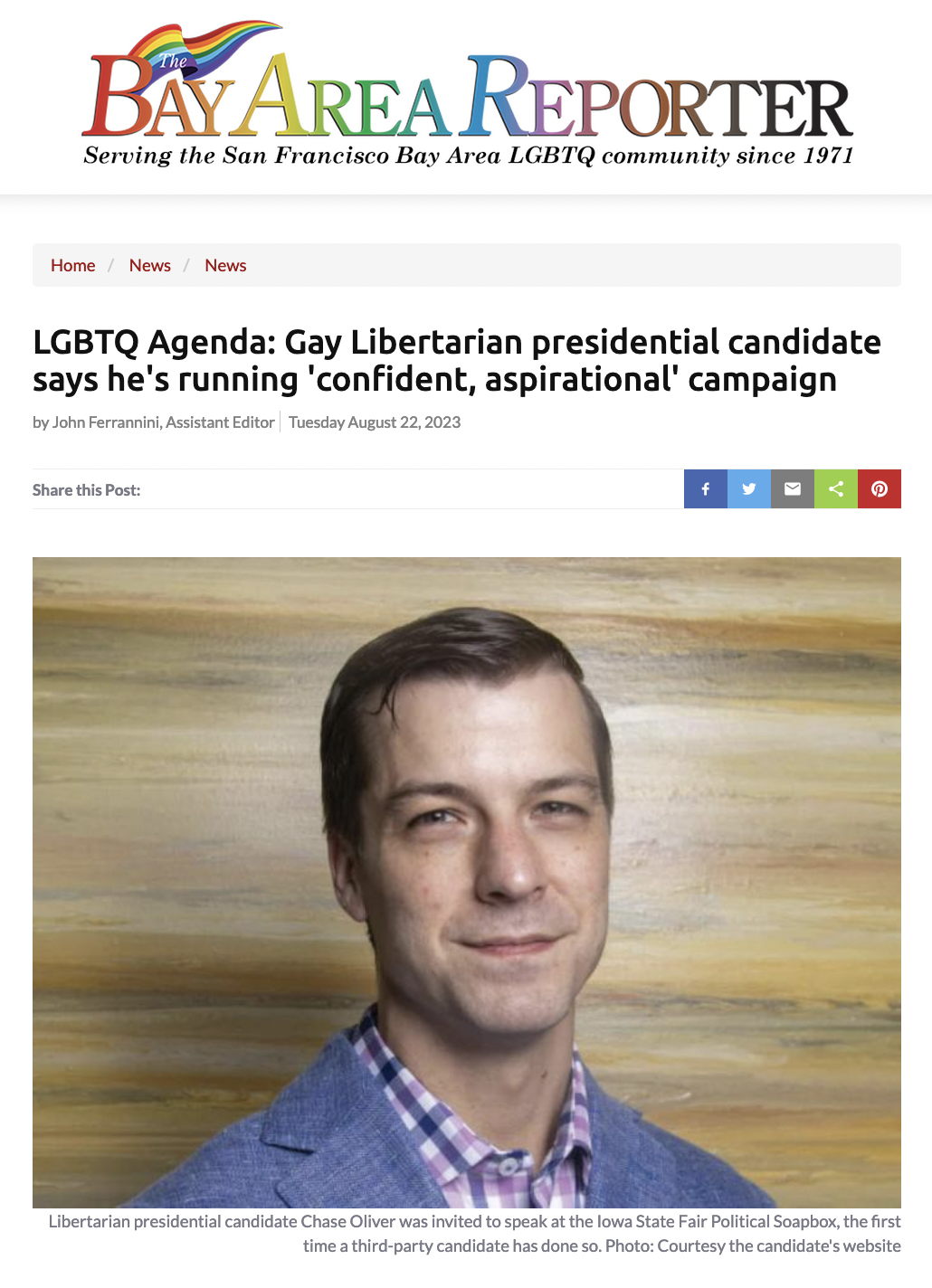
    When I learned that LP presidential contender Chase Oliver had received the green light to be the first alternative party presidential candidate to speak at the famed Political Soapbox event at the Iowa State Fair, I realized that some of the local press might recognize this as a newsworthy story and give some coverage. Especially the local LGBTQ press, given that Chase happens to be gay. 
     
    So I gave some of them a heads-up about it, and one of the outlets, the Bay Area Reporter, has come out with a terrific story that goes well beyond just a short news blurb. Reporter John Ferrannini talked to and quoted not just Chase and myself, but also two of our other Libertarian presidential contenders whose names didn’t even come up in the brief conversation I had with their reporter, Lars Mapstead and Jacob Hornberger. And their online story even includes a video clip of Chase’s full talk at the soapbox event, which I’d been unable to find online!
     
    I think Chase gave a Soapbox speech that did a solid job representing the Libertarian Party and the ideas of freedom for which we stand. Hopefully some of the folks who got a chance to see him there in Iowa, who the political gatekeepers have long denied the opportunity to hear from Libertarian candidates, felt the same. And hopefully more of the media will take a cue from the B.A.R., and give the same level of coverage to Libertarians and other independent parties and candidates that they do to those put forward by the 2-party cartel who are normally showered with attention.
     
    Sometimes they need a little nudge though, or even just the quick tip I provided in this case. Any of us can help make news like this happen by keeping our eyes open for stories involving Libertarians, and stories that are important to the freedom movement, and letting local outlets and media people know about them. They won’t always listen, but sometimes they do. And even when they don’t, they won’t be able to honestly say later that they didn’t know!
     
     
  • The Mini-Panic Over SF Shoplifting

    The Mini-Panic Over SF Shoplifting

    Since Chesa Boudin was narrowly elected (with the LPSF’s support!) as San Francisco district attorney in November 2019 over the mayor’s interim DA appointee Suzy Loftus, who was heavily backed by the San Francisco Police Officers Association (SFPOA) and other law enforcement interests, there have been plenty of folks unhappy with that outcome.

    As in many locales, police in San Francisco had long enjoyed an improperly cozy relationship with prosecutors. Even Boudin’s relatively liberal elected predecessor (and former police chief) George Gascon, never really seen as reliably in the SFPOA’s corner during his time overseeing the SFPD, failed as DA to prosecute a single police officer for an unjustified shooting or any other abuse. This was despite occurrences like the gangland-style execution of Mario Woods by multiple SFPD officers in 2015.

    Chesa Boudin has been a breath of fresh air in an office that badly needed reform. A former deputy public defender in the office built by the much-missed Jeff Adachi, he ran on a platform that emphasized issues like opposing mass incarceration, focusing on real (not victimless) crimes, ending cash bail, and holding police accountable. He has been as good as his word on this, enhancing civil liberties and saving taxpayer money via efforts such as getting the SF jail population reduced by around 25% by letting elderly inmates and those with medical conditions, charged with misdemeanors out early, requiring prosecutors to review all available evidence before charging any cases involving allegations of resisting, obstructing or assaulting police officers (charges often trumped up when police don’t have any real cause to arrest someone, or want to make their life more difficult), and working with Supervisor Matt Haney to try to stop police officers with records of abuse from being hired, according to Wikipedia. The people who don’t like him are upset with him in no small part because he is doing what he said he would do.

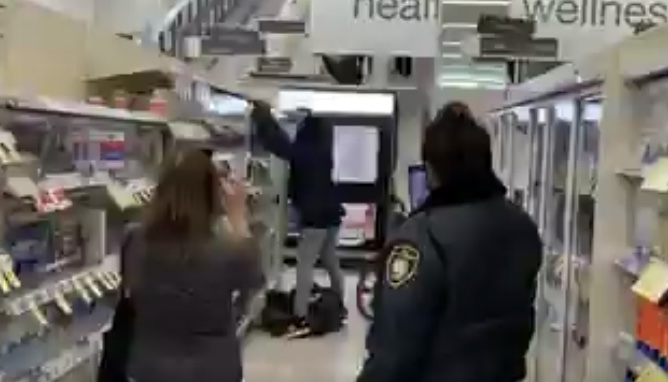
    In seeking to remove Boudin via an upcoming recall election however, opponents have latched onto one issue in particular as an easier “sell” to San Francisco voters who might not be so enthused about a return to criminal justice “business as usual” – shoplifting. In this they were given a major media assist. While most of the mainstream media may lean to the left on many issues, when it comes to local petty crime their statism often has a more right-wing “tough-on-crime” flavor. ABC7 TV reporter Lyanne Melendez exemplified this when she pushed the shoplifting issue to the front burner on June 14 by tweeting a video of a brazen shoplifting incident at a Walgreens store in Hayes Valley. Without providing any evidence or context to support blaming the district attorney, she editorialized her tweet with the words “#NoConsequences @ChesaBoudin”. According to Twitter, that video has now been viewed 6.2 million times.

    Watching it raises some obvious questions, like “Why doesn’t the store security guard make more than a half-hearted grab at the thief’s bag as he rides his bicycle directly past him in a narrow store aisle toward the store exit, when almost anyone in that position making a serious effort could have easily blocked the getaway?”

    The incident almost gives the impression of having been staged. If the security guard was afraid for his own safety (isn’t being exposed to potential physical confrontations part of his job?), why wasn’t he on the phone to 911, or calling for more backup from other store personnel, instead of just standing there watching as the thief swept items from store shelves into a large trash bag? Was this incident really about local criminal justice authorities falling down on the job, or was it about store management having some kind of “don’t interfere” policy designed to avoid bad publicity or potential liability?

    A Tech-Gate story about the incident reports that the man – subsequently taken into custody – had previously robbed the same store on four consecutive days earlier in the month, but that Walgreens declined to prosecute.

    A district attorney can’t prosecute anyone unless they are first identified, which generally means apprehending them. Some commenters have also tried to blame the perceived increase in shoplifting – more on that later – on the Black Lives Matter or police abuse reform movement which saw a major surge after the police murder of George Floyd in May 2020, arguing that cops are more afraid to make arrests now, lest they be accused of police brutality.

    But unless police happen to be on the scene and catch a shoplifter in the act, it is usually store personnel who apprehend shoplifters, so this doesn’t really offer a good excuse for what do appear to be low arrest rates in SF for this type of crime:

    “…state and local crime clearance reports show the problem is not San Franciscans’ failure to report shoplifting to police, but the SFPD’s low rate (4.9 percent) of making arrests in reported thefts compared to police elsewhere in the state (10.5 percent).”

    – From cjcj org/news/13165

    Being arrested is a traumatic experience, typically costing arrestees time and money and affecting their records regardless of what happens afterward, so more SFPD arrests of shoplifters would presumably have some impact.

    Nevertheless, despite the shocking Melendez video and some high-profile incidents of organized shoplifting, the rates for this crime in San Francisco are in fact still much lower than they were back in the 1980s, and have fallen further since 2019:

    “The data shows police-reported shoplifting incidents that are from
    pre-pandemic dates. Also looking even further back then pre-pandemic,
    the data shows that shoplifting rates have been falling more or less
    steadily since the 1980s.

    According to the SF Chronicle, 710 shoplifting incidents were
    reported in the city from January to April of 2021 in comparison to 933
    shoplifting periods from the same period in 2019, an actual decrease.”

    – From davisvanguard org/2021/07/are-shoplifting-rates-in-san-francisco-rising-data-says-nope/

    Some of the people who believe, despite the evidence, that shoplifting is way up in San Francisco, also like to blame state Proposition 47, the criminal justice reform measure that helped address the epidemic of mass incarceration by releasing some non-violent offenders from overcrowded jails.

    But contrary to the myth that the law now lets people caught stealing goods worth less than $950 get off scot free, California statutes actually classify it as a misdemeanor that carries a penalty of up to six months in jail, in addition to potential civil liability to the store owner for:

    • the retail value of the merchandise, if the property is not recovered in sellable condition
    • damages of at least $50 but not more than $500, and
    • costs of bringing the action.

    – From criminaldefenselawyer com/resources/criminal-defense/crime-penalties/petty-theft-california-penalties-defense

    While it’s true that prosecution rates for shoplifting are down since the start of Covid not long after district attorney Boudin was elected, it’s a bit of a stretch to hold him mainly responsible, as a July 9 San Francisco Examiner article shows:

    The numbers show the prosecution rate for shoplifting cases involving
    a misdemeanor petty theft charge for a loss of $950 or less fell under
    Boudin, from 70 percent under former District Attorney George Gascon in
    2019 to 44 percent in 2020 and 50 percent as of mid-June 2021.

    Prosecutors filed charges in 116 of 266 cases presented by police
    involving petty theft in 2020, compared to 450 of 647 cases in 2019,
    according to the data provided by the District Attorney’s Office.

    On the other hand, the prosecution rate for certain organized retail
    theft cases remained between 81 and 84 percent under both Gascon and
    Boudin between 2019 and 2021.

    The office charged 35 of the 43 organized retail theft cases presented in 2020,
    compared to 21 of the 25 cases in 2019…

    Boudin said the decline in prosecution rates for shoplifting cases is
    a reflection of the “difficult choices” his office had to make during
    the pandemic, when the Hall of Justice closed most of its courtrooms and
    city officials decided to largely empty the jails, in part to prevent
    an outbreak.

    “We made an intentional decision to prioritize crimes involving
    violence, injury to human beings and use of weapons,” Boudin said.

    – From SFExaminer com/news/data-shows-chesa-boudin-prosecutes-fewer-shoplifters-than-predecessor/

    So if you’re inclined to blame Chesa Boudin, which of the following alternative courses of action do you think he should have taken?

    • Prioritizing the prosecution of petty theft over crimes involving violence?
    • Trying to force the courts to reopen their courtrooms to enable more prosecutions, and the sheriffs to refill the jails, risking Covid outbreaks?
    • Violating the Constitution by somehow prosecuting people without due process?

    Meanwhile, while shoplifting in San Francisco has decreased in recent decades, homelessness is way, way up. Which must be a bit of a head-scratcher if you think homeless people are disproportionately the ones to blame for such petty crime.

    More to the point though, what should concern us more as a society?

    Petty theft, whether organized or by individuals, from retail establishments of property worth less than $950 per offense?; or

    Organized State robbery in the form of taxes, often many thousands of dollars a year per victim, that leave people with fewer resources to help themselves and their families and exacerbate poverty?

    In humanitarian terms, which is the greater problem that we should be more concerned over?

    While it’s frustrating to see blatant, repeated shoplifting from stores occurring in the community, which ultimately means higher prices for everyone, libertarians should resist the agenda – often pushed by conservatives – of just inflicting harsher punishments on the residents committing these thefts. Asking government to put more people behind bars for longer terms tends to be far costlier to the public. Not to mention a far greater threat to freedom.

    We should not let this largely manufactured panic over shoplifting cause us to vote out a district attorney who is pursuing real, valuable reforms.

  • Go ahead and engage in vote-buying, just don’t be hypocrites

    Go ahead and engage in vote-buying, just don’t be hypocrites

    I heard the same thing about the controversial new Georgia voting law (the “Election Integrity Act of 2021”) that most of you probably have – that it criminalizes giving water to people waiting in line to vote. That part is what many in the media seem to want to focus on. Taken out of context, it definitely sounds like the GOP carrying vote suppression to an utterly petty level.

    Then I read what that part of the legislation, which applies within 150 feet of a polling place or within 25 feet of any voter at a polling place, actually says:

    “No person shall solicit votes in any manner or by any means or method, nor shall any person distribute or display any campaign material, nor shall any person give, offer to give, or participate in the giving of any money or gifts, including, but not limited to, food and drink, to an elector.”

    You remember Brad Raffensperger? The Republican secretary of state in Georgia who defended the integrity of the election results that showed Biden winning the poll in that state and resisted pressure from the president when Trump phoned him and asked him to “find” over 11,000 votes? Well, Raffensperger promised last year that the state would crack down on “line warming,” or handing gifts to people waiting in line to vote as a way to “inappropriately influence voters in the crucial final moments before they cast their ballots.”

    So yeah, Republicans trying to suppress the vote, and Republicans trying to stop shenanigans by their opponents – the two go hand in hand, one providing cover for the other. But the deeper truth is that both sides are trying to rig the system in their favor as best they can. Certain voters in certain areas are generally presumed (with lots of evidence) to be likely Democrat voters. The Republican Party is trying to reduce voter turnout in these areas by making it more difficult to vote, while the Democratic Party is trying to increase voter turnout in these same areas by, among other things, bribing voters. The media mostly understands the first half of this dynamic, and reports it as such, but ignores or misses the flip side of the coin. Free water and snacks may not seem like much of an incentive to vote, but if someone’s on the fence, a little detail like that can make a difference. And in a tight race, every bit of turnout matters.

    Again, both halves of the establishment are trying to rig the game in their favor, they just have different ways of trying to cheat. And don’t think for a minute that this is just about whether people waiting to vote can be given water. That’s just media spin. The real question is whether anything of value can be used to lure people to the polls. If gifts of bottled water are allowed, it won’t stop there; the envelope will be pushed. Democratic operatives will supply as many inducements to vote in areas and among populations where the vote tends to swing their way as they legally (and sometimes maybe illegally) can – snacks, sandwiches, whole chickens, tote bags, gift certificates, etc., so that more of “their” people will make it to the polls.

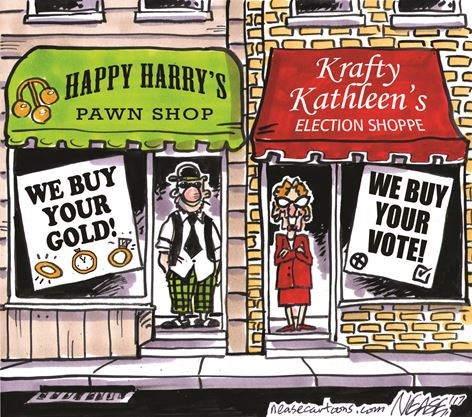
    Don’t get me wrong though – I oppose this Georgia law. Attempting to influence voters should not be criminalized, regardless of whether the lobbying occurs right before they vote or at some other time. Ditto for vote-buying. Your vote belongs to you, and true ownership isn’t only about the right of use, it’s also the right to transfer the thing in question to another person or group of your choosing. If you can’t sell your vote, in a sense it’s not really yours.

    Politicians and election commentators seldom acknowledge this, but – especially for someone trying to make ends meet – getting the equivalent of $5 (about the price of a bottled water and a snack) or $20 or $50 or whatever from somebody hoping you’ll vote the way they want you to, may have more of a direct, positive impact on your life than any votes you as one individual cast in the voting booth.

    For some people, a decision to sell their vote (or to receive something of value, however slight, from someone seeking to influence how they cast it) might be not only rational, but a more honest reflection of their values and priorities than any selection available to them on the ballot, and thus a more legitimate expression of democracy.

    Only let’s call it what it is, and not pretend this latest hullabaloo is motivated by a sudden humanitarian concern for grandma’s physical nourishment while waiting in line to vote, from people who never showed any similar interest in her well-being when she was waiting in line at the DMV, or sitting around at court after being called for jury duty.

    Attempted vote-buying is nothing new. The reason many people vote for the politicians they do in the first place is because the pols promise free stuff. If they’re allowed to get votes by promising “free” health care, “free” education, “free” border walls, “free” Covid relief checks, etc., after they’re elected, why shouldn’t they be allowed to get votes by handing out freebies before the vote, and using their own resources to pay for them, instead of stolen tax money? That way voters have a chance to get something concrete, in advance, that is at least a bit more ethically sourced, and they don’t have to just rely on politicians’ promises. It would be an effective way of transferring money from the rich (big money donors) to the poor (low-income and minority voters) without coercion and without government taking the lion’s share before the money gets to those for whom it’s purportedly intended.

    If you’re recoiling in horror from the idea of buying and selling votes, you can rest easy. It’s about as likely to become law any time soon, as the Biden administration is to be fiscally responsible. Please direct your outrage toward the practices already in place now that tilt the political field in favor of the well-heeled. Like shutting less deep-pocketed alternative party candidates out of debates, not allowing voters to register with their parties in many states, and charging outrageous filing fees just to get on the ballot or have a candidate statement. When I ran for State Assembly last year, no statement appeared by my name in the voter information pamphlet, because they wanted to charge me $1572.00 to print one. But of course voters reading the pamphlet weren’t informed of that reason; all they saw was a blank space, giving the impression that I just didn’t care enough to write anything. Just one of the dirty little tactics of the 2-party duopoly cartel.

  • November 2020 Ballot Recommendations

    Proposition ANO. This $960 million bond measure (the estimated cost to taxpayers of borrowing $487.5 million after all the interest and costs are paid) promises everything but the kitchen sink. Prop. A would supposedly fund “investments” (the Voter Information Pamphlet’s biased language) in “supportive housing facilities”, shelters, parks, recreation facilities, facilities for “persons experiencing mental health challenges”, streets, etc. All things that could be paid for out of the city government’s $13.7 billion regular budget (a budget larger than those of many states and even most countries!). But as CPA and former civil grand jury member Craig Weber pointed out, they would rather spend that budget on things like an average salary of $108,774 and an additional average cost of $49,864 in benefits for their over 38,000 employees (a bloated “city family” larger than the entire city of Burlingame).

    Proposition BNO. We’re sympathetic to the desire to shake things up after Mohammed Nuru, the longtime head of the Department of Public Works (and ex-boyfriend of mayor London Breed) was arrested by the FBI on multiple charges of corruption. But Prop. B isn’t exactly a house-cleaning. Nearly half of current DPW employees would just be transferred to a newly-created Department of Sanitation and Streets, with duplicative support staff meaning an additional cost of $2.5 to $6 million annually, according to the Controller’s statement. What it does not do is guarantee that bureaucrats who are not doing their jobs in keeping the streets clean will be replaced, or that the new department won’t be subject to the same kind of cronyistic political appointments as the old one. As former judge Quentin Kopp notes, it’s just an attempt to “take the heat off City Hall criminality” without fundamentally changing anything.

    Proposition CYES. This measure would simply give non-citizen residents the same opportunity as other San Franciscans to serve on city boards, commissions, and advisory bodies. Libertarians strongly support the right of people to move freely from one country to another, and for people to have full equality under the law regardless of citizenship, which is ultimately just another Big Government program that enables those in power to divide and control people and extort money from them on the basis of nationality. According to a ballot argument by the LGBT Asylum Project and others, 35% of voting-age San Franciscans are foreign-born, and we oppose restricting any of these individuals from full political participation. As we argue in a paid statement in the Voter Information Pamphlet, “Laws must not be allowed to discriminate on the basis of innate characteristics like race, gender, sexual orientation, or national origin.”

    Proposition D YES. While we generally oppose additional government spending and bureaucracy, the life and death power that law enforcement agents have over the rest of us creates an even more pressing need for independent oversight than is the case for the rest of government. Incidents like the gladiator-style fights that the Public Defenders Office learned some SF sheriff’s deputies were staging among inmates for their own amusement, drive the point home. Prop. D would create an Office of Inspector General with the power to investigate in-custody deaths and complaints against Sheriff’s Department employees and contractors in at least some cases, and make recommendations regarding the department’s use of force policies. Also an Oversight Board that would hold public meetings and receive input from the public, as well as being able to subpoena witnesses and require the production of evidence. At less then a $3 million additional annual cost, this seems like a good pro-freedom tradeoff. In the wake of the killings of George Floyd and numerous other Americans at the hands of law enforcement, the need to rein in the abuses of gun-toting government agents should be abundantly clear to everyone, and this measure to create some independent oversight of the 800 or so SF Sheriff’s Department employees should do at least a bit to help.

    Proposition EYES. This measure would remove the absurd requirement that San Francisco maintain a minimum of 1,971 sworn SFPD officers, a mandate so out of whack with actual needs and budgetary considerations that it has not even been consistently followed anyway. Our paid ballot argument supporting Prop. E notes that this force size exceeds not only that of neighboring cities like San Jose, which has more residents than San Francisco, but even the per capita policing in Paris under the hated regime of Louis XVI and Marie Antoinette that was overthrown in the French Revolution of 1789! While certain types of incidents such as auto break-ins have been up the past few years, the SFPD has plenty of capacity to address this trend if they get their priorities straight and focus on investigating and responding to real crimes against life, liberty, and property, rather than victimless actions like drug sales and use, prostitution, and public camping. Additionally, mental health crises and other types of service calls should involve personnel trained to address those situations, not police officers (who have a disturbing tendency to use excessive force against the mentally ill and others), and efforts underway to transfer some of these responsibilities away from the SFPD will likewise free up  more officers to focus on apprehending actual criminals.

    Proposition FNO. Trying to parse what this 125-page monstrosity of a ballot measure would actually do is extremely difficult, which is a reason in itself to regard it with a high degree of skepticism. We couldn’t figure out from the text itself what the net effect of swapping a payroll tax for a gross receipts tax in all their respective intricacies would be, but according to the Controller’s statement it amounts to an estimated $97 million/year tax increase. Which is no doubt why Mayor Breed and the entire Board of Supervisors, unreformed statists all, are supporting it. You might think politicians would have more sense than to try to foist a massive tax hike on local businesses during a government lockdown that has already forced more than half of The City’s retailers to close their doors, many of them permanently, but you would be underestimating #GovernmentGreed. The Democrats who run SF claim that Prop. F would provide relief for businesses most impacted by the government’s ham-fisted response to Covid-19, but of course they could have provided that relief without tying it to higher levels of legalized theft that will harm other businesses.

    Proposition GNO POSITION. We debated this one. Several of us thought this was a clear libertarian “yes”, but several other members had concerns including that minors still legally under the control of their parents could be influenced by them on how to vote. On the flip side, 16 and 17 year olds do still pay sales tax and other taxes, and “taxation without representation” was one of the prominent complaints of the American colonists who seceded from Great Britain in 1776. You make the call.

    Proposition H YES. Prop. H represents a rare local ballot measure that would actually increase economic freedom, by streamlining or eliminating a few of the city government’s myriad noxious regulations that make it expensive and difficult to start and maintain a business in San Francisco. Currently, the Planning Code needlessly prohibits many sensible and harmless uses of commercial space. This has contributed, even pre-Covid19, to a glut of business failures and vacant storefronts. One sentence in the Controller’s statement kind of says it all, noting that under the measure, “Fees for additional reviews required due to City errors would be waived.” Does anyone other than the most retromingent statists think it’s reasonable to impose additional fees on businesses as a result of government errors?

    Proposition I NO. Riddle: How do you top an effort to increase business taxes by $97 million during the worst economic downturn the U.S. has seen since the Great Recession, if not the Great Depression (Prop. F)? Why, with an effort to raise real estate taxes during a housing shortage when there are over 8,000 homeless people on the streets of San Francisco according to the official count (which is probably an underestimate) by double that amount. This would be Prop. I, which the Controller’s statement estimates would add an average $196 million a year to the cost of housing and commercial real estate. A pair of small business owners writing in the Voter Information Pamphlet note that the measure doesn’t just apply to the sale of property, but also to small business and storefront leases – in other words, a hit on some of the same businesses that some of the same Supervisors supporting this proposition claim that they are trying to help with Prop. F. “At a time when many [mom and pop businesses] are desperately trying to sell, break, or renegotiate their leases, this tax will increase their rents and threaten their safety nets when they can least afford it,” write small business owners Gwen Kaplan and Rodney Fong.

    Proposition J NO. What would an election be without some kind of appeal to rob people “for the children”? Enter Prop. J, a regressive $48 million annual parcel tax increase that would hit every property owner (small or large) in the city not given a special exemption with an extra $320 on their property tax bill, to flow into the coffers of the SF Unified School District. Close behind appeals to commit robbery for the children are arguments to do it for the teachers, and this measure promises “raising the salaries of teachers” – oh, and unspecified “other School District employees” (read: members of bloated administrative non-teaching staff). The SFUSD would also have the “sole discretion as to allocation of the proceeds” among these and other assorted purposes – meaning they could if they chose spend 90% of the money on more administrative bureaucracy.

    Proposition KNO. The LPSF won the “lottery” process to be selected as the official opponent on this one, and its supporters – again a laundry list of local political power players including every member of the Board of Supervisors – decided to try to sell it as an anti-racism measure, touting the fact that it would override the California Constitution’s Article 34, a 1950 ban on government development of housing for low income persons unless first authorized by a public vote. “Prop. K is a step towards removing this racist legacy”, they write. In reality Article 34 says nothing about race, and does not stop low cost housing from being built by independent builders. It simply prevents government officials from using taxpayer money to subsidize such housing against the will of the public. The irony is that supporters of Prop. K are making arguments suggesting that they want to engage in racism by handing out housing on a preferential basis to people of certain racial backgrounds. Rather than attempting to get into the housing construction business, an endeavor that won’t end well, the mayor and Board of Supervisors should cut the red tape and expensive bureaucratic requirements that prevent more affordable housing getting built by independent builders. Legalize tiny homes and ADUs (accessory dwelling units, also called “granny units”), for example. And make more legal free parking places for people living in RVs and vans. Those options won’t be ideal housing for everyone, but they work for many people and are better than sleeping on the street, as thousands of San Franciscans do now.

    Proposition LNO. This is an effort to pressure businesses to pay their top executives less, or other workers more, when those executives receive more than 100 times the median pay of their workers, by stealing more money from such companies in the form of a higher gross receipts or payroll tax. Unfortunately, robbing a company as a whole won’t necessarily come at the expense of its overpaid executives, but could easily instead negatively impact other workers who may see lower compensation or be more likely to lose their jobs (or not get hired in the first place), as well as at the expense of members of the public who could face higher prices for the company’s products. It could also cause some businesses to stop doing business in San Francisco, costing local jobs and reducing the choices available to residents. Executive overpay is a legitimate concern when driven by factors other than simple market-based compensation based on relative demand for different types of labor and skills, but a better way to address the issue is through corporate governance reforms to make management more accountable to shareholders. Not by simply feeding a State which is even more bloated than the biggest independent companies and whose own top employees are already overpaid at the public’s expense.<!–break–>

  • March 3, 2020 Ballot Recommendations

                Longtime freedom-oriented observers of politics in the City by the Bay won’t be greatly surprised that exactly none of the local measures on the March 3 ballot are worth supporting. The Libertarian Party of San Francisco recommends voting NO on all five. Here’s some brief thoughts on why:


    Proposition A – $845 million City College “Job Training, Repair and Earthquake Safety” bond

    According to a faculty union representing teachers at City College, spending on administration has grown to comprise 10% of the school’s personnel costs, up from 7% just five years ago.

    An October bulletin published by the union describes how students, teachers and community members recently had to “push back on exorbitant raises” for top administrators, “including a proposal to compensate Associate Vice Chancellors at $275K/yr.” Meanwhile, City College enrollment is down from 90,000 in 2011-2012 to 65,000 today, according to a piece by Marc Joffe of the Reason Foundation. “With so many San Franciscans living on the streets, investing in educational infrastructure seems to be an especially odd priority,” he writes. We agree. Vote NO on Prop. A.

    Proposition B – $628.5 million “Earthquake Safety and Emergency Response” bond

    Another massive tax-and-spend measure in the name of “safety”. San Franciscans have already voted time and again to appropriate money for earthquake preparedness and emergency services. Just last year voters adopted a $425 million bond measure billed as protecting the city from flooding and earthquakes. As with all bond spending, this measure is wasteful – the controller estimates that borrowing $628.5 million will end up costing taxpayers over $1 billion by the time the principal is repaid with interest to the companies financing the bonds. A nice deal for Wall Street financiers perhaps, but not so great for overtaxed residents including tenants, who could see up to half the cost of the measure passed along to them in the form of higher rents.

    Proposition C – Retiree Benefits for Former SF Housing Authority Employees

    The Housing Authority is a local agency, but has been funded by the federal government. Now some former SFHA employees are being hired by the city government. This measure would make them eligible for city government retirement benefits based not just on their time as municipal employees, but also based on the years they spent drawing federal government paychecks. This sounds like a recipe for double-dipping, and most government employees are already over-compensated compared to people doing similar work in the voluntary sector. Increasing government employee compensation also means stealing more money from the taxpayers to pay for it. We say Vote NO.

    Proposition D – Vacancy Tax

    This measure would tax owners of commercial storefront property for allowing it to sit vacant, incentivizing landlords to rush to fill leases quickly rather than taking the time to consult with community members and groups and seek out tenants who are a good match for their neighborhoods. The usually statist editors of the Bay Area Reporter newspaper correctly point out that retail vacancies are growing nationally “as a result of the convenience of online shopping, competitive prices, and speedy delivery”, and that “the challenges of doing business in San Francisco” , among them “bureaucratic red tape and a protracted permitting process, onerous taxes, scarcity of workers” make the problem even worse here. They note that instead of “doing the hard work of cutting the red tape that frustrates and discourages businesses from operating in our neighborhoods,” the Board of Supervisors “punted and placed Prop. D on the ballot.” We agree – please vote NO.

    Proposition E – Limits on Office Development

    This measure would limit the amount of office space that can be built in San Francisco unless the city government meets its goals for the development of “affordable” housing. More housing is urgently needed, but development of new office space should not be held hostage to this need. Creating laws like this based on guesses about what future needs will be is a bad idea. Limiting creation of office space will also pave the way for politicians to hand out special exemptions based on political favoritism and corruption. One such loophole already built into the measure would allow new office space development in exchange for affordable housing being built off-site, but would require such off-site housing to be located “within an economically disadvantaged community”. In other words, new housing for poor people would have to be located in places where poor people already live, further reinforcing the de facto segregation of the city into poor and wealthy areas, as driven by past government policies like redlining, rather than allowing market development to happen organically. Vote NO on Prop. E.

    Aside from voting to oppose the ballot measures, the LPSF also voted to support three candidates in this election:

    Starchild for State Assembly (write-in)

    Such is the lack of democracy in this largely one-party town that incumbent Assembly member David Chiu was the only candidate to fill for his District 17 seat that comprises the eastern half of San Francisco, leaving an opening for a write-in candidate to run in the primary and automatically appear on the November ballot without having to feed the State by paying a filing fee of hundreds of dollars. LPSF chair Starchild decided this was too good an opportunity to pass up, and decided to collect the signatures needed to be that candidate. The erotic service provider and freedom activist says the core of his campaign message will be the idea of a consent-based society in which government does not tell people what to do with their own bodies and resources, and you can live your life as you choose so long as it does not involve initiating force or fraud against others. “Consent is not just about sex, it matters in every aspect of our lives,” Starchild asserts. He also pledges to champion the rights of homeless people, immigrants, sex workers, independent and homeschool families, the kink and poly communities, people in the cannabis and psychedelic communities, and others who have been marginalized and harmed by the statist quo, while cutting the 6-figure salaries and lavish benefits of those in government who are profiting off the backs of the poor and the victims of government taxes and fees.

    Maria Evangelista for Superior Court Judge

    Like newly elected district attorney Chesa Boudin, Maria Evangelista is a public defender who has worked at the award-winning SF Public Defender’s Office built by the late Jeff Adachi. Her opponent, by contrast, is a former prosecutor. In a criminal justice system that has given the U.S. what is widely reported to be the highest per capita incarceration rate in the world, we need more judges whose background is in trying to keep people out of jail, rather than trying to lock them up. Evangelista’s parents emigrated from Mexico to work as farm workers and took refuge here in San Francisco as undocumented migrants, and her mother collected recycling to help make ends meet, so she has first-hand experience of being poor and on the wrong side of the authorities, if not the law (the Feds actually have no constitutional authority to criminalize or regulate who migrates to the U.S., only the process of becoming a citizen). “Every day I see how our courts have failed to meaningfully address homelessness, car break-ins, and violence”, she writes. “Everyday I see how the courts are disproportionately arresting and imprisoning people of color. We are stuck in a cycle of catch, imprison and release.” It is notoriously difficult to find solid information on the policy positions of candidates for judge, but from her background we believe Maria Evangelista is likely to be the more pro-freedom candidate in this race, and recommend Libertarians support her for Seat 1 on the Superior Court.

    John Dennis for Congress

    There was some dispute in our ranks as to whether we should be recommending a vote for a Republican in a partisan race, but John Dennis has a history of engagement with the freedom movement dating back to Ron Paul’s first campaign for president back in 2007, when he walked the streets alongside many of us canvassing for the libertarian Republican and lifetime Libertarian Party member. A plurality of our committee felt that history, and his positions aside from some regrettable stances on immigration and homelessness, make him a more pro-freedom choice than establishment incumbent Nancy Pelosi or any of her other challengers. John is against overseas wars and in favor of cutting Pentagon as well as other government spending, auditing the Federal Reserve, a return to sound money, and reining in warrantless spying on Americans by the federal government. While we cannot endorse candidates of other parties, we recommend a vote for John Dennis for Congress in District 12 as the best choice in a race without a Libertarian candidate.

    *       *       *

  • Sympathy for the Sausage Makers

    Sympathy for the Sausage Makers

          Politicians and bureaucrats certainly give people plenty of good reasons to hate them, but from time to time you have to sympathize with them, because in their power-addiction, serving as cogs in the leviathan they have created, they victimize themselves too.

          Just because they are oppressing us from the top of the pyramid doesn’t mean that most of the individuals running government necessarily have a good quality of life. I don’t think most people would actually enjoy doing their jobs. They may have power, but the daily grind of exercising it, cranking out the sausage on a day-to-day basis, can’t be very enjoyable for most of them. They’re like junkies who keep chasing after that power fix even though it’s destroying their lives.

          What do senior government officials really spend their time doing, to earn all the taxpayer money they suck up? Many of them spend significant amounts of time writing, reading, interpreting, and/or overseeing compliance with material that’s written like this:

    ———————————————————————————————————————

    SEC. 13. Section 17070.57 is added to the Education Code, to read:

    17070.57. (a) A school district submitting an application for an apportionment shall include all of the following as part of the school district’s application package:

    (1) A school facilities master plan adopted pursuant to Section 17070.54.

    (2) A certification by the governing board of the school district acknowledging the applicable school facilities program grant agreement and the school facilities program’s associated audit requirements.

    (3) Any information and forms required by the board and department required pursuant to law.

    (4) Written approval from the State Department of Education that the site selection, and the building plans and specifications, comply with the standards adopted by the State Department of Education pursuant to subdivisions (b) and (c), respectively, of Section 17251.

    (5) Plan approval of the project by the Department of General Services pursuant to the Field Act, as defined in Section 17281.

    (6) A certification by the governing board of the school district indicating that upon receiving an apportionment, the school district will have entered into construction contracts within 90 days for at least 50 percent of the work included in the scope of the application.

    (7) For modernization projects, a certification that the school district complied with the requirements of Section 116277 of the Health and Safety Code.

    (8) The applicable grant agreement associated with the school district’s applicable project.

    (b) Subject to the availability of funds, the board shall disburse apportionment funds to an eligible school district only upon a certification by the school district that the required matching funds from local sources have been expended by the district for the project, or have been deposited in the county fund, or will be expended by the district by the time the project is completed.

    (c) As a condition of participating in the school facilities program, a school district shall certify that it has submitted a five-year school facilities master plan pursuant to Section 17070.54 and that the school facilities master plan is consistent with the goals, actions, and services identified in the school district’s applicable fiscal year’s local control and accountability plan for the first state priority, as described in paragraph (1) of subdivision (d) of Section 52060, as it relates to school facilities. In developing its required school facilities master plan, a school district shall review any data that is publicly reported for the school accountability report card related to the safety, cleanliness, and adequacy of school facilities pursuant to paragraph (8) of subdivision (b) of Section 33126.

    (d) (1) New construction and modernization applications submitted before August 30, 2019, shall be processed in accordance with this chapter, as it read on August 30, 2019.

    (2) New construction and modernization applications submitted before August 30, 2019, that are withdrawn and subsequently resubmitted by a school district shall be processed in accordance with this chapter, as it read on August 30, 2019.

    SEC. 14. Section 17070.59 is added to the Education Code, to read:

    17070.59. For purposes of determining the points used to compute the adjustments applied pursuant to Sections 17072.30 and 17074.16, the department shall compute the sum of the following point computations applicable to each school district:

    (a) For each school district, the department shall divide the district’s gross bonding capacity by the district’s total enrollment, as determined for purposes of this chapter.

    (1) A school district determined to have a gross bonding capacity per enrollment of between zero dollars ($0) to nine thousand nine hundred ninety-nine dollars ($9,999), inclusive, shall receive four points.

    (2) A school district determined to have a gross bonding capacity per enrollment of between ten thousand dollars ($10,000) to nineteen thousand nine hundred ninety-nine dollars ($19,999), inclusive, shall receive three points.

    (3) A school district determined to have a gross bonding capacity per enrollment of between twenty thousand dollars ($20,000) to fifty-four thousand nine hundred ninety-nine dollars ($54,999), inclusive, shall receive two points.

    (4) A school district determined to have a gross bonding capacity per enrollment of more than fifty-five thousand dollars ($55,000) shall receive one point.

    (b) For each school district, the department shall identify each district’s unduplicated pupil percentage as determined for purposes of the local control funding formula pursuant to Section 42238.02.

    (1) A school district determined to have an unduplicated pupil percentage of between 75 percent and 100 percent shall receive eight points.

    (2) A school district determined to have an unduplicated pupil percentage of between 50 percent and 74.99 percent shall receive six points.

    (3) A school district determined to have an unduplicated pupil percentage of between 25 percent and 49.99 percent shall receive four points.

    (4) A school district determined to have an unduplicated pupil percentage that is less than 24.99 percent shall receive two points.

    (c) A school district that has a pupil enrollment of 200 pupils or fewer shall receive one point.

    (d) The department shall draft regulations for consideration by the board to further clarify the requirements of this section.

    ———————————————————————————————————————

          If you take a few minutes to try to read and understand the material above, and then consider the fact that there’s much more where that came from which you may need to read for context (see http://leginfo.legislature.ca.gov/faces/billTextClient.xhtml?bill_id=201920200AB48 to get started), and that even the material there comprises just one single document out of an endless web of government documents that relate to each other in various ways, you may be moved to feel some pity for your oppressors. (At least until you recall the inflated paychecks, generous benefits, and pensions they give themselves at your expense!)

          Except in regimes where tyrants simply do as they please regardless of what’s written in the law, the actual functioning of government on a large scale is always entwined in a morass of this kind of legalese. Humorist P.J. O’Rourke called the notion that the senior bureaucrats who live and breathe this stuff are lazy a “delusion”, noting that wasting as much money as government does requires “enormous effort and elaborate planning”. And as novelist Mary McCarthy said, reminding us that it really isn’t funny but destroys peoples’ lives, “Bureaucracy, the rule of no one, has become the modern form of despotism.”

          If you think you can tell me, in a few readily understandable sentences and without resorting to reading someone else’s analysis, what effect adding the above regulations to state law will have in the real world, please do so. I’d honestly like to know. After all, I’m a voter.      

          Which leads me to sort of the kicker of this essay: Those running government expect you to understand it. I mean, that’s the basic premise of putting a piece of legislation before the voters, isn’t it? A belief that voters are competent to understand the proposal and make an educated decision on it.

          Do you feel competent to make a decision based on your understanding of what real-world effect the regulations copied above would have if enacted? Because this material was taken from Assembly Bill 48, a piece of legislation that put a $15 billion bond measure on California voters’ ballots this year. If you vote for that bond measure, designated as Proposition 13 on the March 3, 2020 ballot, all 55 pages or so of it will become the law of the land in California.

          Mind you, you won’t see the whole thing on the ballot, only one part out of 56. But if voters approve that part, guess what? The other 55 sections that weren’t in the ballot will also take effect! Scroll all the way down to the bottom of the legislation, and you’ll see, “Sections 1 to 56, inclusive, of this act shall take effect upon the adoption by the voters of the Public Preschool, K–12, and College Health and Safety Bond Act of 2020, as set forth in Section 54 of this act.”

          So it you might vote for something with a title like that, and believe in being a responsible voter who makes educated decisions on ballot measures based on understanding what a measure you’re voting on actually does before you support it – you’ve got a few weeks as of this publishing to bone up on the document.

          And again, if you think you do understand this legislation, and can explain in plain English exactly what it will do in the real world, please do share! I’m serious – send me an email with your response, putting “I Can Explain What AB 48 Does” in the subject line. If I were designing a video game here, accomplishing this task might earn you your Master Bureaucrat credentials. Sadly I don’t have any of those to give out, but I can tell you the real world relevance: $15 billion of Californians’ money is at stake.

          Even if you believe “your” state senators and assembly members who voted to put it on the ballot are smart, honorable people in whom you have full confidence, are you sure they read and understood the legislation before voting on it? To ask that question is to answer it – they vote on hundreds of bills a session and spend most of their time fundraising. It’s on you! Before you go along with letting government relieve you and your fellow residents of that kind of cash without their individual consent, shouldn’t you or someone you trust have first read the plan and understood it well enough to be able to explain what any of the language in it means if asked?

          But if you don’t feel like doing all that work for no actual compensation (unlike the well-paid politicians, bureaucrats, and lawyers who generate this stuff) – and what sane person would? – there is a libertarian shortcut: Vote No.

          Even if they’ve given it a really appealing title, like “The Public Preschool, K–12, and College Health and Safety Bond Act of 2020.” Even if you see a lot of slick fliers and TV ads telling you the great things it’s going to do. Just Vote No.

          Don’t feel bad for rejecting the legislation without understanding it. If you can’t understand something, chances are there’s a lot of unsavory stuff hidden in those bits of legal sausage. Supporting a piece of legislation is saying you want it to be The Law™, which means that someone could be prosecuted for not obeying it – they could have their money taken or be put in jail or worse. Voting to potentially inflict that kind of harm on people without even understanding what you’re voting on is immoral.

          And if studying a proposed law sufficiently to understand it would take an unreasonable amount of your time, you have no actual moral or civic responsibility to do so before rejecting it. The people who wrote it, or had it written, or voted on it, have no legitimate basis on which to expect you to understand it, and the reality is they don’t expect you to. Odds are most of them don’t really understand it either.

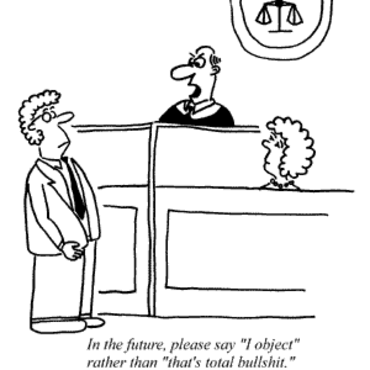
          It’s not really written in English after all, but in another language whose meanings can be quite difficult to comprehend. Some call this language legalese or bureaucratese, but there is another more revealing term for the particular dialect found in lengthy pieces of legislation like this, and that term is bullshit.

          Really grokking* this last point is something a number of Libertarians have achieved. It may lead to some deep epiphanies, among them:

    • Maybe you aren’t meant to understand it; maybe that’s the point – “if you can’t dazzle them with brilliance, baffle them with bullshit,” as the coffee mug saying goes

    • Master Bureaucrat credentials are kind of like Master Huckster credentials, they just involve specializing in and mastering different types of bullshit

    • Hang on, why did I think employing large numbers of people at great public expense to immerse themselves in creating and processing bullshit was a good idea?

    • Government is a scary bunch of bullshit, I should become an anarchist

          Anyway, thank you for reading this considerably shorter and more reader-friendly column. Besides giving you a small head start on next year’s ballot questions, if it has in any slight way enhanced your insight into understanding government, then it has served its purpose. 

          And if you know of any high school or college teachers who might be interested in having someone come in and give their class(es) a “real world” talk on civics and American government based on this essay, please write and put us in touch with them!

                                                                 *          *          *

    *Science fiction writer Robert Heinlein invented the verb “grok” to describe understanding something deeply and holistically.

     

  • 5 Practices For Being An Effective Libertarian Activist

    5 Practices For Being An Effective Libertarian Activist

         Here are a few insights I’ve found in my time as a libertarian (pro-freedom) activist which I consider valuable and thought I’d share in the hope that others may find them useful…

    • If you find yourself debating or arguing with someone (in person, online, or wherever) whose stance in the conversation is more pro-freedom on the particular topic or issue being discussed than yours, change the topic or leave the conversation. If you want to debate that issue, go find another conversation in which the person or people you’re debating are less pro-freedom on it than you are. In this way, you can ensure that your advocacy is on the side of freedom, not against it.

    • Think about your life in broad terms and consider what you can do to share libertarian ideas and advance the cause of freedom. What talents or connections do you have that you can share with the freedom movement which would be helpful in spreading the message?

    • Ask yourself where in your life you can make a difference in terms of influencing where money goes (your own or others’) and how that spending could be altered to create a more positive outcome for freedom, whether it is directing resources toward businesses, organizations and individuals that support or are beneficial to the cause, or withdrawing resources from those that don’t/aren’t. Make preparations to also seek a more positive outcome for freedom for whatever resources you expect to leave behind when you skip off this mortal coil, especially if they are significant and you expect to do so in the not distant future.

    • For each libertarian (pro-freedom) organization you are part of, strive to spend at least as much time communicating with your colleagues in the organization about freedom, philosophy, activism/outreach outside the organization, and events in the world, as you do communicating with them about the politics or operations of the organization itself or interpersonal conflicts/issues that arise – this will not only keep your own efforts focused on actually advancing freedom, but help keep our movement’s groups focused on that purpose as well.

    • Keep some libertarian (pro-freedom) materials (e.g. literature, stickers, rubber stamps, buttons, petitions to sign, Nolan Chart cards, etc.) with you as often as possible, and as you go about your day, be on the lookout for places to distribute these materials and opportunities to share them with people.

         Be creative in thinking about the opportunities to help freedom that may exist for you within each of these bullet points, and may the Non-initiation of Force be with you!   🙂