Tag: police

  • LPSF Ballot Recommendations – March 5, 2024 Election

    LPSF Ballot Recommendations – March 5, 2024 Election

    Proposition (“Affordable” Housing Bonds) – NO  

    Here we go again. Another election, another tax increase in the form of borrowing money that taxpayers will be expected to repay – the least fiscally responsible way to fund stuff, since you have to pay a lot of interest on top of the actual amount you borrow. In this case, Controller Ben Rosenfield reports that the “best estimate” of the cost of borrowing $300 million by selling bonds would be “approximately $544.5 million”. Once again, proponents are playing dishonest word games to pretend that the bond measure is cost-free, claiming in their ballot argument that Prop. A “does not increase property tax rates”, even though the costs are right there in the controller’s statement, which notes that the cost for someone with a house valued at $700,000 would be approximately $55 a year.  


    Proposition B (Police Staffing) – NO

    It’s shameful how quickly some politicians have abandoned the calls for police reform they took up in the wake of the police murder of George Floyd in 2020, and have now gone back to carrying water for the powerful law enforcement lobby. One side in this fight wants to hire more cops immediately out of the existing budget at the expense of other programs and services, while they other side wants to use the supposed need for more cops as an excuse to raise taxes. The reality is they are both wrong. San Francisco does not need more police. The city already has more law enforcement personnel, per capita, than Paris did under the hated regime of Louis the XIV before the French Revolution. Contrary to what fearmongers want you to believe, violent crime in the city is significantly lower than it was in past decades. But it’s higher than it would be if the politicians would stop criminalizing people for trying to protect themselves, and respect our individual right to keep and bear arms as guaranteed by the Second Amendment.


    Proposition (Real estate transfer tax exemption) – YES

    Just about any tax reduction is good news, and the need to revitalize the downtown neighborhood by allowing vacant office buildings to be repurposed is severe enough that it’s gotten the mayor and some of the supervisors to rein in government greed for a change. While it wouldn’t Prop. C also has the admirable feature of allowing the Board of Supervisors to further reduce the transfer tax (but not raise it!) in the future, without special voter approval.


    Proposition D (Ethics) – NO POSITION

    When it comes to ethics measures on the ballot, we’re often reminded of the metaphor about rearranging deck chairs on the Titanic. This one will pass – they always do. Everyone claims they’re against corruption, at least until they get caught engaging in it. Yet the perennial problem of self-dealing doesn’t go away, because these measures never address the fundamental issue – government has too much power, which draws money and lobbying from those trying to get politicians and bureaucrats to use that power, and the stolen taxpayer money at their disposal, to benefit them and their interests, the way a big steaming pile of cow manure draws flies. While Proposition D might do some good on the margins by closing off a few avenues for city officials to enrich themselves at the public’s expense, it does nothing to rein in State power. As long as the excessive power over the economy and people’s lives is there, money will continue flowing into politics the way water flows downhill, routing around whatever obstacles are placed in its path. We also wonder what politically correct DEI type indoctrination may be bundled into the “ethics training” the measure would require city officials to undergo, although on the bright side, every hour they spend sitting around listening to lectures on ethics is an hour less to spend potentially engaged in other more harmful activities such as writing up new laws and regulations violating other people’s rights.


    Proposition E (increased police powers) – NO
    The way the ballot description for this measure opens is really misleading: “Shall the city allow the Police Department to hold community meetings before the Police Commission can change policing policies…?” What’s wrong with having more public input, right? But Prop. E’s presentation is deceptive, because whether or not there are community meetings about proposed changes in SFPD policies is not what’s at the heart of this measure. What it’s really about is expanding police powers at the expense of civil liberties. Adding more surveillance cameras, drones, and other intrusive new technologies to monitor and spy on the public, including at political protests. Letting police engage in high-speed car chases of suspects even if it endangers pedestrians and other members of the public (as such chases often do), etc. If you understand that we already live in too much of a police state, and that going further down this road will ultimately make all of us LESS, not more safe – as we hope Libertarians do – opposing this measure is a no-brainer.


    Proposition F (Making people get drug tested to receive welfare) – NO
    As long as the right to choose what you put into your own body is being wrongfully criminalized, a measure like Prop. F that adds new government policies further stigmatizing the use of banned substances is a step in the wrong direction. Government welfare is bad enough to begin with – it relies on stolen tax money and typically fosters a culture of dependency on government among recipients, often with rules that create perverse incentives for people not to work (e.g. paying them less if they get jobs). But when it starts to involve attempted social engineering by the State, it takes on a more sinister character. You may like the idea of incentivizing people to stop abusing drugs, but once the precedent of government discriminating against people whose lifestyles those in power don’t approve of is established, will you like it when you find yourself ineligible for various things your taxes have paid for because something you do is deemed to no longer be “politically correct”? Like, say, being denied health care benefits if you have “too much” screen time? If tax-funded welfare has a legitimate purpose it is a humanitarian one, not turning the state into a de facto church that punishes you for various perceived “sins”.


    Proposition G (8th grade algebra) – NO POSITION

    Libertarians generally favor the separation of School and State, and would like to see government get out of the education business altogether. So tinkering with the details of the curriculum in government-run schools doesn’t greatly excite us. Prop. G isn’t even a binding measure, but would simply put voters on record asking the school district to overturn its decision to stop offering algebra to 8th grade students (a subject it now offers only to those in high school, which proponents say harms those seeking to pursue a college prepratory focus on STEM (Science Technology, Engineering, and Math) that includes higher math classes in subjects like calculus. Our opinions about the value of algebra vary, but we generally support students and families having more educational choices. On the other hand, the most meaningful and positive educational choice they could make is getting their kids out of government schools. To the extent these schools fail to adopt reforms that ameliorate parental concerns and prompt more families to exit the SF Unified School District, this could be a positive outcome. Yet we’re reluctant to embrace this kind of cynical strategy of hoping things get worse in the short run.
  • Freedom of Association – Respecting the Right to Refuse Service

    Freedom of Association – Respecting the Right to Refuse Service

    By Derek Varsalona
    America is obsessed with guns – whether owning, carrying and using them, or trying to prevent others from doing so.  Loving them and hating them is part of the national culture, as common (and loathed by some) as sex or cigarettes.  And self defense is a natural human right, which translates into the civil right to keep and bear arms.  Just do not tell that to one local baker. 
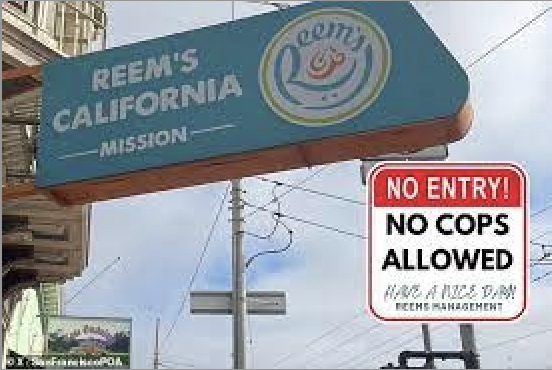
    Reem’s California, an Arab bakery and street food establishment with several outlets in California including one at 2910 Mission Street in San Francisco, is refusing to serve customers who have guns on them.
    Yes, the right to keep and bear arms is legally enshrined in the Second Amendment.  But this is a private business. They can set a policy of not allowing guns in their store, just as a business can require that customers wear shoes, belong to a particular sex or gender, or be vaccinated.  If you want to come and eat at Reem’s, or just buy their wares, don’t come armed.
    To her credit, Reem’s proprietor, Palestinian-Syrian chef Reem Assil, doesn’t have a double standard when it comes to civilian guns versus government guns.  Police officers carrying firearms aren’t welcome in her establishment either.  Again this is totally her decision to make, and she’s aware there could be consequences for not serving the men and women in blue in terms of loss of business.
    Libertarians may not appreciate a business choosing to interfere with self defense rights, or with other rights such as the right to free speech, to be nude, to use drugs, etc. But libertarian principles are clear that if an entity isn’t receiving public funds, they shouldn’t have to serve anyone they don’t want to serve.
    According to proprietor Reem Assil, her business doesn’t get a penny in taxpayer subsidies. “While I would appreciate government assistance, I would rather see policies that will lift all of us up,” she told KQED in 2020. “Sometimes, I feel like the advocacy [among restaurateurs] is more narrow-minded on a national level about what it would take to save restaurants.”
    The baker says she decided to take a stand on guns due to the fact that both she and her customers are afraid of what they see as growing political extremism in society. That’s a feeling with which many Libertarians, in some ways caught in the middle between increasingly polarized Democrat and Republican partisans, can relate.   
  • November 2020 Ballot Recommendations

    Proposition ANO. This $960 million bond measure (the estimated cost to taxpayers of borrowing $487.5 million after all the interest and costs are paid) promises everything but the kitchen sink. Prop. A would supposedly fund “investments” (the Voter Information Pamphlet’s biased language) in “supportive housing facilities”, shelters, parks, recreation facilities, facilities for “persons experiencing mental health challenges”, streets, etc. All things that could be paid for out of the city government’s $13.7 billion regular budget (a budget larger than those of many states and even most countries!). But as CPA and former civil grand jury member Craig Weber pointed out, they would rather spend that budget on things like an average salary of $108,774 and an additional average cost of $49,864 in benefits for their over 38,000 employees (a bloated “city family” larger than the entire city of Burlingame).

    Proposition BNO. We’re sympathetic to the desire to shake things up after Mohammed Nuru, the longtime head of the Department of Public Works (and ex-boyfriend of mayor London Breed) was arrested by the FBI on multiple charges of corruption. But Prop. B isn’t exactly a house-cleaning. Nearly half of current DPW employees would just be transferred to a newly-created Department of Sanitation and Streets, with duplicative support staff meaning an additional cost of $2.5 to $6 million annually, according to the Controller’s statement. What it does not do is guarantee that bureaucrats who are not doing their jobs in keeping the streets clean will be replaced, or that the new department won’t be subject to the same kind of cronyistic political appointments as the old one. As former judge Quentin Kopp notes, it’s just an attempt to “take the heat off City Hall criminality” without fundamentally changing anything.

    Proposition CYES. This measure would simply give non-citizen residents the same opportunity as other San Franciscans to serve on city boards, commissions, and advisory bodies. Libertarians strongly support the right of people to move freely from one country to another, and for people to have full equality under the law regardless of citizenship, which is ultimately just another Big Government program that enables those in power to divide and control people and extort money from them on the basis of nationality. According to a ballot argument by the LGBT Asylum Project and others, 35% of voting-age San Franciscans are foreign-born, and we oppose restricting any of these individuals from full political participation. As we argue in a paid statement in the Voter Information Pamphlet, “Laws must not be allowed to discriminate on the basis of innate characteristics like race, gender, sexual orientation, or national origin.”

    Proposition D YES. While we generally oppose additional government spending and bureaucracy, the life and death power that law enforcement agents have over the rest of us creates an even more pressing need for independent oversight than is the case for the rest of government. Incidents like the gladiator-style fights that the Public Defenders Office learned some SF sheriff’s deputies were staging among inmates for their own amusement, drive the point home. Prop. D would create an Office of Inspector General with the power to investigate in-custody deaths and complaints against Sheriff’s Department employees and contractors in at least some cases, and make recommendations regarding the department’s use of force policies. Also an Oversight Board that would hold public meetings and receive input from the public, as well as being able to subpoena witnesses and require the production of evidence. At less then a $3 million additional annual cost, this seems like a good pro-freedom tradeoff. In the wake of the killings of George Floyd and numerous other Americans at the hands of law enforcement, the need to rein in the abuses of gun-toting government agents should be abundantly clear to everyone, and this measure to create some independent oversight of the 800 or so SF Sheriff’s Department employees should do at least a bit to help.

    Proposition EYES. This measure would remove the absurd requirement that San Francisco maintain a minimum of 1,971 sworn SFPD officers, a mandate so out of whack with actual needs and budgetary considerations that it has not even been consistently followed anyway. Our paid ballot argument supporting Prop. E notes that this force size exceeds not only that of neighboring cities like San Jose, which has more residents than San Francisco, but even the per capita policing in Paris under the hated regime of Louis XVI and Marie Antoinette that was overthrown in the French Revolution of 1789! While certain types of incidents such as auto break-ins have been up the past few years, the SFPD has plenty of capacity to address this trend if they get their priorities straight and focus on investigating and responding to real crimes against life, liberty, and property, rather than victimless actions like drug sales and use, prostitution, and public camping. Additionally, mental health crises and other types of service calls should involve personnel trained to address those situations, not police officers (who have a disturbing tendency to use excessive force against the mentally ill and others), and efforts underway to transfer some of these responsibilities away from the SFPD will likewise free up  more officers to focus on apprehending actual criminals.

    Proposition FNO. Trying to parse what this 125-page monstrosity of a ballot measure would actually do is extremely difficult, which is a reason in itself to regard it with a high degree of skepticism. We couldn’t figure out from the text itself what the net effect of swapping a payroll tax for a gross receipts tax in all their respective intricacies would be, but according to the Controller’s statement it amounts to an estimated $97 million/year tax increase. Which is no doubt why Mayor Breed and the entire Board of Supervisors, unreformed statists all, are supporting it. You might think politicians would have more sense than to try to foist a massive tax hike on local businesses during a government lockdown that has already forced more than half of The City’s retailers to close their doors, many of them permanently, but you would be underestimating #GovernmentGreed. The Democrats who run SF claim that Prop. F would provide relief for businesses most impacted by the government’s ham-fisted response to Covid-19, but of course they could have provided that relief without tying it to higher levels of legalized theft that will harm other businesses.

    Proposition GNO POSITION. We debated this one. Several of us thought this was a clear libertarian “yes”, but several other members had concerns including that minors still legally under the control of their parents could be influenced by them on how to vote. On the flip side, 16 and 17 year olds do still pay sales tax and other taxes, and “taxation without representation” was one of the prominent complaints of the American colonists who seceded from Great Britain in 1776. You make the call.

    Proposition H YES. Prop. H represents a rare local ballot measure that would actually increase economic freedom, by streamlining or eliminating a few of the city government’s myriad noxious regulations that make it expensive and difficult to start and maintain a business in San Francisco. Currently, the Planning Code needlessly prohibits many sensible and harmless uses of commercial space. This has contributed, even pre-Covid19, to a glut of business failures and vacant storefronts. One sentence in the Controller’s statement kind of says it all, noting that under the measure, “Fees for additional reviews required due to City errors would be waived.” Does anyone other than the most retromingent statists think it’s reasonable to impose additional fees on businesses as a result of government errors?

    Proposition I NO. Riddle: How do you top an effort to increase business taxes by $97 million during the worst economic downturn the U.S. has seen since the Great Recession, if not the Great Depression (Prop. F)? Why, with an effort to raise real estate taxes during a housing shortage when there are over 8,000 homeless people on the streets of San Francisco according to the official count (which is probably an underestimate) by double that amount. This would be Prop. I, which the Controller’s statement estimates would add an average $196 million a year to the cost of housing and commercial real estate. A pair of small business owners writing in the Voter Information Pamphlet note that the measure doesn’t just apply to the sale of property, but also to small business and storefront leases – in other words, a hit on some of the same businesses that some of the same Supervisors supporting this proposition claim that they are trying to help with Prop. F. “At a time when many [mom and pop businesses] are desperately trying to sell, break, or renegotiate their leases, this tax will increase their rents and threaten their safety nets when they can least afford it,” write small business owners Gwen Kaplan and Rodney Fong.

    Proposition J NO. What would an election be without some kind of appeal to rob people “for the children”? Enter Prop. J, a regressive $48 million annual parcel tax increase that would hit every property owner (small or large) in the city not given a special exemption with an extra $320 on their property tax bill, to flow into the coffers of the SF Unified School District. Close behind appeals to commit robbery for the children are arguments to do it for the teachers, and this measure promises “raising the salaries of teachers” – oh, and unspecified “other School District employees” (read: members of bloated administrative non-teaching staff). The SFUSD would also have the “sole discretion as to allocation of the proceeds” among these and other assorted purposes – meaning they could if they chose spend 90% of the money on more administrative bureaucracy.

    Proposition KNO. The LPSF won the “lottery” process to be selected as the official opponent on this one, and its supporters – again a laundry list of local political power players including every member of the Board of Supervisors – decided to try to sell it as an anti-racism measure, touting the fact that it would override the California Constitution’s Article 34, a 1950 ban on government development of housing for low income persons unless first authorized by a public vote. “Prop. K is a step towards removing this racist legacy”, they write. In reality Article 34 says nothing about race, and does not stop low cost housing from being built by independent builders. It simply prevents government officials from using taxpayer money to subsidize such housing against the will of the public. The irony is that supporters of Prop. K are making arguments suggesting that they want to engage in racism by handing out housing on a preferential basis to people of certain racial backgrounds. Rather than attempting to get into the housing construction business, an endeavor that won’t end well, the mayor and Board of Supervisors should cut the red tape and expensive bureaucratic requirements that prevent more affordable housing getting built by independent builders. Legalize tiny homes and ADUs (accessory dwelling units, also called “granny units”), for example. And make more legal free parking places for people living in RVs and vans. Those options won’t be ideal housing for everyone, but they work for many people and are better than sleeping on the street, as thousands of San Franciscans do now.

    Proposition LNO. This is an effort to pressure businesses to pay their top executives less, or other workers more, when those executives receive more than 100 times the median pay of their workers, by stealing more money from such companies in the form of a higher gross receipts or payroll tax. Unfortunately, robbing a company as a whole won’t necessarily come at the expense of its overpaid executives, but could easily instead negatively impact other workers who may see lower compensation or be more likely to lose their jobs (or not get hired in the first place), as well as at the expense of members of the public who could face higher prices for the company’s products. It could also cause some businesses to stop doing business in San Francisco, costing local jobs and reducing the choices available to residents. Executive overpay is a legitimate concern when driven by factors other than simple market-based compensation based on relative demand for different types of labor and skills, but a better way to address the issue is through corporate governance reforms to make management more accountable to shareholders. Not by simply feeding a State which is even more bloated than the biggest independent companies and whose own top employees are already overpaid at the public’s expense.<!–break–>