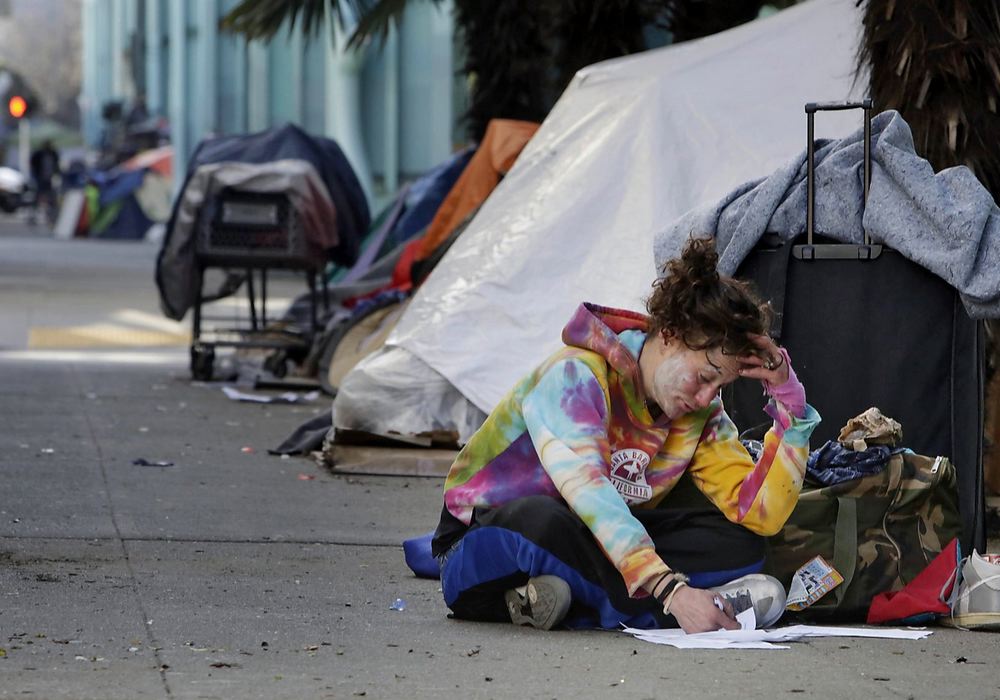
It’s common knowledge that San Francisco has thousands of homeless people living on the streets and a shortage of not just housing, but even temporary shelter space. San Francisco also has a government-run school system that includes over a hundred schools occupying public space, each with multiple buildings that are vacant and unused at night.
At some point, someone – probably multiple someones, perhaps even including yourself – may have thought, “Instead of having people without homes out on the streets, at risk of illness or death from exposure, crime, etc, and without places to practice proper sanitation and hygiene, or spending a bunch of taxpayer funds building new shelter facilities, why not let some of the homeless in these unused existing public facilities, where they will be safe and can have access to restrooms and showers?”
As you may or may not be aware, this is not a hypothetical. Not only was this idea contemplated, it has actually been put into effect as a government program – well, sort of. So how is that working out for us?
To begin with, the idea was pared way back, limiting the number of people likely to be helped by it. Rather than making space available after hours at government schools in different neighborhoods across the city, the program was limited to a single school, Buena Vista Horace Mann (BVHM), a Mission district kindergarten through 8th grade school located at 3351 23rd Street.
Then the program was further limited to serving families with children attending that particular school, with assurances to this effect presumably intended to pacify neighborhood and school community xenophobes.
Did I say xenophobes? Sadly, yes.
Fear and hostility toward outsiders, people who aren’t here now, aren’t part of the “in group” isn’t just a thing with Donald Trump and his supporters – it’s also a local thing here in SF. Especially (at both the national and the local level) if those outsiders happen to be poor.
City officials may be regretting those assurances however, because now – after reportedly sinking money into startup costs such as putting in new showers (did the school previously lack showers for students using the gym? were those showers not good enough for homeless people?) – they say they can’t continue the program unless they expand it, because not enough homeless families with students at Buena Vista Horace Mann are applying.
Did I say applying? Sadly, yes.
You might think that something like making BVHM’s gymnasium available after hours to homeless families needing a place to stay for the night would be pretty straightforward: Somebody shows up with kids needing a place to sleep for the night, you let them in. Hardly even worthy of being called a “program”. When I let friends or others crash at my place, I don’t call it a program, and there is no application process – people just ask me. But when it comes to government, nothing’s ever so simple. Government is where good ideas go to die.
Here’s how the “program” is actually working (or not working):
“Interested families usually begin the conversation by saying they are running out of housing options and they were told the school has a shelter,” writes reporter David Mamaril Horowitz in the bilingual Mission-area newspaper El Tecolote. “They first speak to Chandler”.
That would be Nick Chandler, the schools’s social worker. According to El Tecolote, he then “vets” these families and “forwards them to Dolores Street Community Services” (DSCS). Why DSCS? Because they are the non-profit organization managing the “shelter”. You might think the school itself should be capable of managing the task of allowing students from its own student body, and their families, to use its own gymnasium, but you are not thinking like a government bureaucrat.
DSCS’s Mayra Medel-Sanchez is the project’s program manager. You might assume that title means she’s in charge of designing and planning the program. You would be wrong again. They have a separate person for that, one Saul Hidalgo.
Both Hidalgo and Medel-Sanchez defended the program to El Tecolote (surprise, surprise). But then again, who are they not to have an opinion, when on any given day they may comprise a double digit percentage of the program’s direct beneficiaries?
That’s right – since it was opened as a shelter in November, according to a critical March 1 story by Jill Tucker and Trisha Thadani in the San Francisco Chronicle, the gym at BVHM has had “an average occupancy of less than two people per night”.
Tucker and Thadani didn’t get that information from the program’s managers, according to the story, but from yet another individual being supported by tax dollars to “help” the homeless – Department of Homelessness and Supportive Housing director Jeff Kositsky. (Kositsky’s salary of $205,000 a year is presumably not factored into the reported cost of the program – more on which shortly.)
Although the facility fails to attract any homeless individuals several nights a month, Kositsky said that doesn’t mean it’s completely empty at these times. “Shelter workers are on-site seven nights a week and through holidays, whether anyone shows up or not,” he told the Chronicle. Must be a tough gig!
The total number of families who’ve used the “shelter” since it’s been open? Five, according to the Chronicle. Seven, according to Nuala Sawyer in SF Weekly, who took the daily paper to task for “implying it’s a failure”. “What may need to happen is a reframing of the program,” Sawyer opined.
Meanwhile, according to the Chronicle, the city government is paying Dolores Street Community Services $40,000 a month to manage the program (wrong, it’s only $37,000 a month, says SF Weekly). Either way, this doesn’t include any program-related outlays or other costs incurred by Buena Vista Horace Mann school or the city government, such as the aforementioned startup costs. (I couldn’t find an estimate of those costs; Sawyer reports the new showers were “donated with pro bono work”, although by whom, or why, and whether there were any other costs involved, she doesn’t say.)
This means that for the three-month period of December through February, taxpayers have shelled out a bare minimum of $111,000, and probably significantly more, so that between five and seven families have been able to spend some time sleeping on the floor of a gymnasium.
Perhaps in future months administrators could instead consider putting homeless families up at the Ritz-Carlton or the Four Seasons, where they could have full access to the hotel’s concierge service to connect them to local resources? With monthly rates at these hotels, they might be able to save some money.
But in government it’s all about perceptions, so Sawyer’s proposed “reframing” is a more likely outcome for what responsible (or irresponsible, depending on your point of view) parties are calling the “Stay Over Program”. What would this involve? Essentially “keeping people out of the gym’s shelter” rather than getting them into it. If that sounds odd, it is not without precedent – government has long been paying farmers not to grow food, and there is the famous, if possibly apocryphal, story of the U.S. general in Vietnam who explained how they had to bomb a village in order to save it.
In seeking to continue the program, BVHM principal Claudia DeLarios Morán, program manager Medel-Sanchez, Sawyer, and others, claim the number of families who’ve been sleeping in the gym doesn’t tell the real story. The real benefit, they assert in so many words, has been getting people into other government programs.
“All participants in the program register with the the city’s Mission Access Point, which enters them into the city’s homelessness response system and makes them eligible for its services. They are also able to meet with a case manager who provides counseling and guides them to resources,” program manager Medel-Sanchez told El Tecolote.
The paper reported that 59 Horace Mann families (out of an initial 64 that SF Weekly says were identified as “housing insecure”) have spoken with Chandler, and at least 26 have “received case management”.
Once families show up at the shelter, they “receive support and services from trained professionals who have the connections to get them help,” DeLarios Morán told SF Weekly. That wasn’t happening previously, she said. “This is a level of coherence we’ve never really had before.”
Since the families had already been identified, you might think that much could have happened without the need to pay a non-profit group tens of thousands of dollars a month to run a shelter that few of them apparently wanted to use. But again, you would not be thinking like a bureaucrat – remember, these are “trained professionals”.
Supervisor Hillary Ronen, who initially championed the idea in Spring 2018 along with DeLarios Morán and in whose district this is all taking place, said the program won’t be continued unless it can be made more cost-effective. For the number of families involved, it “doesn’t make any financial sense,” she admitted to SF Weekly. “We might as well buy a condo for that amount of money,” she said. Yup, or failing that, give the Ritz-Carlton a call.
Along with pretty much everyone else quoted by the media with the exception of the NIMBYs, Ronen favored expanding the program to allow the families of students attending other schools in the district to participate. On March 12, members of the SF Unified School District’s Board of Education, aka the school board, agreed, unanimously voting to do what common sense suggests should have been done in the first place. At a minimum, that is – I’ve seen no explanation for why homeless people not related to SFUSD students, whose taxes after all help pay for those government schools, shouldn’t also be allowed to participate. In any case, the “Stay Over Program”, rather than being slated for shutdown on June 30, got a new lease on life.
The NIMBYs aren’t without some wisdom of their own, however, even if their motives may be less than pure. “This is not to me a success,” BVHM parent Johanna Lopez Miyaki told the Chronicle. “Why didn’t they ask those 60 families what they needed? Why didn’t they ask the 60 families if they wanted to sleep on the gym floor?”
An estimated 2,200 students in the SFUSD “cope with homelessness or housing insecurity”, according to the El Tecolote article. But how many of their families will be willing and able to deal with the bureaucracy around the program in exchange for the dubious priviliege of accessing a mattress on the floor of a school gym when needed? That remains to be seen.
But let there be no confusion on this point: Letting homeless people sleep in a government school at night, which school board member Mark Sanchez noted is probably a first in the country, is not the problem, just as the problem with California’s Proposition 64 was never the idea of legalizing cannabis – as with Prop. 64, the problem is all the government BS that has come with it.
Now that it has been expanded, if not yet reframed, will this comi-tragic effort manage to morph into something both useful and reasonable, as those who conceived it presumably intended, or will their good intentions be once again defeated by the nature of government, its non-profit patronage system, and the Lennon Rule* as the program matures into an even larger and more wasteful boondoggle?
Stay tuned…
*”Everything the government touches turns to shit.”
– John Lennon