Category: Uncategorized

  • Scammers, Tools, and Suckers (Who Loves Public Campaign Financing?)

    Scammers, Tools, and Suckers (Who Loves Public Campaign Financing?)

    The following conversation is fictional, but may not be too far from the truth. Let’s listen in at a banquet event attended by various political insiders some years ago…

    Lobbyist:  How’s the campaign going, Ed?

    Senator:  Not bad, but we’re having to raise more cash this time around to guarantee our margin of victory. Even when you’re the incumbent, it never hurts to out-spend them by 3:1 or 5:1 to be on the safe side.


    Assemblymember: Too true. Look what happened to Smith last November. Thought he had a safe district, and then wham!  Now he’s doing time on the Waste Management Board and trying to rebuild his career.

    Lobbyist: Well, you know we’re in for a few grand as usual, but beyond that I’m afraid the association’s budget is about tapped out for this quarter.

    Senator: Damn, I hate calling people for money. It’s too bad we can’t just tap the public to pay for our campaign, the way we tax them to pay for our legislation!

    Assemblymember:  Ha, they’d never go for that! Can you imagine the headlines? “Pols Want Voters To Subsidize Their Annoying Campaign Ads, Junk Mailers, and Robocalls!”.


    Lobbyist:  (looking thoughtful) You know, I’m not so sure it wouldn’t fly. It all depends how you sell it. Call it “campaign finance reform”, make the voters think they’re getting money out of politics, ending the influence of “special interests”.

    Senator:  (grinning) You mean people like you?

    Lobbyist:  (grinning) Exactly! Of course we’d still be around lining up the usual contributions for you, but it’d be more indirect, low profile. Officially, you wouldn’t have anything to do with our spending on your behalf. Less bad PR for both of us that way.

    Assemblymember:  Hmm, he does have a point Ed! But imagine the Libertarians and Greens and all the other fringe anti-establishment wingnut candidates receiving public funding… I’m not sure it would be worth it. With more money, some of them could really cause trouble for us.

    Lobbyist: Who says they need to get any significant share of the loot? Make it so you first have to raise money in order to get money. A reasonable-sounding formula that meets your needs without rocking the boat too much. I’m sure you guys can come up with something.

    Senator: I think I’m sold. (turning to aide) Steven, put “campaign finance reform” on our legislative to-do list!

    Aide: Yes, sir!

    Now let’s fast-forward to San Francisco, 2017…

    “In 2000, voters adopted a voluntary partial public financing program for Board of Supervisors candidates,”Joshua Sabatini wrote in the March 29, 2017 San Francisco Examiner.

    “In the November supervisor contests, the public financing program provided $1.5 million to a total of 12 candidates. Funds dispersed averaged $126,858 per candidate, with a low of $49,035 and a high of $155,000, the maximum allowed. Candidates who raise $10,000 can receive $20,000 of public funds. For the next $50,000 raised, they are matched $2-to-$1, and for the remaining $35,000 raised, there is a $1 to $1 match.”

    According to the San Francisco Department of Elections, there were 28 candidates for Supervisor on voter ballots in San Francisco in November 2016, plus an unknown number of write-in candidates whose ranks presumably included anyone who couldn’t afford the $500 filing fee to run for supervisor, or the time spent gathering signatures in-lieu of the filing fee from 1,000 registered voters (which, based on my own experience as a petitioner, amounts to working for less than the government-mandated minimum wage), and who, being excluded from listing on the ballot and with scant chances of getting elected, did not bother to file the Statement of Write-In Candidacy, nomination signatures, and Statement of Economic Interests (FPPC Form 700), required to be “official” write-in candidates, required to be “official” write-in candidates whose names would appear in the results.

    In other words, fewer than half of the candidates for the eligible offices – and, it’s virtually certain, none of the seriously underfunded candidates running write-in campaigns – received any taxpayer funding. But a lucky minority – often those least in need of additional funding – collectively got a million and a half bucks to spend furthering their career ambitions and employing supporters, courtesy of the taxpayers. One such recipient was Ahsha Safai, now elected supervisor for District 11. While on the public campaign finance dole, Safai benefited from a cool $780,327 in spending by outside groups “in support of him alone”, the Examiner reported in the article noted above.

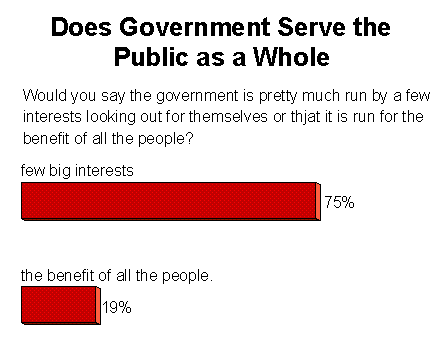
    It’s hard to escape the conclusion that if you’ve supported public financing of campaigns in San Francisco, you’re either a scammer, a tool of scammers, or an unwitting sucker.

     

  • Wheel of Misfortune

    Wheel of Misfortune

    A recent news item highlights the insanity of what the taxpayers are paying for when we employ the police. The police are supposed to be paid to protect life and property, but the sheer number of ridiculous laws gives the police the discretion and power to enforce those ordinances they choose to enforce since no government, save a 100% police state, can possibly enforce all the laws on the books.

    A homeless man was recently cited by the San Francisco Police Department for eating pizza at a downtown bus shelter near Market and 7th. The fine was $250 for “Eating and drinking in or on a system facility or vehicle in areas where those activities are prohibited by that system.” OK, prohibiting food or beverage on a MUNI vehicle might be understandable considering the litter that riders leave behind, but eating pizza at a bus shelter?! Are they out of their minds? What did MUNI have to say about it? Even MUNI spokesman Paul Rose said he didn’t know whether it was OK or not to eat at a bus shelter. The San Francisco Police Department—in what should have been a major embarrassment—could only muster up the following pitiful explanation: “It looks like it was (issued) right after a stabbing in that shelter,” and the officers only wrote the citation to “move him along,” and the police department had received multiple complaints about eating and smoking at that bus stop. While soda tax proponents frequently cite the diabetes “crisis,” we’re not aware of any law against eating per se—at least not yet—and smoking is still legal, so we’re not sure why complaints from busybodies should be a compelling reason to issue a fine to someone who’s not harming anyone (or even himself in this case). Of course the man is very unlikely to have to pay the fine as judges often dismiss the charges, especially for a homeless man unable to pay the ticket, but isn’t this a waste of time, not to mention taxpayer money? Worse still, we’d like to know why crimes with real victims, like murder, assault, house break-ins, car break-ins, and theft, are not being tended to by the police, while officers are wasting time harassing a homeless man with few resources.


    This brings us to the Spinning Wheel of Ridiculous San Francisco and California Laws that we introduced at our Pride booth last year. The idea was to highlight to visitors to our booth the breadth and insanity of laws on the books, often unenforced but still there, for police officers to use as needed when they feel like it. They fly completely against the rule of law and make it rule of man. We came up with the following list of illegal actions that could land you in the slammer or result in a substantial fine:


    • Sitting on a sidewalk (Section 168 of the SF Police Code)
    • Storing a bicycle in a garage (Chapter 6 of the SF Housing Code)
    • Burning wood in your fireplace (Reg 6, Rule 3—Bay Area Air Quality Management District)
    • Leaving moldy leftovers in your refrigerator (Section 581 (9)-Article 11 of the SF Health Code)
    • Giving away free toys in restaurants (Healthy Foods Incentives Ordinance No. 290-10)
    • Selling lemonade/cookies or fudge brownies with no permit (Article 6-SF Business/Tax Regulation Code)
    • Not separating your trash into 3 curbside containers (Chapter 19 of SF Environment Code)
    • Hanging a parrot cage outside your apartment less than 20 feet from the window (Section 37b of SF Health Code)
    • Setting your dog outside without full access to an enclosed building at all times (Section 41.12-SF Health Code)
    • Giving a young relative a pet rabbit (Section 48a of SF Health Code)
    • Walking 4 or more dogs at any one time without a permit (Section 3902-Article 39 of SF Health Code)
    • Refusing to allow a master tenant to add roommates to an apartment lease (SF Ordinance 171-15)


    We will be at the Pride Fair at Civic Center Plaza once again this June 24 and 25 with our usual extensive collection of freedom-oriented outreach literature, the World’s Smallest Political Quiz, and the Spinning Wheel of Absurd Laws. If the wheel spinner lands on a slot that lists an action that is still legal (last year we only had walking down the street peacefully without a government-issued ID and leading a tour in San Francisco without government permission), he or she wins a fun prize. We purposely made 12 slots as illegal actions and only 2 slots as (still) legal actions to emphasize the proliferation of meddlesome laws into everyday life. The spinning wheel was well received by visitors and amused, surprised, shocked, and occasionally outraged those who took a spin.

    We will again be inviting visitors to take a spin this year, and to keep it fun and fresh and still make our point, we are looking to update some of the crazy laws sporadically enforced, so we are inviting our readers to add to our list of laughable laws by suggesting any new ridiculous ones they can find. The trick is to find the applicable ordinance or penal code that makes it illegal. Anyone can google crazy laws and find an amusing list of unbelievable laws on the books, but we want our visitors to know that we didn’t make them up, so listing the ordinance number or code on the spinning wheel is critical for credibility. Believe us, some of the laws are so nutty that we didn’t believe them ourselves without the ordinance or code number. And winding through the byzantine maze of laws on the books—it’s harder than you think. Please email us at chair@lpsf.org with any suggestions for additions to our spinning wheel (with the applicable ordinance or code number), and we’ll be happy to send you one of our fun and provocative posters for your efforts. And don’t forget to drop by our booth at the Pride Fair on the last weekend of June to browse, chat, and take a spin yourself!

  • A Funny Thing Happened on the Way…

    A Funny Thing Happened on the Way…

    A few months ago, we started planning our annual panel discussion, which we usually hold sometime in April to coincide with Tax Day. Early on we decided it would be on Sanctuary Cities, a nice meaty and timely topic. We expected that in a well-known Sanctuary City like San Francisco, it would be a cinch to locate a prominent proponent and we would be hard-pressed to find any prominent person to take the contrarian position publicly in a panel. But a funny thing happened on the way to organizing this panel: we could not secure even one prominent politician, public official, or journalist willing to defend their public stance in a serious, balanced panel discussion on the issue. Just as strangely, we located a prominent opponent of Sanctuary Cities more than willing to discuss the issue publicly in one quick email response to our invitation. It does seem odd indeed that in the most noted Sanctuary City in the country, not one notable proponent would step forward.

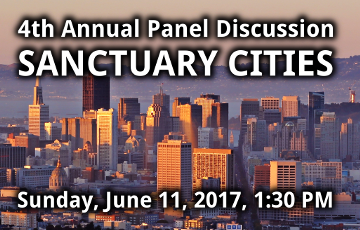
    Our 4th Annual Panel Discussion is now officially set, so save the date and get ready for one heck of a discussion on the issue. It will be held on Sunday, June 11, 2017 at the San Francisco Public Library (Main) at 100 Larkin Street in the Latino/Hispanic Community Meeting Room located on the library’s lower level (enter at 30 Grove Street and go downstairs). The panel discussion will run from 1:30-3:30 PM, but we usually bring our cattle prod to clear out the room for cleanup at the end due to audience engagement during Q&A during the last half hour, so we may run slightly longer, especially this time.


    Our guest panelists will be Steve Frank, noted political consultant and publisher of California Political Review, and Starchild, noted political activist and Outreach Director and Vice Chair of the Libertarian Party of San Francisco. Steve Frank will be presenting the case against Sanctuary Cities, and Starchild will present the case for them. We thank Steve Frank for agreeing to participate period, especially in a Sanctuary City, and further agreeing to participate in a panel where the hosting organization has one of its own members taking the contrary position on the panel. We thank Starchild for stepping up to the plate and speaking on a heartfelt issue that local politicians and journalists felt wasn’t important enough to give a fair public airing.


    Sanctuary Cities is a highly-charged, emotional, and complicated issue touching on many aspects of what government should be and shouldn’t be doing. Should the borders be opened or closed? How do you properly vet for terrorists? Should the government be protecting jobs? What about the tragic shooting of Kate Steinle? Should taxpayers be forced to pay for legal costs of those who chose to enter the US illegally? Does the welfare state encourage more immigration? Should Dreamers be detained and deported? How are overcrowding and limited resources for government schools affected by illegal immigration? What about lawsuits faced by Sanctuary Cities when an illegal immigrant commits a real crime (against an actual victim)? What is the proper relationship between local governments and the federal government? What about immigrants who just want to work in this country and aren’t interested in becoming citizens? The list of questions could go on and on, and undoubtedly our 4th Annual Panel Discussion will not cover every possible angle, but we can absolutely promise you that it will be a provocative and informative few hours giving a fair airing of the issue that you won’t hear anywhere else. Please join us on June 11— and bring your own questions too!

  • Recap of the 2017 California Libertarian Party Convention

    Recap of the 2017 California Libertarian Party Convention

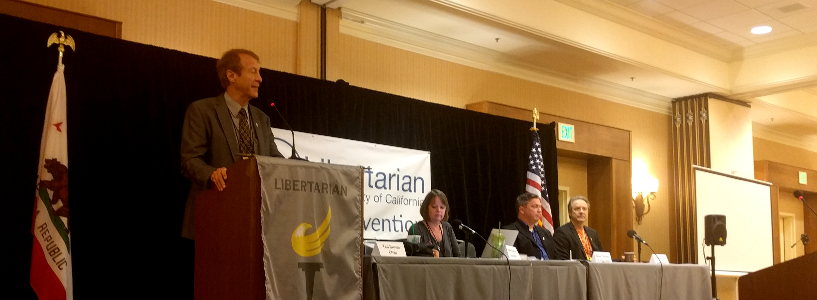
    This April marked the annual Libertarian Party of California convention, which this year was held close to home for us– at the Marriot hotel in Santa Clara. Over the weekend, over 80 delegates plus many others met to hear reports from our elected officials, discuss and vote on revisions to the party platform and bylaws, and hear from influential speakers.

    After an opening banquet on Friday evening, the convention kicked off on Saturday with a keynote from Richard Fields of the Pacific Legal Foundation, who spoke about the work that their organization has done to provide pro-bono legal support in cases where big government is encroaching on property rights, extorting entrepreneurs with huge fines or discriminating against individuals based on race. This was followed by reports from our Chair, Ted Brown, Vice Chairs Brian Theimer and Jonathan Jaech, and Secretary, Mimi Robson, covering the progress of the party, boasting upwards of 30% growth in many counties throughout the state.


     Over lunch, we were joined by Eric Garris, Libertarian activist and founder of Antiwar.com and LewRockwell.com, who spoke about the detriment of war and gave a strong argument against military intervention overseas. Unfortunately, opposing unnecessary intervention has become a distinguishing mark of the Libertarian party, while the two corrupt parties in power can only seem to agree on clamouring for more war.


    Rounding out Saturday’s agenda was the somewhat controversial bylaws meeting, in which members proposed changes to the party bylaws. Among those proposed was a new bylaw which would add a responsibility for the Secretary to distribute membership counts to all counties. Another, proposed by Kenneth Brent Olsen, laid out a plan to further divide the North and South regions. This would create a new Central Vice Chair to relieve some of the burden on the Northern Vice Chair, who is currently tasked with coordinating a whopping 48 counties. However, in true Libertarian fashion, after much debate, the only thing the delegates could agree on was to get rid of our own Convention rules– specifically, Rule 4, which concerns tallying votes by county and has become obsolete and been suspended in prior years.

    Saturday night there was another banquet which featured the CEO of Overstock.com, Patrick Byrne, as well as Libertarian activist and entrepreneur Chris Rufer. Unfortunately, I wasn’t able to attend this banquet, so I can’t provide details about this– sorry!

    On Sunday morning, a somewhat groggy crowd reconvened to another great keynote from Matt Kibbe, President and Chief Community Organizer of Free the People. Kibbe spoke of entrepreneurism and the necessity of Liberty for innovation, as demonstrated through the story of Fritz Maytag, a businessman who poured his fortune into perfecting the brewing process of Anchor Steam and gave us craft beer as we know it today.

    With everyone re-energized and somewhat thirsty for an IPA (maybe not until later in the afternoon), the convention turned back to perhaps the most important official business of the weekend; election of officers. To keep things short, I can say upfront that all these seats were filled with unanimous support from all 80 or so delegates who were present. Those re-elected were our Chair, Ted Brown, Southern Vice Chair, Jonathan Jaech, and the acting Secretary Mimi Robson. All these candidates showed strong enthusiasm for the growth of the party and were very well appreciated by their nominators and by the crowd. We especially took several opportunities to applaud Mimi Robson on her amazing progress after stepping in as secretary just a couple months prior– thank you, Mimi! We also had a couple of fresh faces step into these roles as well, with Kenneth Brent Olsen passionately taking on the role of Northern Vice Chair and Steve Haug taking over as Treasurer. We at the LPSF had the pleasure of meeting Dr. Olsen already when he attended one of our meetings earlier this year, and we are not the only county to say this– clearly, he has already made his rounds!

    With a reinvigorated group of officers and delegates alike, we had the wonderful opportunity to hear from acclaimed economist, writer and anarcho-capitalist David Friedman. Over lunch, Friedman spoke about Feud Law as an alternative to the governments of today in which, essentially, there is no executive branch. He spoke briefly about the topics of his book Machinery of Freedom, in which he explores the potential of letting individuals form and enforce contracts as individuals and through private collectives rather than subjecting everyone to the rule of government.

    2017 Libertarian Party of California State Executive CommitteeGetting back to business, the delegates convened again to elect members to our Executive Committee. Again, all these positions were filled by impassioned individuals who have already made great contributions to the party and are eager to continue that role. Those elected to the ex-com were Robert Imhoff, Boomer Shannon, Alex Appleby, Wendy Hewitt, Tyler Kuskie, and Zachary Moore, plus Jennifer Imhoff and Baron Bruno as alternates. Congratulations to all elected!

    For the final task of the day, Alex Appleby presented the Platform Committee’s report, which included several proposals to revise the language and format of the party platform, plus the addition of a new section specifically to outline our stance on marijuana. This section, as some delegates pointed out, is already stated in other parts of our platform, however the majority felt that calling out this issue specifically is important to explain our stance. This is especially true after many saw the LP’s “no” recommendation on California Prop 64 as contradictory, but as well stated several times in our discussion, 60+ pages of regulations does not make you more free!

    With these very successful and well thought out updates to our platform, the convention came to a close and everyone could go home to their respective counties– except, of course, for the Executive Committee, who met just afterwards for several hours of what I can only assume was constructive debate.

    And so closed the 2017 California Libertarian Party convention, the first I had the pleasure of attending, and undoubtedly not the last.

    Photo of the 2017 Executive Comittee borrowed from the Libertarian Party of California Facebook page.

  • Digging for Data

    ridesharesIs there no limit to the hypocrisy spouted by our local politicians? Did you read about the recent resolutions introduced by Supervisor Aaron Peskin at both the San Francisco County Transportation Authority (SFCTA), which he chairs, and the San Francisco Board of Supervisors calling on state legislators to give government officials the right to review the confidential business data of Uber and Lyft? The reason for this nosiness is because the rideshare companies are allegedly causing traffic congestion in The City. The resolution, which was authored by Peskin and co-sponsored at the Board of Supervisors by Supervisor Sandra Fewer, argues that access to the trip data is necessary so government bureaucrats can study it and figure out what to do about traffic congestion. Peskin is unhappy that the California Public Utilities Commission (CPUC) has the data from Uber and Lyft but will not share it with the public or the bureaucrats. According to Mayor Lee, “I think asking for data is good, and that data should inform us how to relieve that (traffic) congestion.”

    In the first place, while 100% transparency is necessary for good government, in the voluntary economy, its’s a completely different matter. In order for healthy competition to occur between firms in the same industry, companies’ business data should be kept confidential and regarded as sacred and proprietary—and definitely none of the government’s business. The CPUC granted confidentiality of trip data to Uber and Lyft so each company would not get a competitive edge on the other. “Asking” for data might sound harmless, but where government officials are involved, they “ask” first, then demand, and then quickly move on to threats, fines, and penalties the moment compliance doesn’t occur.

    Secondly, if the politicians are that concerned about the gridlock occurring in The City, they need to look at their own programs rather than looking for scapegoats. With the relentless rolling out of Plan Bay Area, it should be rather obvious that the continual removing of traffic lanes and parking spaces increases gridlock. For years now, the streets in one neighborhood after another are being quietly redesigned, and the end results are always less driving lanes for motorists and more bike lanes for bicyclists, along with bulb outs and wider sidewalks for pedestrians. The recent construction began a few months ago on Van Ness Avenue between Mission and Lombard to build bus traffic lanes in the middle of Highway 101 will probably improve mass transit—though no guarantee with the ever- unreliable MUNI—along that corridor. However, this will come at a cost of removing 2 out of 6 lanes of traffic for passenger cars. Where will the cars go? They’re not going to magically disappear, as the bureaucrats hope. Most likely they will end up on other less crowded streets or possibly that other major thoroughfare through The City—19th Avenue, which already handles thousands of cars every day. As anyone who ever attended Plan Bay Area public hearings for “input” can testify, the outcomes were pre-determined and contrary viewpoints are politely listened to—and then ignored. The fact of the matter is that the politicians and their cronies decided years ago that people should give up their cars and walk, ride, or take public transit. If a little nudging won’t do it, then perhaps making driving in The City more miserable might do the trick. As always, this is all by design.

    While it should come as no surprise to politicians why traffic is getting worse, something else irks them no end. They not only prefer that folks give up riding in their own cars—they don’t want people riding in any cars. Uber and Lyft have proven to be wildly popular with consumers who need to get around, much to the dismay of the politicians. Hence the endless “requests” for driver data from the ridesharing companies. Peskin has said that transportation officials from the SFMTA and the SFCTA believe the surge of Uber and Lyft drivers may be impacting the congestion but “we need to back up the anecdotal experiences citywide.” The real motivation behind this sudden concern about traffic is contained in Peskin’s resolution as he cites a drop in BART ridership to SFO due to Uber and Lyft and also that having ridesharing companies draws people away from public transportation in general. Imagine that! Folks having access to all this wonderful government transportation but still preferring to use evil private (voluntary) services instead. Peskin and his henchmen need to get hold of more data to stop this outrage!

  • Race to the Bottom

    As we approach Tax Day, when millions of taxpayers deal with our convoluted tax laws, many San Francisco parents have more than taxes on their minds. This is the time of year when the San Francisco Unified School District (SFUSD) mails out the school assignment letters to anxious parents awaiting the results of the government school lottery system. Many a hope realized or dashed rests on that single envelope received in the mail from the school district. This is not just an esoteric issue, but one that strikes at the core of things—the family budget. If the parents are lucky and get assigned to one of their schools of choice, they will save anywhere from $10,000 to $30,000 per year per child if they send their children to government schools.

    And yet, despite the huge financial benefit of sending their kids to government schools, why do so many San Francisco parents choose private schools? Why is the percentage of families with school-age children choosing private schools over government schools so much higher in San Francisco (36%) than statewide (9%) or even a major city like New York (20%)? What factors are at work here that would turn off folks who would prefer not to have their kids in elitist schools for the rich? Why are new private schools popping up like wildflowers in San Francisco, of all places?

    These are the private schools that have opened in San Francisco in the last 8 years: Proof School (7th – 12th grades and $35,000/year), Golden Bridge School (K-8 and $13,000/year), Alt School (K-8 and $19,100/year), LePort School (Pre-K to 8), Presidio Knolls (K-8 and $23,500/year), Brightworks (K-8 and $23,920/year), La Scuola (K-8 and $25,000/year), San Francisco Schoolhouse (K-8 and $10,000/year), Alta Vista (K-8 and $22,000/year), Marin Prep (K-8 and $22,070/year), Stratford School (K-8 and $16,220/year), and Millennium School (6th – 8th grades and $31,000/year). We’ll add in Live Oaks (K-8 and $23,500/year), which has been around for ages but is now doubling enrollment “to meet increasing demand” and dubs itself “The private school for public school parents.” Just why is there so much demand?

    No issue has been more contentious in recent years than how the SFUSD has handled the new Common Core mathematics curriculum. Algebra has been taught in middle school for ages, but because so many San Francisco middle schoolers have done so poorly at it, it is not even taught until high school anymore. Parents whose children didn’t do well with Algebra are OK with postponing it until the 9th grade, but for families eyeing college and looking ahead, this is a complete disaster. For one thing, the bright kids who are math proficient are held back from moving on to the next level and are basically “doing time” until high school. Furthermore, they are encouraged to help tutor their struggling contemporaries. While there is merit in picking up teaching experience as a middle school student and most San Francisco parents are not philosophically opposed to the compassionate angle of helping those less able than themselves, the cold hard fact is that it’s a competitive world out there and wasting a year in middle school will do nothing to improve the able students’ chances of getting into the college of their choice. Not to mention that if a student doesn’t take Algebra until the 9th grade, he/she is now a year behind in mathematics and won’t get to Calculus until the senior year, but most colleges making their decisions for admissions look at the junior year and before, so a Calculus course taken so late will put all such students at risk. True, parents who can afford it, can and will send their kids for private tutoring to catch up on their math skills, but what about those parents who can’t afford to pay for supplemental courses to make up for lost time? Summer school is often mentioned as an option, but for a school district that squanders its money on diversity training and environmental gardens, don’t count on the funding to be there for summer school if high school students start failing the “compression” option (take two difficult mathematics courses in either the junior or senior year to make it through the full Calculus sequence) chosen by the school district.

    Even with Common Core, there were other options for teaching math, and the school district could have complied with the curriculum without writing off the most able students. It could have easily supported numerous high-level demanding magnet schools devoted to math and science for those who wanted them, but instead it quietly did away with all the honors math programs in the schools that did offer it. Indeed not very smart for a city full of high tech workers whose offspring might have innate math and science abilities in their genes. Furthermore, rather than force all 8th graders to wait until high school to take Algebra, why didn’t they show enough flexibility in their approach to allow those more advanced students to take it in the 8th grade? Just because so many of the students were so behind in their math skills, does that mean that a one-size-fits-all approach is best for everyone? Is it any wonder that several of the new schools listed above are geared toward accelerated learners with more emphasis on math and science?

    The real issue here is the attitude and focus of the SFUSD. It’s all about equity and fairness and a matter of social justice. Why should some students do better than others just because they come from richer homes or more nurturing families? The practice of tracking and segregating students based on ability is a no-no because it might make the less able students feel like failures. We all know that government schools, by law, must accommodate all children once they become of school age, so clearly that will include many children from low socioeconomic backgrounds and many children learning English as a second language. That poses many challenges for government schools and explains why their academic scores can never compete with private schools. Nevertheless why ignore the bright ones and deny them the education they deserve? This is a complete slap in the face to the more financially comfortable families that pay the property taxes that fund the government schools and then have the GATE and honors programs discreetly ended for their children? One parent who toured a government school for her 4-year old who could already read was told that she could tutor other students still learning to read; she ended up in a private school because her mother felt there would be very little challenge for her with so few children at her level. Another parent reported that when her daughter applied at Lowell, the application was filled with an unsettling emphasis on hard luck life experiences, as if she were applying for disability. She also noted that when she toured another government school and asked about challenging her daughter with math, the teacher looked down her nose superiorly and informed her that it was wrong to give any child any opportunity all children didn’t receive and she would never let any kid do more advanced work than the others. That would be reason enough to pass up that school and find out why that teacher wasn’t fired right on the spot.

    We will leave the last word about the dismal state of government schools to outspoken filmmaker Michael Moore, of all people. If anyone should be for government schools, it ought to be him, but he chose to put his daughter in a private school. When asked why, he said, “Our daughter is not the one to be sacrificed to make things better.”

  • Valentine’s Day Special

    This past Valentine’s Day, while most people were busy sending valentines, flowers, and chocolates to their loved ones, San Francisco’s Board of Supervisors were dreaming about what they love the most—more taxes. Seven of the eleven supervisors (Peskin, Fewer, Ronen, Kim, Yee, Safai, and Cohen) voted for Resolution No. File 170161, which urged the California state legislature to amend the Revenue and Taxation Code to allow local California jurisdictions to collect personal and corporate income taxes as a “sustained source of funding for transportation and public health priorities.” The resolution cites AB1690 introduced by then-State Assemblyman Mark Leno in 2003 (which thankfully died in committee) as a model for this latest effort “to look for progressive revenue sources…in a menu of options.” And we’re not talking about chump change here—they want a full 10% of an individual’s state income tax liability. That’s on top of the federal income tax and the California state income tax, which at 13.3% is the highest rate in the entire country. Triple taxation!

    The reasons cited for the necessity of this new tax are the threatened loss of federal funding due to Sanctuary City policies and the intended repeal of Obamacare. Is the loss of federal funding serious enough to The City’s budget to require two new taxes? What will become of President Trump’s executive order to identify funds the federal government can withhold to punish Sanctuary Cities? Will Obamacare be repealed and not replaced? Why don’t the politicians consider cutting costs when confiscations are down?

    First let’s take a serious look at the cutting of federal funding to Sanctuary Cities. Regardless of what the President says, cutting off federal funds is not as easy as it sounds. The first problem is that it’s unconstitutional to use federal funds to force local government agencies to cooperate with the federal government. The second problem is that the President’s power to withhold federal funding is limited without the help of Congress. There are three federally funded programs all administered by the Department of Justice that could be blocked without Congress’ approval: The Edward Byrne Memorial Justice Assistance Grant Program (JAG), the Community Oriented Policing Services (COPS), and the State Criminal Alien Assistance Program (SCAPP). However, since the President’s executive order included language protecting federal grants “deemed necessary for law enforcement purposes by the Attorney General or the Secretary,” it might not be so easy to block even these three grant programs. Furthermore, to maintain funding, jurisdictions must be in compliance with U.S. Code 1373, which says that state and local governments can’t forbid employees from sharing information regarding the citizenship or immigration status of any person. The Department of Justice could block the grants without Congressional approval, but it must first refer each jurisdiction’s case to the non-partisan Office of the Inspector General, and because over 300 jurisdictions have Sanctuary City policies, it’s a typical convoluted government process that could take months or even years for approval before actual fund-cutting occurs. In actuality, many of the Sanctuary Cities are already in compliance with U.S. Code 1373, so it might not even make sense for the Trump Administration to waste resources on this effort. The federal government could issue new regulations redefining what “compliance” with 1373 is, but even that would necessitate a 30-day public response period and numerous challenges in court. It seems apparent that even President Trump for all his bluster would take a long time—possibly years—before being able to actually cut any of the federal funding.

    As for Obamacare, anyone following the hot air rising in Washington should be able to see that it’s not going away anytime soon. For years the Republicans have railed that it must be repealed, but now that they’re in control of both houses, they’re getting cold feet. Some Republicans are now cautioning against moving too fast to dismantle the current system without something better to replace it. There is absolutely no consensus on the replacement, which became especially obvious recently when Republican lawmakers had to shelve legislation that would have dismantled Obamacare due to a lack of supporting votes. Most certainly the Republicans do not want to get blamed for widespread disruption in health insurance coverage. Furthermore, despite the general unpopularity of Obamacare, some parts of it, like coverage for pre-existing conditions and allowing “children” 25 or younger to remain on their parents’ policy, have gone over well with the voting public, so any replacement plan would have to retain those features or offer something similar. The Republicans are petrified that if people start losing coverage, the media will spring into action with gut-wrenching stories about cancer victims or disabled people suddenly losing coverage. Most Republicans lack the backbone to actually get rid of Obamacare and replace it with more market-based approaches like tax credits (not deductions) for individuals for healthcare costs and getting rid of the restriction on selling insurance across state lines, which would greatly increase the types of plans available and lower costs. Getting rid of Obamacare’s thousands of pages of rules would also be a good place to start, but the recent effort by the Republicans did not even attempt that. In short, Obamacare—or something very similar to it—will be with us for the foreseeable future.

    So that brings us back to the question of why additional taxes need to be levied in San Francisco when there is no immediate or even short-term chance of major funding cuts from the federal government. There is no impending “crisis”—the leaders of “The Resistance” are just using it as yet another excuse for increased taxes and more bloated government. They have no shame.

  • Sign of the Times: Rec & Park Dept. Nixes Summer of Love Free Anniversary Festival

    HippieHillPercussionists3hCity Hall, aka “The Man”, never had the warmest relationship with the hippies who were questioning their authority, violating their rules, etc., and this fact was demonstrated again yesterday. Political appointees on SF’s Recreation and Parks Commission backed the decision of department staff to deny a permit to a promoter seeking to hold a free festival in Golden Gate Park to celebrate the 50th anniversary of the legendary “Summer of Love”, the 1967 apex in San Francisco of the mid-1960s to early 1970s countercultural revolution.

    According to the SF Examiner (Friday Feb. 17), the grinch-like commisars were dissatisfied with what department permit director Dana Ketchum said were promoter Boots Hughston’s alleged lack of “security, police and medical plans” for the event planned to be held June 4 in the Polo Field. No word on why “security” and “police” were listed as two separate items. If the police are not there to provide security, what would they be there for? To provide some period atmosphere by making oinking noises at attendees, or posing for photos wearing pig masks?

    “Rec and Park turns down request due to concerns about safety”, read the Examiner’s subhead. But that’s taking the bureaucrats’ justification at face value. If it’s an official dignitary visiting, or a high-profile sporting event like football’s Super Bowl or the America’s Cup yacht race, the City government seems to bend over backward to be accommodating, spending taxpayer money freely to make the event happen. But apparently no such luck if you just want to throw a free celebration for the people in commemoration of some history the authorities would probably secretly prefer to forget.

  • Creating Strife (Again)

    Do you ever wonder what sets legislators’ hearts aflutter? Is it a desire to pander to where the most votes are? Do they really believe that passing more laws and mandates will improve the lot of the masses? Do they ever consider that their constant attempts to “help” will actually backfire and hurt those who are supposed to be helped the most? Do they really believe that force—backed by the heavy hand of government—will make this a more civil society?

    The latest attempt by California State Assembly Members to tell California employers how to run their businesses is AB-5, the Opportunity to Work Act, which was introduced in Sacramento on December 5, 2016. This latest in an unending series of laws to micromanage the relations between employees and employers would require all California employers of 10 or more to offer additional hours of work to an existing nonexempt employee (by law must be paid overtime) before hiring an additional employee or subcontractor. Of course there’s more: the employer would be required to post a notice of employee “rights” and also the requirement of additional documentation proving compliance.

    Needless to say, this latest intrusion in the hiring process will do little to improve relations between employees and employers, but it will help to increase labor costs in California and be one more reason to set up shop elsewhere. First of all, the law assumes that employers are silly enough to incur unnecessary (and not insignificant) recruitment costs by looking for green pastures outside the company when they have more qualified workers in-house. This doesn’t make much sense, especially since in the “real” world, most employers are looking to keep costs low so they can lower their prices to their customers to be competitive. The only reason they would look to the outside is because they don’t have in-house employees with the necessary skills or expertise to get the job done. In an increasingly specialized workplace, it is unrealistic to assume that all jobs are easily interchangeable. It is also unrealistic to think that government bureaucrats—many of whom have never worked outside of government—would have knowledge enough of the particulars of a business to make a judgement call as to who would be the best person to get the job done.

    Secondly the law would add to the already contentious environment that California businesses face by encouraging the not-the-cream-of-the-crop employees in their organizations to run to the government, file complaints against the hands that feed them with the Division of Labor Standards Enforcement Police in the Department of Industrial Relations, or bring civil lawsuits against their employers. What business is it of the employees to dictate who, what when, or why their employer hires other employees? They were hired to do a particular job at a voluntarily agreed upon rate of pay dictating the pay, benefits, hours, and working conditions, and if something changes within the organization that rubs the employee the wrong way, they should just move on. Encouraging busybodyism, as this bill does, is not one of the proper functions of government.

    Yet another aspect of this outrageous bill is, “An employer shall use a transparent and nondiscriminatory process to distribute the additional hours of work among existing employees.” They make it sound like who’s going to take out the trash this week. In the real world, skills and effort really do count, so of course it would be perfectly logical to “discriminate” and “distribute” additional hours to your best employees, not everyone equally. If some urgent orders come in unexpectedly and someone’s going to need to work extra hours to get them out, of course you’re going to choose your best employees to work extra, not your marginal employees. You would be wasting company money if you did otherwise. By trying to force employers to act as if all workers were created equal—that’s a slap in the face to those employees who produce the most.

    Lastly there are the additional posting of signs and paperwork burden that accompany AB-5. OK, the signs won’t cost that much—and nobody will read them anyway—but the real problems are the soft costs of complying with this proposed law. Per Section 559 (e), “An employer shall retain all of the following:

    (1) For any new hire of an employee or subcontractor, documentation that the employer offered additional hours of work to existing employees prior to hiring the new employee or subcontractor

    (2) Work schedules of all employees

    (3) If applicable, the written statement of an employee pursuant to subdivision (k) (welfare-to-work person can opt out)

    (4) Any other records or documents that the division requires the employer to maintain to demonstrate compliance with this section.”

    So every time an employee or subcontractor is hired, an employer must document that the company offered the additional work to be done to the current employees. This sounds to us like the existing employees must “sign off” that it’s OK to hire from the outside—they grant their employer “permission.” Suppose the employee does not agree to hire a new employee and requests the additional work him/herself. This would create disruption in the workplace as the employee’s skills may not be a good fit for the job functions required. Indeed the employee may be getting in over his/her head and may be doomed for failure—a situation that makes everyone worse off.

    Again we marvel at how those in Sacramento feel they know better how to micromanage all businesses in the state (with 10 or more employees) simply by passing a law. This particular bit of top-down legislation is yet another feel-good attempt to pander to employees (and not always the best ones) to “help” them. The better way to “help” would be to loosen up regulations so employees unhappy with their employers can start a business of their own, rather than setting them up for failure with their current employers. Also since busybody politicians are always interested in “creating” more jobs, we find this bill to be particularly hypocritical since it would make it harder to hire new employees. But then again it’s apparent that the politicians have no consistent agenda to increase individual liberty, but rather just pass laws with nice-sounding names that make it worse for everyone. We hope Busybody Bill AB-5 dies a deserving death in committee in Sacramento.

  • Conscription Watch

    Like the blob, beware the rollout of CleanPowerSF (CPSF)! It’s coming to your neighborhood soon. Recently service was rolled out to 7,400 commercial customers in the Bayview, Haight, and Castro neighborhoods, and they just added in residents in districts 5 and 8. There is another major rollout planned for this spring.

    The history of this not insignificant change in service providers actually goes back to 2002 when state legislators passed Assembly Bill 117, which was ironically heralded by its proponents as the Community Choice Law. Otherwise known as a CCA (Community Choice Aggregation program), the law allowed any city or county to supply its own power to its residents, businesses, and municipal facilities in a “community wide electricity buyers’ program.” In 2007 San Francisco formed CPSF’s 2007 Implementation Plan with the ambitious goals of building 210 megawatts of in-city energy efficiency and new renewable generation capacity and a 150 megawatt regional wind facility, as well as reaching a 51% renewable energy portfolio within 10 years. Two factions of government bureaucrats have been battling each other for a decade on how to accomplish these goals. CPSF is administered by the San Francisco Public Utilities Commission (SFPUC) and monitored by the San Francisco Local Agency Formation Committee (LAFCo), which was most recently chaired by former Supervisor John Avalos. The SFPUC—hardly an ensemble of liberty-leaning officials—at least seems to have been more cautious about what is basically a government takeover of PG&E’s electricity grid, while San Francisco LAFCo officials are 100% gung-ho for the rollout—no matter what the cost is. While of course climate change, the carbon footprint, and “clean” energy are all part of the implicit motivation for getting CPSF off the ground, there’s more at work here: the evil “P” word must be removed from the mix. Paul Fern, the Grand Poobah of the clean power movement in California who was instrumental in getting AB117 passed, has advised the San Francisco LAFCo, “It’s about moving away from a 19th century model—the Rockefeller model to maximize profits. It’s about managing demands, not profits, because the program is owned by customers. It’s about democratization, not just clean power.”

    What really irks us about CPSF more than anything is the way the bureaucrats are implementing it with their opting-in shenanigan. Otherwise known as “slamming” when companies in the voluntary sector do it, but somehow when government officials do it, it becomes part of a Community “Choice” Aggregation program and it is now government-blessed. When a community signs on to a CCA, all of the customers are automatically enrolled in the new program. No one asks you if you prefer CPSF or PG&E—the default is the government-owned and run utility. On the Sonoma Clean Power website (similar arrangement CCA with everyone opted in) in FAQ, to the question why have I been opted in without my consent, the smug answer is that the state mandated that everyone be opted in, plus PG&E is a monopoly anyway and they never asked you if you wanted to be their customer. Of course AB117 was specifically designed by those who are foisting government electricity on us, and they knew that slamming everyone in would give the CCA’s an expected advantage over staying with PG&E. The “Choice” part of a CCA is complete hypocrisy. Yes, all customers do have the option of opting out of CPSF, and CPSF claims that it will mail you four paper notices—knowing very well that most folks toss most, if not all, of their junk mail out without opening it. You can bet that most customers will have no idea that they’ve been slammed and scammed since their bills will still be from PG&E, even after the changeover. Since most consumers don’t review their bills that closely these days—if they even look at them at all—and with online bill paying and automatic debit payments, it’s likely the switch will be the opposite of transparent. Again we say this is all by design.

    As to the reliability of whether the “new and improved” energy will actually be that much cleaner than PG&E energy, that remains to be seen. Originally The City contracted with Shell Energy North America in 2010 to create a program that achieved The City’s goals, and the SFPUC staff reported that the power purchased from Shell would be 100% greenhouse gas-free. However, it turned out that the Renewable Energy Certificates (REC’s) included a mix of “unbundled” credits (dirty energy from fossil fuels or other non-certified green sources). In the end, the contract with Shell was dissolved, and CPSF is now providing a base “green” package of energy that’s anywhere from 33%-50% renewable sources. At least that’s what CPSF claims. Mind you, let’s not forget that PG&E currently gets 22% of their power from nuclear sources, which is considered pretty “clean” energy, but that doesn’t count towards their 29.5% renewable score because the state doesn’t allow nuclear power to count as renewable.

    Finally, what will all this cost? CPSF claims that the basic “green” package will not cost more than PG&E’s energy. But that’s only using PG&E’s transmission and distribution system. CPSF has a much more ambitious plan in store for us, which is to “build local.” It wants to start funding the construction of local renewable energy projects to “create jobs” and also boost the renewable energy supply. Even SFPUC commissioners are concerned that starting to build out could easily make CPSF’s costs—and rates—a lot higher. The City has a pretty poor track record, to say the least, of cost containment of anything it has delved into, and we see nothing but trouble ahead once CPSF has pushed out PG&E completely. That will leave San Francisco energy users with only the most expensive “choice” of all. While we’re no fan of PG&E—a government-protected monopoly—in this case, the lesser of two evils might be the better choice.