
Category: Uncategorized

  • Judged to Chill

    Judged to Chill

    Most judges’ races are anything but exciting. Unless you know the judge personally, they’re all pretty much the same when it comes time to vote. However, what would you say about a judge who imposed punitive attorneys’ fees on plaintiffs working in the public interest to improve election laws? Punitive to the tune of $243,279.50.

    Judge Curtis Karnow up for re-election this spring is the judge who imposed the outrageous fees on the six plaintiffs suing to overturn “The Top Two” law the voters approved in 2010. The Top Two, as you probably know, essentially banned closed primaries in California and made it open season for all candidates in the June election but allowed only the top two vote getters to advance to the November election. Concocted in the dark of a winter night in 2009, the Top Two was a concession by Democrats in the California legislature to State Senator Abel Maldonado in exchange for his support of a state budget package. The Top Two was supposed to discourage extreme partisanship “so they (legislators) can meet in the middle and get things done,” per Governor Schwarzenegger in 2010. Indeed, they have gotten “things done” like increasing the overreach of state government in California by increasing spending, giving the Democrats a super majority in the state legislature, expanding the amount of money spent on state elections, and cutting third parties out of the November election completely. The change to the Top Two allowed two Democrats only to advance to the November election in the 2016 US Senate race, which was the first single-party Senate election since California began direct election of its senators in 1914. Both Washington state and California have “The Top Two,” and not one single time has a third- party candidate ever made it to the general election when both major parties fielded candidates. Incredibly, the Top Two doesn’t even allow write-in candidates, so no wonder so many voters just left the office of US Senator blank when they voted in 2016. The Top Two has not worked out the way it was envisioned, and most political analysts and politicians (including Democrats) would be happy to scrap it and, if not go back completely to closed primaries, at least allow each political party to have one candidate in the November election. After eight years, the experiment has failed.

    The plaintiffs who challenged the law were actually visionary and were acting in the public interest. It’s easier to see that now. Perhaps it wasn’t so apparent back in 2010 when the original lawsuit started, but was this a frivolous lawsuit that warranted a punitive fee of almost a quarter of a million dollars? No evidence was ever presented that the lawsuit harmed the public interest or was frivolous, yet incredibly Judge Karnow slapped the six plaintiffs with the unprecedented fine.

    Here’s what some commentators had to say about Karnow’s punishment. Election law professor Rick Hassen called Karnow’s ruling “absolutely outrageous.” Russell Mokhiber wrote in his “Corporate Crime Reporter,” “Judge Karnow’s order misapplies the law and punishes the voters in this case for exercising their First Amendment right to petition.” Joe Mathews wrote, “One consequence of the judge’s decision is the message it sends to those who might challenge California’s community of wealthy reformers and good government groups: if you get in our way, we’ll make you pay.” Los Angeles Times business reporter Michael Hiltzik who wrote about the case noted that “Charles Munger Jr.’s fee claim may chill

    public interest suits.” Election Administration Reports noted in its August 13, 2012 issue, “This unusual award was viewed by knowledgeable California lawyers as having an intimidating effect on those who would bring voting right suits.” And finally, Thomas D. Elias, a California political consultant who actually supported the Top Two wrote, “This is just plain wrong. First it serves to intimidate the not-so-wealthy from even attempting to challenge rich folks like Munger and Maldonado (whose family farm employs about 250 people). And second, it is probably illegal.”

    In the end, the six plaintiffs did not pay the outrageous amount imposed on them. When the plaintiffs obtained a pro bono law firm to challenge the amount of the punishment, Charles Munger Jr’s law firm dropped the amount to $100,000 if the plaintiffs agreed to drop their appeal. One of the plaintiffs had deep pockets at the time, so he paid the $100,000 fee himself and that was that.

    However, beyond the issue of the shortcomings of the Top Two or who paid the lawyers’ fees, the larger issue is a judge punishing public-interest plaintiffs with exorbitant attorneys’ fees for simply exercising a time-honored tradition of using the courts to redress a legitimate grievance. Karnow’s fine was in total disregard for federal and state laws and an extreme case of judicial overreach. The local media has been talking about the fact that four public defenders are now trying to unseat Karnow and three other incumbent judges because they were appointed by Republicans and are too conservative for progressive San Francisco. Establishment politicians are saying that’s nonsense because the four judges are all Democrats and the unusual run by the public defenders is politically motivated. We can’t speak for the other three judges, but they’re all missing the point when it comes to Karnow. He deserves to be “retired” from his job the old-fashioned way by being voted out of office and replaced with Maria Evangelista, one of the four San Francisco Public Defenders we expect to have more regard for the average person.

    (A special thanks to Richard Winger, editor of Ballot Access News, and one of the six plaintiffs in the case, who provided the background information for this article.)

  • Republicans Provide Crutch To Lessen Pain of Taxes on Poor – Democrats Add Armpads

    Republicans Provide Crutch To Lessen Pain of Taxes on Poor – Democrats Add Armpads

    Usually it’s the other way around – heartless Republicans trying to screw the poor, and Democrats trying to “help” them (but without addressing the actual source of the problem, and often making it worse).

    But yesterday’s Examiner (March 4) had a kind of “man bites dog” story – Assembly Bill 503, authored by Republican Assemblyman Tom Lackey of Palmdale and signed into law last year, requires local agencies to offer payment plans to poor people burdened by government fines they cannot afford.

    To give local Democrats their barely-deserved slice of credit, once this GOP-originated crutch became law, SF’s Democrat city Treasurer, Jose Cisneros, added extra padding to make the crutch a little easier to use by implementing a plan that goes further in some respects than what the law requires. Which his spokesperson was not too modest to tell the Examiner:

    As implemented locally by Cisneros, the plan goes “far beyond what was legally mandated”

    (more…)

  • Tolled to Death

    Tolled to Death

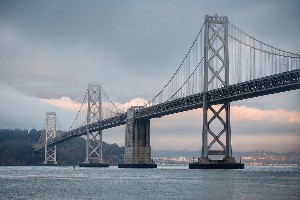
    The folks at the Metropolitan Transportation Commission (MTC) have something “exciting” in store for the residents of the Bay Area’s nine counties.  SB 595, authored by Senator Jim Beall of San Jose, will “give the voters the chance” to approve a $3 toll increase in all Bay Area bridges, except the Golden Gate Bridge.  The bureaucrats make it sound like an honor for the voters to be given such an opportunity to tax themselves. Apparently we should be thankful they granted us this chance to give the bureaucrats more tax money to waste.  We note also that the MTC voted recently to hike the toll increases faster than was initially suggested, and the measure was moved up to the June 2018 ballot, rather than the November 2018 ballot, so as not to “interfere with other local measures planned for November.”  The lust for “revenue stream” was just too much to resist.

    RM3, as the bureaucrats’ dream is called, includes a smorgasbord of impressive-sounding projects: expansion of BART’s railcar fleet to accommodate its extension to Milpitas and East San Jose; further extension of BART’s Silicon Valley service to downtown San Jose and Santa Clara; extending Caltrain to downtown San Francisco; expanding transbay bus services and AC Transit’s bus rapid transit lines; a freeway connector from northbound US 101 to eastbound I-580 in Marin County; improving the westbound approach to the Richmond-San Rafael Bridge and the I-580/Richmond Parkway Interchange in Contra Costa County; construction of a direct connector between I-680 and I-880 in Fremont; upgrading the I-680/State Route 4 interchange in Contra Costa County, the I-680/State Route 84 interchange in Alameda County, and the US 101/State Route 92 interchange in San Mateo; upgrades to the Dumbarton Bridge Corridor and improve Route 37 in Marin, Sonoma, Napa, and Solano counties; extend the new SMART rail system to Windsor and Healdsburg; expand San Francisco’s fleet of Muni rail cars; and adding more ferries to the San Francisco Bay Ferry Fleet.  The MTC notes that Bay Area voters have twice approved bridge toll increases for regional transportation as if it were an expected and obvious “no brainer” for them to do so again.

    A closer look at the improvements for RM1 in 1988 and RM2 in 2004 shows a definite and disturbing trend these regional transportation measures are taking.  RM1 funded the new Benicia Bridge, the Carquinez Bridge replacement, the new I-880/92 interchange, the widening of the San Mateo Bridge, the Richmond-San Rafael Trestle and deck, and the widening of Bayfront Expressway.  RM2 projects included the Transbay Transit Center, extending BART to Warm Springs, the e-BART extension to Pittsburg and Antioch and widening of Highway 4, the Oakland Airport Connector, I-80 HOV lanes, SMART rail extension, AC Transit Rapid Bus, San Francisco’s Central Subway, Transit Center upgrades and new buses, regional ferries, and the BART tube seismic retrofit.  See any pattern here?  RM1 ended up being closer to a user fee, where those who are paying for the improvements get some benefit from it.  RM2, on the other hand, as regional government began to creep into the Bay Area, clearly had an emphasis on mass transit, not road improvements, so it was motorists paying for benefits going to others.  This is otherwise known as taxes or wealth distribution—a recipe for bloat.  We are not surprised at some of the shabby accomplishments of RM2.  The Central Subway in San Francisco—millions over budget, years behind schedule, it will end in Chinatown rather than Fisherman’s Wharf (which would have been more logical), and riders will have to exit the subway in one spot and walk several blocks to catch it again.  Then there’s the Transbay Center, another bureaucratic fiasco.  It’s only a 4-story bus terminal but has gone from a budget of $1.189 billon to $2.259 billion.  It was supposed to be a state-of-the-art transportation hub and hailed as the “Grand Central Station of the West,” but already they are substituting cheaper building materials to cut costs, and The City had to cough up $260 million to bail out the project in an embarrassing effort to complete phase one of this project.  They say the entire project will be completed in 2024—we won’t hold our breath.  The Oakland Airport Connector is yet another example of failure and waste.  The estimated cost was $232 million, but the final cost was actually $484 million.  The cost of the AIRBART service used to be $3, but the fare for the BART extension is $6.  Even though Oakland Airport’s passenger numbers are rising as more airlines are flying in to Oakland, ridership on the Oakland Connector should be picking up, but it isn’t.  Ridership on the BART extension is lower than predicted as those going to Oakland Airport are increasingly choosing the convenience and cost savings of the voluntary economy (Uber and Lyft). 

    So, what about RM3—is it going to be more user-fee based or tax-based?  Of the proposed projects, it is estimated that 62% will support mass transit, 31% will go towards roads and highway improvements, and 7% will go for bicycle and pedestrian projects.  When 69% is pegged for projects that have little to do with actual road work and those paying the “fees” are not those receiving the benefits, a 31% user-fee rates an “F” in our book.  If history is any indication, we can count on continued waste of toll payer “fees” by the MTC.  Where did the money come from for the MTC to purchase the palace at 375 Beale Street that is now the new headquarters for itself and other regional agencies that it rents out space to?  Toll fees.  Even an audit report by the State Auditor’s office questioned why the MTC bought a building that was twice the size of what it had before in Oakland.  The report also noted that the financial risk of being unable to repay all of the toll revenues significantly increased in May 2013 when the Bay Area Headquarters Authority announced plans to convert 101,000 square feet of the building into an atrium and building support space.  Since when was the MTC given the authority to jump into the real estate business and become a commercial landlord? Furthermore, by what right did the MTC invest toll revenues in risky ventures like interest rate swap investments?  In 2002 the MTC made an interest rate swap exchange deal with a Wall Street firm named Ambac, which was supposed to save the MTC millions of dollars for the toll payers.  Originally touted as a model way to obtain a marginally lower interest rate, after the financial meltdown in 2008, the MTC was forced to pay $104 million to cancel its interest rate swap with Ambac.  San Francisco Chronicle columnists Matier & Ross noted, “If you’re a bridge commuter, this might give you road rage—about a year’s worth of toll hikes, or $120 million thanks to a bond-credit swap gone bad.”  As a public agency entrusted with millions of dollars of toll fees, wasn’t the MTC supposed to act like a guardian of the public’s money and safeguard it carefully?  Is there any compelling reason to believe the MTC will be any more fiscally responsible  with the “fees” collected from RM3 than it was with RM1 and RM2?

    We must point out one more disturbing trend in these regional measures that are popping up with more frequency lately.  RM1 and RM2 were only voted on by the voters in 7 Bay Area counties; however, RM3 will be voted on in all 9 counties (Napa and Sonoma will now “get the chance” to vote which they didn’t get earlier), and the 50% + 1 vote required majority will apply to all votes cast in all 9 counties.  Never mind the fact that in the last regional ballot measure ($12 parcel tax to “Save The Bay”), 4 of the 9 Bay Area counties did not get the required 2/3 vote to authorize the tax, yet it became the law anyway in all 9 counties.  So much for counties being the legal jurisdictions which answer to the voters.  Of course it’s the rural counties located furthest from the heavily urbanized counties like San Francisco and Santa Clara that are least likely to approve additional taxes and “fees,” but they’ll get stuck paying them anyway.  Never mind the fact that they are calling this extraction a “fee,” rather than a tax, which allows the measure to pass with only a simple majority rather than the 2/3 requirement for a tax when the largest chunk of the extraction will not go towards the roads.  Clearly regional government with its appointed bureaucrats and army of highly paid consultants is running amok in the Bay Area—and getting more powerful with each election.

    Lastly in the huge and well-funded by special interests propaganda campaign that will be hitting the Bay Area over the next few months touting the benefits of RM3, you will hear little, if any, mention of the $1 million of bridge tolls which will go towards the creation of an Independent Office of the BART Inspector General.  After the first year of operation, the Bay Area Toll Authority “may increase the amount of funding allocated for this purpose.”  Why are we not shocked that more tax money collected needs another set of bureaucrats to oversee things?

  • The Anti-North Dakota

    The Anti-North Dakota

    Never content to rest until San Francisco’s government runs every aspect of our lives, supervisors Malia Cohen and Sandra Fewer recently requested the formation of a municipal city bank task force to study and advance the idea of a San Francisco public bank.  The idea has been around since the financial crisis of 2008 and is catching on more these days with the problem of legalized recreational pot in California and banking laws like the Bank Secrecy Act of 1970 that obligate financial institutions to report suspicious activity, which includes pot financial transactions that are still illegal under federal law.  While it is understandable that the new law has created a problem with the incompatibility of current banking laws (a problem created by government), is it really necessary for one of the most bureaucratic bureaucracies in the nation—if not the entire planet—to stick its big nose into another industry?  The politicians think so, and their hearts are aflutter with even the mere thought of San Francisco becoming the first city in the country to launch a government bank. 

    The reasons touted for the necessity and advantages of a San Francisco city or county government bank are many.  First and foremost, private banks are motivated by profit (evil), while a public bank is non-profit (angelic), which means lower interest on loans to borrowers.  Secondly, the goal is to get away from the big banks, which are heavily invested in fossil fuels, a political no-no on the left.  The return of profits would go back to The City, not greedy shareholders, so it could mean lower costs for capital projects, which are usually funded by issuing debt through private banks.  Supervisor Fewer noted that a government bank will insure more social responsibility such as more loans to small businesses and more “affordable” housing.  A San Francisco government bank would also allow The City to increase its financial services and “help” residents and “underserved populations.” 

    Currently the only government bank in the country is the state-owned and operated Bank of North Dakota (BND), which has been around for almost a century.  It is often cited as proof that a government bank can operate and still be profitable; thus BND is held up as a model to emulate.  All State of North Dakota funds are constitutionally required to be deposited in the bank.  Citizens may make deposits in the bank, but this is a small part of the bank’s business.  The bank only has one location and does not offer ATM services.  The BND partners with more than 100 North Dakota community and regional financial institutions that provide loans to local businesses and citizens.    While the bank is generally given high marks for being well-run and helping North Dakota maintain a local banking sector that is doing better than its neighboring states and the national average, it should be noted that much of its below-market lending is to the fuel fossil industry, and much of its credit risk has been shifted to the federal government through its federally guaranteed student loan program.

    What has worked quite well in the heartland of America would likely be a disaster in San Francisco.  For one thing, BND has purposely made it a point not to compete with the voluntary banking sector, but rather to partner with voluntary banks on various projects.  This would not be the case in San Francisco, where there would be a big push to get rid of all the other banks in The City.  Secondly, for the most part, BND is run on a for-profit basis.  The bank evaluates lending according to how likely the loans are to be repaid.  As the BND’s President and Chief Executive Eric Hardmeyer noted, “If you are going to have a state-owned bank, you have to staff it with bankers.  If you staff it with economic developers, you are going to have a very short-lived very expensive experiment.  Economic developers have never seen a deal they didn’t like.  We deal with that every day.”  Clearly, politics, political appointments, “public-private” cozy arrangements, and cronyism would determine who would be running a San Francisco government bank—and how the taxpayers’ money would be disbursed.  It goes without saying that a government city bank would require a whole new “Department of Banking” in San Francisco’s already bloated government—as if over 41,000 (and growing every month) city employees weren’t enough already.  More foot soldiers would be needed to staff yet another bureaucracy. Already, the Tax Collector’s office, which does all the banking and investment activities for The City, recently hired a new staff member to help study a public bank and other investment strategies.  An excuse to hire even more employees is a tantalizing dream for those who want San Francisco government to be even more powerful.  The statists would use a public bank to allow The City to increase its financial services to, as always, select residents.  During the last fiscal year, The City spent $3,771,663 on financial services for “underserved populations,” including $1.5 million for a college savings program called “Kindergarten to College,” $832,000 for smart money “coaching,” and $756,000 for “technical assistance” to small businesses. As of July 2017, there were $86 million in loans outstanding for the current programs.  The report prepared for Supervisor Fewer pointed out that the current programs “could be enhanced or added to though the level of funding that could be made available for such purposes from City funds now deposited with The City’s commercial banks could significantly expand funding available for such purposes.”  “Expand” is an understatement if we’ve ever heard one—having a City bank would open the floodgates to fulfilling every social dream of the bureaucrats.  Short of having control of the printing press for money printing, a public bank is a statist’s Nirvana with untold possibilities.  And, as we’ve seen in other areas like transportation, energy, and education, The City’s leaders have done everything they could to drive out the voluntary sector until the government has a complete monopoly on all services.  Creating a public bank would be an ideal opportunity to rid The City of the evil, private banks.  OK, banking isn’t exactly laissez-faire these days, but would a government-run-and-owned bank be any less susceptible to politics rather than sound financial decision-making?  We think not.  Worse still, at least with private banks which make poor loan decisions and are facing default, they have to ask for a bailout from the government (unfortunately often given), but with a “public” bank, there would be no asking for bailouts, and the taxpayers, as always, would get stuck paying for the bureaucrats’ mistakes.  The pressure in a leftist city like San Francisco with embedded cronyism to fund every social program in town with new-found “free” money would simply be too great to pass up.  Rather than looking to expand its “carbon footprint” in the lives of its residents, San Francisco’s government should return to basics and save its taxpayers from one more misguided way to “lead the nation.”

  • True Colors

    True Colors

    Recently every board member of the San Francisco Board of Education demonstrated what hypocrisy in action means.  The entire Board of Education unanimously rejected an application for a new KIPP elementary charter school set to open in the Bayview next year.  Never mind that hundreds of parents, teachers, and students showed up in support of the charter school.  Never mind, also, that a large chunk of the KIPP supporters were African-Americans from the Bayview, which the Board purportedly wants to help, but when push comes to shove, you can always count on government bureaucrats to vote for the status quo and less individual choice.  After all, they do know better. 

    The Board’s commitment to traditional government schools and bias against charter schools or any kind of “school choice” was obvious.  “I worry regularly that as we start chipping away at the system of traditional public schools, that we start chipping away at those other options and opportunities that we are committed to providing to our young people,” lamented Board President Hydra Mendoza-McDonnell.  “We have no choice but to find a space and place for them,” chimed in Commissioner Shamann Walton, and he also noted that charter schools encroach on the San Francisco Unified School District’s per pupil funding.  “Revenue stream”—always an issue where government bureaucrats are involved—is clearly more important than the students themselves.  The Board also used the phony excuse of suspension and expulsion policies to cut into KIPP even though KIPP has had no expulsions in the last two years.  The rigorous curriculum was also blamed for the most challenged students being “counseled out,” and one commissioner complained that “There is no makeup policy if you miss the assignment and get a zero.”  Imagine that?!  A school with high academic standards—is that so terrible?  The fact that more than 150 parents signed the petition expressing an interest in enrolling their children in the proposed KIPP school indicated that parents were looking for a school with higher quality options, yet it was precisely the higher academic standards and lower tolerance for misbehavior and disruption that upset the Board the most.  Clearly the Board’s priorities are misplaced.

    So, what exactly are charter schools and why do our government bureaucrats object to them so much?  How are they different from traditional government schools?  Charter schools are in fact government schools and are tuition-free, open to anyone, and no religious teaching is allowed.  What makes them different from traditional government schools is how they are managed.  They are independent and are not owned by the central school board, so the local school district cannot tell them what kind of curriculum to use, when to open or close their doors, whether they can require uniforms or not, and whether to hire a for-profit company to manage the school.  Most important, charter schools are not required to hire union teachers.  In the 43 states that do allow charter schools, approximately 15% of the nation’s 6,900 charter schools are for-profit.  What also makes a charter school different from a traditional government school is that it has a limited contract, usually 3-5 years, to prove itself, and the entity that authorizes the charter school reviews the school’s performance, typically based on test scores, graduation rates, and the school’s finances.  The charter school must really “perform” just like any normal business in the voluntary sector, or it will be shut down—unlike traditional government schools which go on and on for decades, whether they “perform” poorly or not.  Another difference is that traditional government schools receive about 30% more funding per pupil than charter schools, mainly due to the fact that charters don’t receive the revenue from school construction bonds like traditional government schools.  Lastly another difference is that traditional government schools provide school busing and charter schools do not, so the parents have to arrange transportation to and from charter schools if they want their children to attend.

    Strangely enough, even with 30% less funding, no “free” transportation, and no guarantee that the schools will even be around in a few years, a study done by Stanford University found that charter schools perform on average about the same or better than traditional government schools.  So much for the argument we always hear that California is 46th in the nation in per pupil funding, and that’s why the government schools perform so poorly (“If only we gave them proper funding…”).  In fact, the real reason that traditional government schools don’t—and never will—measure up to schools that parents actually choose for their children is the one-size-fits-all approach treats all of its “customers” the same and not as individuals.  Inevitably in the end, by trying to appeal to all, children with special needs, talents, and interests get lost in the shuffle to provide “equal opportunity to all.”  Innovation is crushed and standards are definitely lowered.  No matter how much money is thrown at government schools—and especially traditional government schools—the outcome is doomed.    

    Charter schools, even though fed by mandated compulsory education laws, at least offer parents significant advantages over traditional government schools.  They give more choices and alternatives to children who don’t thrive in the one-size-fits-all setting.  The neighborhood school may be too small or too large to have the right academic focus for some children.  Charter schools also encourage much-needed competition since the money tends to follow the student, so charter schools must “perform” or risk losing their “customers” and being closed down.  Most important, charter schools can decide what kind of student they are catering to and focus on developing innovative ways to teach.  While they can’t pick and choose what students will attend—a lottery system is used when a charter school gets more applications than open slots—they can target a particular market, and parents can pick accordingly for their child.  And because the parents have chosen a particular charter school, the chances are greater that parents will have a stronger commitment to make the students succeed by increased parental involvement.  

    The refusal of the San Francisco Board of Education to acknowledge the obvious benefits of charter schools reflects an obsession with “equal opportunity.”  Because charter schools target a particular type of student, not all students will be able—or want—to attend a particular charter school.  The bureaucrats view this as discriminatory and unfair and therefore a negative.  However, children from low income families have tended to languish in traditional government schools, and the strongest support for charter schools has come from parents who have never gone beyond a high school education, and right now charter schools are tilted toward serving low income children.  Why won’t the Board of Education give those at the lower end of the economic spectrum a fighting chance?  Is it possible that the parents themselves are smarter than the elites?

  • Paying for Parks You Aren’t Allowed to Use

    Paying for Parks You Aren’t Allowed to Use

    A public park in San Francisco’s SOMA district has been sitting closed behind a fence for almost all of 2017, with chain link fence segments installed in February replaced with a $145,000 black iron barrier in June.

    Because, you know, if those in power didn’t do things like saying they’re going to use taxpayer money for improving parks, then “improve” them by closing them so you can’t use them, it would create a public health risk – people seeing a well-functioning government might die of shock! Freedom is dangerous.

    The San Francisco Examiner says that District 6 Supervisor Jane Kim is planning a public hearing in January, where she will no doubt have to try and appease the neighborhood bullies who want The State to police who uses a public park even if that means keeping it perpetually closed so that nobody gets to use it. Since she already caved to them by pushing for the appropriation of the stolen funds that paid for the more permanent barrier around the park, they may now believe they can get her to throw away the key.

    For those with a dark sense of humor, the Examiner story’s comment section provided some (beyond that inherent in the news item itself):

    “I live nearby”, wrote one apparently cowering local NIMBY in defense of the status quo. “It is far too dangerous to remove the fence. We agitated for months to get it installed, and the crime that came with the park largely stopped or went elsewhere.”

    Well, yeah, crime usually does go down in a location when there are virtually no potential victims due to the fact of it being closed! If you close the amusment park, you get fewer injuries on the roller coaster too. If you close the roads, you get fewer road accidents.<!–break–>

    “Sure would like to know who those ‘neighbors’ are”, the NIMBY continued. “They must not live around or close to the McCoppin Hub.” Well probably not, if you’re referring to homeless people who used to spend time in the park – it’s a safe bet they can’t afford to live indoors in your neighborhood, so when you neighborly types got the place where they had sought sanctuary closed, it wouldn’t be surprising if they were displaced. (Or they could simply be living a few blocks away in front of the home or business of someone you might actually acknowledge as a neighbor.)

    Yours truly posted the following comment:

    “What insanity. If you think people should be forced to pay for a park that they aren’t allowed to use, please explain how you think this is fair.

    Homeless people are also forced to pay taxes, both directly and indirectly. Taxes are part of the reason homes are so expensive. Is the justification for these taxes to enable people at City Hall to collect six-figure salaries and nice benefits while parks sit closed, surrounded by $145,000 fences built with stolen tax dollars, and thousands of people live on the streets without places to call home?

    How does it feel for some of you to act like little Donald Trumps in your own neighborhood, supporting a wall to keep the “bad hombres” out (while costing everybody else money and freedom at the same time)?”

    The question felt appropriate, given that Donald Trump and his immigration policies are not exactly popular in SOMA, yet someone going only by the inhospitable attitudes expressed by some residents on local land use issues like this might easily guess otherwise.

    I wonder how many of those residents have noticed the resemblance between their own reactions of fear and animosity toward those who are strangers to them, and the xenophobic policies espoused by Trumpian nationalists.
     

  • Time to Act: Help Repeal California’s Top 2 Law

    Time to Act: Help Repeal California’s Top 2 Law

    If you ever want to see a Libertarian elected in California, your action is needed to repeal the restrictive Top 2 law that has made it much more difficult to get on the ballot.

    Click here to print and sign the petition
    or visit https://stoptop2.com to donate, become a circulator or subcribe to the newsletter.

    In 2010, the California legislature introduced a ballot measure and duped the voters into restructuring California’s primary elections into a single open primary where only the top two vote-getters earn a spot on the ballot. Being as the single primary is nonpartisan, this means that it is possible for two candidates with nearly the same views to end up on the ballot as the only choices. This is what happened 2016, when voters in the general election were forced to choose between Kamala Harris and Loretta Sanchez— two democrats— for U.S. Senate. Under the Top 2 system, even write-in votes are not allowed in the second round1, leaving many voters without a choice that represents them. In fact, over 16% of voters abstained from voting in this race entirely2.

    In order for the Libertarians or any other smaller party in the state to have a chance of getting elected in California, we need to act fast to repeal the Top 2 law. Tom Palzer, a Republican in San Bernadino County, is already working to accomplish this. The Foundation to Stop Top 2 has started a petition for a ballot initiative for a direct repeal of CA Proposition 14 which created the law, and this has seen broad support from most parties throughout the state. However, in order to get an initiative for a constitutional amendment onto the ballot, we need to reach a minimum of 585,407 signatures3 in support of the petition. That means we need Libertarians, Greens, Democrats, Republicans, Peace and Freedom, American Independents, and anyone who wants to see more choice in our state elections to support this initiative and sign the petition.

    Please, if you haven’t already, take the time to print and sign the petition today. We also need circulators to volunteer their time to gather signatures. If you can help in any way, please contact san.francisco.coord@stoptop2.com and check https://stoptop2.com for more information and ways to contribute.

    Please help make the future of California a little bit brighter!

    1. http://blogs.findlaw.com/california_case_law/2011/09/court-upholds-prop-14-bans-on-write-in-votes-unqualified-parties.html
    2. Based on records from California Secretary of State, see: http://elections.cdn.sos.ca.gov/sov/2016-general/sov/2016-complete-sov.pdf and http://elections.cdn.sos.ca.gov/sov/2016-general/sov/06-sov-summary.pdf.
    3. Minimum number of signatures required by the Secretary of State guidelines, see page 5: http://elections.cdn.sos.ca.gov/ballot-measures/pdf/statewide-initiative-guide.pdf

  • More Free Stuff

    Supervisor Jane Kim is at it again. Not content to rest on the laurel of her “victory” of making San Francisco City College tuition-free by introducing last year’s successful ballot measure W (dubbed the Mansion Tax), she’s found another way to make San Francisco more “affordable.” She recently asked the city controller to analyze the costs of providing universal childcare in San Francisco, and she plans to introduce a ballot measure for the November 2018 election that will offer “affordable” childcare for all. Kim wants a system that would reduce childcare costs for San Francisco families to just 10% of their income. According to the Children’s Council San Francisco, a beneficiary of the largesse, the average cost of full-time childcare for families with an infant in San Francisco ranges from $16,800 to $22,800 per year, and for 4-year-olds, the range is $14,400 to $18,000. San Francisco’s current universal preschool program is not truly universal—yet. While funding covers 100% of the tuition for low-income children, middle and upper income families get only 25% off the cost of childcare. Grandstanding for the proposed measure, Kim said, “If we truly believe that families are the backbone of our city, then we all have to do what we can to hold onto them. We can do better, and we have to.”

    The City’s involvement in the childcare business goes way back to 1991 when San Francisco voters approved the creation of the Children’s Fund, which was funded by a property tax set-aside of 3 cents per $100 of assessed property value. This fund provided services for some childcare programs, as well as health services, job training, social services, and delinquency prevention programs. In 2004, The City’s voters approved the creation of the Public Education Enrichment Fund (PEEF), which allocated one-third of the set-aside to the Preschool For All (PFA) program for 4-year-olds. The City went deeper into the childcare business in 2014 with the passing of Prop C, which increased the set-aside to 4 cents per $100 of assessed property value, extended the set-aside to 2041, and extended the age group for “children” up to age 24. (The LPSF was the official opponent to Prop C and also the only voice raised against it.) Notably Prop C extended funding for universal preschool to include 3 to 5-year-olds, but gave priority to 4-year-olds, and The City could now use the funding for programs for children from birth to 3 years old. The proponents’ argument signed by the Mayor and every member of the Board of Supervisors said, “We can’t stop now. We need to do everything we can to provide high quality education and enrichment opportunities for all of our children and youth, make San Francisco livable for our families, and ensure that those with the most need are given the best opportunities to thrive.”

    Indeed, they can’t stop now. As the premise has already been touted and widely accepted that those little creatures now belong to society as they are our children, why should the parents be the ones responsible for providing for the children’s needs? As Supervisor Norman Yee, also a cosponsor of the measure, pointed out, “Whether the child is a 4-year-old or a 3-year-old or a 1-year-old, it doesn’t really matter.” Once a nice-sounding idea creeps in, all the statists need is a tiny little opening to get started, and the idea comes to fruition in stages. First the Children’s Fund, then PEEF, then PFA, and now finally “affordable” childcare for all. If “affordable” childcare turns into anything like “affordable” housing, then it will definitely be time for The City’s residents to hide their checkbooks from the government.

    Then there’s the unpleasant business of how to pay for these freebies. Since The City can’t print money out of thin air like the federal government, it will have to take it from someone. Supervisor Kim hasn’t identified a firm “revenue stream” (tax) for her proposal yet. She has said that it may be modeled after an Alameda County ballot measure being prepared for the June 2018 election which is asking the voters to approve yet another sales tax increase. Amazingly, San Francisco voters have rejected the last two sales tax ballot measures, so it will be interesting to see how Kim’s measure fares if it involves a sales tax increase. There surely will be a major “outreach” (propaganda) campaign to “Save The Children” or a catchy slogan with the word “Children” in it and in the ballot measure’s title to prey on the voters’ emotions.

    If this measure makes it to the ballot box, you can be sure the LPSF will be opposing it. In the first place, one of the main reasons childcare is so expensive is the oppressive list of regulations and licensing requirements governing setting up and maintaining a childcare center. That alone deters many potential childcare providers from even attempting the costly and frustrating process, which then limits the supply and pushes costs upwards. The list of regulations includes such requirements as “Must have 35 square feet of indoor space and 75 square feet of outdoor space per child,” “Hot water must be kept between 105 degrees and 120 degrees,” and “Signs must be posted at the entrance of the childcare center that provide the telephone number of the local health department and information on child passenger restraint systems.” More important, since when is it the proper role of government to provide any childcare at all? Who is responsible for the welfare of each child—the government or the parents? Who cares about the child more—the government or the parents? Due to the wide availability of contraceptives these days—they even distribute them to middle schoolers in government schools—is there any good reason for the parents not to assume the full cost of providing for their children which they chose to have? Did they not know that childcare would be one of the major costs of choosing to have children? If they chose to reproduce, why should their neighbors be forced to help pay for their childcare costs? In the end, does providing yet another free ride encourage personal responsibility or the forced generosity of others?

  • A Thorn in Their Side

    The next time you head down to The Embarcadero you may notice that Justin Herman Plaza will now be called Embarcadero Plaza.  While San Francisco activists have no Confederate statutes to dismantle, the desire to “clean house” in a historical sense is sweeping the country, and San Francisco officials don’t want to be left in the dust.  In July Supervisor Aaron Peskin introduced a resolution proposing to temporarily rename the plaza, citing Herman’s role in the displacement of minority residents, until a new replacement name can be decided on.  The rest of the Board of Supervisors quickly supported the resolution by voting unanimously to rename the plaza.  The late poet Maya Angelou, who was the first black female streetcar operator in San Francisco, is the name mentioned most often as the likeliest candidate to have the plaza named after her.

    Justin Herman certainly earned a place in San Francisco history, and it’s easy to see why current government officials are anxious to distance themselves from his legacy.  He was the person most responsible for the Western Addition redevelopment fiasco that decimated the predominately black neighborhood.  Herman was appointed Executive Director of the San Francisco Redevelopment Agency in 1959 and stayed in that position until his death in 1971.  Herman had extensive experience working with the federal government and knew all the tricks to leverage more federal funding for redevelopment.  While the Fillmore was declared “blight” in 1948, and the first phase began in 1956, it was Justin Herman who really got the (wrecking) ball rolling in 1964.  He expanded the redevelopment area to 60 square blocks using the government’s power of eminent domain to purchase Victorian homes and buy out local businesses.  According to city records, 883 businesses and 4,729 households were forced out of the area, and 2,500 Victorian homes were bulldozed in one of the largest urban renewal projects in the western half of the United States.  Employees of the agency went door to door in the Western Addition and gave the head of each household a certificate of preference that stated they would be given preference for future housing built in the area.  However, in what reminds us of a similar travesty in the Kelo case in Connecticut 12 years ago, broken promises resulted in large patches of the Western Addition lying vacant for years and, in some cases, decades, so the certificates of preference became worthless.  The cost of all this turmoil:  $50 million.  And all this time Herman was building a little kingdom of his own at City Hall as the number of bureaucrats working for the San Francisco Redevelopment Agency mushroomed from 60 before he took office to 462 after his death.  Is it any wonder that Herman has fallen from grace as we look back?

    Unfortunately renaming the plaza will remove this piece of shameful San Francisco history from current and future generations’ opportunity to learn about the mistakes of the past.  With his name gone, there will be no reminder of the misery he created and why government shouldn’t be in the housing business in the first place.  Just because a piece of history is unsettling—even embarrassing—is that a good reason to pretend it didn’t happen?  Are today’s members of the Board of Supervisors learning from the mistakes of the past?  Judging from the number of schemes they support—from “affordable” housing to rent control to inclusionary housing requirements to zoning restrictions to a million and one developer requirements and fees—it looks like the current batch of supervisors is doing a better job of driving poor folks away from The City than Justin Herman ever did.  The African American community in particular has fared extremely poorly under current San Francisco housing policies, with the percentage of blacks in San Francisco dropping from 13.4% in 1970 to 6.5% in 2005 to 5% (or less) today.  Rather than passing symbolic resolutions trying to erase the memory of previous shameful governmental programs, the Board of Supervisors should recognize that “redevelopment” was nothing more than corruption, cronyism, and property rights abuse.  Another lesson to be gleamed from the entire program should be for residents to be wary of government promises to “be taken care of.”  Furthermore, one person alone could not have caused all this harm by himself, as there were plenty of other government officials who were also complicit in the whole misadventure.  Scapegoating serves no purpose and can never change the past.  Move on—and remember that past.

  • Guarding le Régime Moderne

    Guarding le Régime Moderne

    In 1798, Thomas Malthus predicted that population growth would lead to mass starvation. If things had continued as they did for thousands of years previously, he might have been right. Fortunately, the advent of the Industrial Revolution dramatically boosted productivity, and gains in productivity haven’t let up since. In recent times, global productivity has increased by an estimated 1.8% per year between 1964 and 2014. With improvements in technology and know-how, a single worker today can typically produce what it would have taken dozens to produce a few hundred years ago in the same amount of time, resulting in much better standards of living for most people than were the norm in Malthus’s era.

    A worker in the United States today earns more in 10 minutes, in terms of buying power, than subsistence workers, such as the English mill workers that Fredrick Engels wrote about in 1844, earned in a 12-hour day. Or to put it another way, “each farmer (in the United States) in 2000 produced on average 12 times as much farm output per hour worked as a farmer did in 1950.” In other words, to produce the same amount of output, less than 10% as many employees are needed in agriculture as was the case half a century ago. And that’s only over the past 50 years. Go back 200 years or more, and the gains are even more dramatic. While agriculture, once the occupation of 90% of Americans, has particularly benefitted from technological changes that enhanced productivity, many other economic sectors have seen similar increases.

    So how have gains in productivity affected government operations – law enforcement, for instance? How much more crime do today’s police departments prevent, with how many fewer officers, compared to their pre-Industrial counterparts?

    (more…)