
Category: Uncategorized

  • A vaccine mandate hides an ID mandate

    A vaccine mandate hides an ID mandate

    [NOTE: The author will be the guest speaker at November’s LPSF meeting!]


    By Edward Hasbrouck

    (Reprinted from PapersPlease.org)

    As we have long feared, and as has already happened in other countries, COVID-19 vaccination requirements are being used to impose unrelated ID requirements.

    There’s a difference between “unvaccinated” and “undocumented” — a difference that’s  gotten lost in some recent regulations and orders imposing “vaccination mandates”.

    Case in point: the San Francisco Department of Public Health.

    An order from the SFDPH  purports to require people entering indoor businesses or other indoor venues including anywhere food or beverages are served, gyms, and other “large indoor events”  to show “proof” of having been fully vaccinated against COVID-19.

    But proof of vaccination is not what the order actually mandates. Its only real mandate is a an ID mandate, and in practice its effects would be felt primarily by undocumented people (including vaccinated but undocumented people) who don’t have or don’t choose to show ID, not by unvaccinated people.

    Regardless of whether you’ve been vaccinated or whether you think other people should be vaccinated, the ID mandate hidden in this order, like similar ID mandates lurking in other “vaccination” regulations and directives, is a step backward for civil liberties. It is vulnerable to, and deserving of, Constitutional challenge.

    Here’s what the SFDPH order would actually require:

    The SFDPH order defines several acceptable forms of “proof” of vaccination including, among others, a paper vaccination card printed in blank by the Centers for Disease Control (CDC) and filled in by hand at a vaccination site, a photocopy of such a card, an image of such a card displayed on a smartphone, a QR code displayed on a smartphone, or “a written self-attestation of vaccination signed… under penalty of perjury.”

    None of these, with the possible exception of a declaration under penalty of perjury, provides more than the flimsiest evidence that someone (not necessary the person presenting the card or paper copy or showing the image or QR code) was vaccinated. None of them provides “proof”.

    Anyone could write anything on a blank CDC card, photocopy such a card, copy an image or QR code, create a QR code, borrow a smartphone on which an image or QR code is already stored, or edit such an image to fill in the blanks or change the name or other information.

    The most secure of these forms of evidence, at least in terms of the risk taken by someone using it to support a false claim to have been vaccinated, would appear to be a self-certification under penalty of perjury. It’s not clear what law would be violated by changing the name in an image of a vaccination card. And whatever might be said — in seriousness or in jest — about the possible penalties for misuse of Photoshop, the penalties for perjury are probably quite a bit more serious than those for altering an image of a vaccination card.

    But while the SFDPH order defines a self-certification as “proof” of having been vaccinated, Appendix B to the order defines a variety of venues and events for which a self-certification of having been vaccinated will not be accepted, but other trivially produced forms of evidence of having been vaccinated will be accepted.

    There are other inexplicable quirks in which forms of evidence of vaccination are and aren’t acceptable under the SFDPH order.

    The most “official” and widely-recognized record of vaccination is the International Certificate of Vaccination or Prophylaxis (“yellow book”), a longstanding global standard adopted by the World Health Organization (WHO) pursuant to international treaties. These can be used to record vaccinations against COVID-19, and in some countries including Germany they are the primary vaccination records being issued to individuals. In the US, WHO-standard blank “yellow books”  are issued by the CDC and distributed to health care providers and the public by the US Government Printing Office.

    The SFDPH doesn’t include the CDC “yellow book” in its list of acceptable forms of “proof” of having been vaccinated (although international health regulations require its acceptance), but does include any “similar documentation issued by another foreign governmental jurisdiction.” So a WHO-standard yellow book from any other country is acceptable, but not one from the US CDC. Is this deliberate? If so, why?

    But that’s not all, and that’s not the worst feature of the SFDPH order.

    For the venues and events defined in Appendix B to the order, “Covered Businesses are required to cross-check proof of Full Vaccination for each patron against a photo identification.”

    What does this mean? Members of the public and businesses charged with enforcing the order are left to guess. Despite detailed (albeit, as discussed above, arbitrary and unexplained) definitions and specifications of acceptable evidence of vaccination, the SFDPH order contains no definition at all of “photo identification”.

    Responsibility for enforcing this order is assigned to businesses (i.e. to their frontline staff) and operators of venues and events, none of whom have any particular expertise or qualifications to assess claims or evidence of vaccination or identity. There’s no reason to expect such a system to be any more effective at controlling who is actually allowed to enter venues subject to the SFDPH order than the existing and widely flouted rules purporting to require evidence of age to purchase alcohol, tobacco, or other items.

    Whatever is meant by the mandate to “cross-check proof of Full Vaccination… against a photo identification,” it is likely to imply a requirement to remove face masks, which (as at TSA checkpopints and other places where masks must be removed for ID checks) poses a clear health risk.

    As is typical of government orders requiring individuals to show ID to private businesses, the SFDPH order places no restrictions on the ability of those businesses to scan ID credentials (which they are likely to start doing just to be able to show that they have complied with the order to make all workers and patrons show ID) and to retain, use, or monetize the databases of personal ID data they have thus compiled. There are no requirements for securing this sensitive personal data or disclosing how it has been used or with whom it has been shared.

    Do you want every restaurant, bar, club, gym, or theater you have attended to have a copy  of your passport number in an insecure  jury-rigged database? Or to be able to make a little extra money off each customer by selling this information to a commercial data aggregator — without telling you they have done so?

    The SFDPH order also applies to events open to the public and held at indoor public forums operated by government agenccies, to which entry is a right. If someone reserves a room at the library or rents the Civic Auditorium for a political meeting, should the government, as operator of the venue, be allowed to require that attendees identify themselves, and keep a record of who attended? We think not.

    While the SFDPH order allows, or at least originally allowed, self-certification of vaccination in some circumstances, it doesn’t explicitly allow self-certification of identity. In the absence of any definition or qualification of “a photo identification”, it’s at least arguable that the requirements of the SFDPH order could be satisfied by showing a self-certified photo ID, such as a photo with your name or signature written on the back. We’d be interested in hearing from anyone who has tried to gain entry to a covered venue or event with such self-certified photo ID. If you are turned away, what recourse do you have, if any?

    It’s particularly irrational and unfair that the SFDPH is requiring evidence of vaccination to be “cross-check[ed] … against … photo identification”, when no identification at all has been, or is being required by the SFDPH to receive a COVID-19 vaccination.

    As the City and County of SF says, “You can get a free COVID-19 vaccination regardless of your immigration status” and without ID. That’s as it should be. Undocumented people are at just as much risk of infection themselves, and pose just as much of a risk of infection to others, as people who have and choose to show ID.

    The effect of the ID mandate is that undocumented people who have been vaccinated against COVID-19 by the SFDPH at its vaccination sites are prohibited by the SFDPH, purportedly on the basis of their vaccination status, from patronizing or working in restaurants or other covered venues. There is no rational relationship between the ID provisions of the order and any health purpose.

    Vaccinated but undocumented people are barred from working in, patronizing, or attending events at restaurants and many other indoor venues in SF. Unvaccinated people with acceptable ID can get into those same venues by copying and/or making trivial changes to a vaccination card or image.

    The burden of the SFDPH order will fall primarily on vaccinated people who are undocumented or who don’t choose to show ID, not on unvaccinated people.

    A variety of people don’t have ID — especially in a dense city like San Francisco with many transportation options that don’t  require a drivers license — or don’t choose to show ID. Many of them are vaccinated against COVID-19.

    Having been vaccinated isn’t proof of not being infected or not being infectious. A significant percentage of current COVID-19 cases in San Francisco, as throughout the U.S.,  are among people who have been vaccinated. But neither is having or showing ID proof of not being infected or not being infectious. Government-issued ID is not a magic talisman against COVID-19 and does nothing to enhance the effectiveness of any vaccine. There is no reason to conflate ID with vaccination, and good reasons to keep them separate.

    Because the SFDPH order applies to workers as well as patrons in any of the venues to which it applies, it constitutes (or purports to constitute) an additional bar prohibiting undocumented people — even if they are vaccinated — from working in restaurants or other covered venues. Was this really what was intended? Or it is just another example of the inevitability of unintended  collateral damage whenever ID requirements are imposed?

    Supporters of universal ID requirements have long been quick to seize any opportunity to embed ID requirements in short-term rules that can then be made permanent. COVID-19 vaccination requirements, no matter how well intended, are being used as the latest such pretext. Officials genuinely concerned with public health should resist any attempt to hide ID requirements or ID-linked surveillance in vaccination rules.

    This is just one case study of the “health” orders in San Francisco. How widespread are vaccination rules that are Trojan horses for ID rules? What do they say? Have they been challenged?

    We’re interested in hearing about other “vaccination mandates” hiding ID requirements (please share links in the comments) and in hearing from any attorneys interested in working on challenges to this new flavor of back-door ID mandate.
  • Go ahead and engage in vote-buying, just don’t be hypocrites

    Go ahead and engage in vote-buying, just don’t be hypocrites

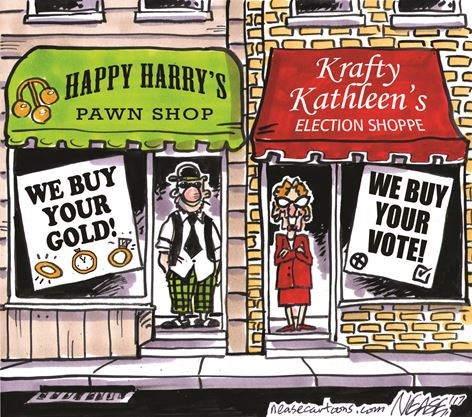
    I heard the same thing about the controversial new Georgia voting law (the “Election Integrity Act of 2021”) that most of you probably have – that it criminalizes giving water to people waiting in line to vote. That part is what many in the media seem to want to focus on. Taken out of context, it definitely sounds like the GOP carrying vote suppression to an utterly petty level.

    Then I read what that part of the legislation, which applies within 150 feet of a polling place or within 25 feet of any voter at a polling place, actually says:

    “No person shall solicit votes in any manner or by any means or method, nor shall any person distribute or display any campaign material, nor shall any person give, offer to give, or participate in the giving of any money or gifts, including, but not limited to, food and drink, to an elector.”

    You remember Brad Raffensperger? The Republican secretary of state in Georgia who defended the integrity of the election results that showed Biden winning the poll in that state and resisted pressure from the president when Trump phoned him and asked him to “find” over 11,000 votes? Well, Raffensperger promised last year that the state would crack down on “line warming,” or handing gifts to people waiting in line to vote as a way to “inappropriately influence voters in the crucial final moments before they cast their ballots.”

    So yeah, Republicans trying to suppress the vote, and Republicans trying to stop shenanigans by their opponents – the two go hand in hand, one providing cover for the other. But the deeper truth is that both sides are trying to rig the system in their favor as best they can. Certain voters in certain areas are generally presumed (with lots of evidence) to be likely Democrat voters. The Republican Party is trying to reduce voter turnout in these areas by making it more difficult to vote, while the Democratic Party is trying to increase voter turnout in these same areas by, among other things, bribing voters. The media mostly understands the first half of this dynamic, and reports it as such, but ignores or misses the flip side of the coin. Free water and snacks may not seem like much of an incentive to vote, but if someone’s on the fence, a little detail like that can make a difference. And in a tight race, every bit of turnout matters.

    Again, both halves of the establishment are trying to rig the game in their favor, they just have different ways of trying to cheat. And don’t think for a minute that this is just about whether people waiting to vote can be given water. That’s just media spin. The real question is whether anything of value can be used to lure people to the polls. If gifts of bottled water are allowed, it won’t stop there; the envelope will be pushed. Democratic operatives will supply as many inducements to vote in areas and among populations where the vote tends to swing their way as they legally (and sometimes maybe illegally) can – snacks, sandwiches, whole chickens, tote bags, gift certificates, etc., so that more of “their” people will make it to the polls.

    Don’t get me wrong though – I oppose this Georgia law. Attempting to influence voters should not be criminalized, regardless of whether the lobbying occurs right before they vote or at some other time. Ditto for vote-buying. Your vote belongs to you, and true ownership isn’t only about the right of use, it’s also the right to transfer the thing in question to another person or group of your choosing. If you can’t sell your vote, in a sense it’s not really yours.

    Politicians and election commentators seldom acknowledge this, but – especially for someone trying to make ends meet – getting the equivalent of $5 (about the price of a bottled water and a snack) or $20 or $50 or whatever from somebody hoping you’ll vote the way they want you to, may have more of a direct, positive impact on your life than any votes you as one individual cast in the voting booth.

    For some people, a decision to sell their vote (or to receive something of value, however slight, from someone seeking to influence how they cast it) might be not only rational, but a more honest reflection of their values and priorities than any selection available to them on the ballot, and thus a more legitimate expression of democracy.

    Only let’s call it what it is, and not pretend this latest hullabaloo is motivated by a sudden humanitarian concern for grandma’s physical nourishment while waiting in line to vote, from people who never showed any similar interest in her well-being when she was waiting in line at the DMV, or sitting around at court after being called for jury duty.

    Attempted vote-buying is nothing new. The reason many people vote for the politicians they do in the first place is because the pols promise free stuff. If they’re allowed to get votes by promising “free” health care, “free” education, “free” border walls, “free” Covid relief checks, etc., after they’re elected, why shouldn’t they be allowed to get votes by handing out freebies before the vote, and using their own resources to pay for them, instead of stolen tax money? That way voters have a chance to get something concrete, in advance, that is at least a bit more ethically sourced, and they don’t have to just rely on politicians’ promises. It would be an effective way of transferring money from the rich (big money donors) to the poor (low-income and minority voters) without coercion and without government taking the lion’s share before the money gets to those for whom it’s purportedly intended.

    If you’re recoiling in horror from the idea of buying and selling votes, you can rest easy. It’s about as likely to become law any time soon, as the Biden administration is to be fiscally responsible. Please direct your outrage toward the practices already in place now that tilt the political field in favor of the well-heeled. Like shutting less deep-pocketed alternative party candidates out of debates, not allowing voters to register with their parties in many states, and charging outrageous filing fees just to get on the ballot or have a candidate statement. When I ran for State Assembly last year, no statement appeared by my name in the voter information pamphlet, because they wanted to charge me $1572.00 to print one. But of course voters reading the pamphlet weren’t informed of that reason; all they saw was a blank space, giving the impression that I just didn’t care enough to write anything. Just one of the dirty little tactics of the 2-party duopoly cartel.

  • Yahoo! Groups –> Self-Hosted Discourse Forum

    We migrated our Yahoo! Group to a self-hosted Discourse! Almost 40,000 posts were imported, and user accounts were created for the group’s existing subscribers.

    The forum and your preferences can be accessed at https://forum.lpsf.org or via mobile apps.

    –> If you have an account, you can also reply to a post or start a new topic by emailing lpsf-discuss@forum.lpsf.org or lpsf-activists@forum.lpsf.org .

    Discourse is heavily customizable, so if it’s not working the way you want, login and change your settings, or let me know.

    More info on the migration is at: https://forum.lpsf.org/t/migration-from-yahoo-groups-to-a-self-hosted-discourse/21353

  • November 2020 Ballot Recommendations

    Proposition ANO. This $960 million bond measure (the estimated cost to taxpayers of borrowing $487.5 million after all the interest and costs are paid) promises everything but the kitchen sink. Prop. A would supposedly fund “investments” (the Voter Information Pamphlet’s biased language) in “supportive housing facilities”, shelters, parks, recreation facilities, facilities for “persons experiencing mental health challenges”, streets, etc. All things that could be paid for out of the city government’s $13.7 billion regular budget (a budget larger than those of many states and even most countries!). But as CPA and former civil grand jury member Craig Weber pointed out, they would rather spend that budget on things like an average salary of $108,774 and an additional average cost of $49,864 in benefits for their over 38,000 employees (a bloated “city family” larger than the entire city of Burlingame).

    Proposition BNO. We’re sympathetic to the desire to shake things up after Mohammed Nuru, the longtime head of the Department of Public Works (and ex-boyfriend of mayor London Breed) was arrested by the FBI on multiple charges of corruption. But Prop. B isn’t exactly a house-cleaning. Nearly half of current DPW employees would just be transferred to a newly-created Department of Sanitation and Streets, with duplicative support staff meaning an additional cost of $2.5 to $6 million annually, according to the Controller’s statement. What it does not do is guarantee that bureaucrats who are not doing their jobs in keeping the streets clean will be replaced, or that the new department won’t be subject to the same kind of cronyistic political appointments as the old one. As former judge Quentin Kopp notes, it’s just an attempt to “take the heat off City Hall criminality” without fundamentally changing anything.

    Proposition CYES. This measure would simply give non-citizen residents the same opportunity as other San Franciscans to serve on city boards, commissions, and advisory bodies. Libertarians strongly support the right of people to move freely from one country to another, and for people to have full equality under the law regardless of citizenship, which is ultimately just another Big Government program that enables those in power to divide and control people and extort money from them on the basis of nationality. According to a ballot argument by the LGBT Asylum Project and others, 35% of voting-age San Franciscans are foreign-born, and we oppose restricting any of these individuals from full political participation. As we argue in a paid statement in the Voter Information Pamphlet, “Laws must not be allowed to discriminate on the basis of innate characteristics like race, gender, sexual orientation, or national origin.”

    Proposition D YES. While we generally oppose additional government spending and bureaucracy, the life and death power that law enforcement agents have over the rest of us creates an even more pressing need for independent oversight than is the case for the rest of government. Incidents like the gladiator-style fights that the Public Defenders Office learned some SF sheriff’s deputies were staging among inmates for their own amusement, drive the point home. Prop. D would create an Office of Inspector General with the power to investigate in-custody deaths and complaints against Sheriff’s Department employees and contractors in at least some cases, and make recommendations regarding the department’s use of force policies. Also an Oversight Board that would hold public meetings and receive input from the public, as well as being able to subpoena witnesses and require the production of evidence. At less then a $3 million additional annual cost, this seems like a good pro-freedom tradeoff. In the wake of the killings of George Floyd and numerous other Americans at the hands of law enforcement, the need to rein in the abuses of gun-toting government agents should be abundantly clear to everyone, and this measure to create some independent oversight of the 800 or so SF Sheriff’s Department employees should do at least a bit to help.

    Proposition EYES. This measure would remove the absurd requirement that San Francisco maintain a minimum of 1,971 sworn SFPD officers, a mandate so out of whack with actual needs and budgetary considerations that it has not even been consistently followed anyway. Our paid ballot argument supporting Prop. E notes that this force size exceeds not only that of neighboring cities like San Jose, which has more residents than San Francisco, but even the per capita policing in Paris under the hated regime of Louis XVI and Marie Antoinette that was overthrown in the French Revolution of 1789! While certain types of incidents such as auto break-ins have been up the past few years, the SFPD has plenty of capacity to address this trend if they get their priorities straight and focus on investigating and responding to real crimes against life, liberty, and property, rather than victimless actions like drug sales and use, prostitution, and public camping. Additionally, mental health crises and other types of service calls should involve personnel trained to address those situations, not police officers (who have a disturbing tendency to use excessive force against the mentally ill and others), and efforts underway to transfer some of these responsibilities away from the SFPD will likewise free up  more officers to focus on apprehending actual criminals.

    Proposition FNO. Trying to parse what this 125-page monstrosity of a ballot measure would actually do is extremely difficult, which is a reason in itself to regard it with a high degree of skepticism. We couldn’t figure out from the text itself what the net effect of swapping a payroll tax for a gross receipts tax in all their respective intricacies would be, but according to the Controller’s statement it amounts to an estimated $97 million/year tax increase. Which is no doubt why Mayor Breed and the entire Board of Supervisors, unreformed statists all, are supporting it. You might think politicians would have more sense than to try to foist a massive tax hike on local businesses during a government lockdown that has already forced more than half of The City’s retailers to close their doors, many of them permanently, but you would be underestimating #GovernmentGreed. The Democrats who run SF claim that Prop. F would provide relief for businesses most impacted by the government’s ham-fisted response to Covid-19, but of course they could have provided that relief without tying it to higher levels of legalized theft that will harm other businesses.

    Proposition GNO POSITION. We debated this one. Several of us thought this was a clear libertarian “yes”, but several other members had concerns including that minors still legally under the control of their parents could be influenced by them on how to vote. On the flip side, 16 and 17 year olds do still pay sales tax and other taxes, and “taxation without representation” was one of the prominent complaints of the American colonists who seceded from Great Britain in 1776. You make the call.

    Proposition H YES. Prop. H represents a rare local ballot measure that would actually increase economic freedom, by streamlining or eliminating a few of the city government’s myriad noxious regulations that make it expensive and difficult to start and maintain a business in San Francisco. Currently, the Planning Code needlessly prohibits many sensible and harmless uses of commercial space. This has contributed, even pre-Covid19, to a glut of business failures and vacant storefronts. One sentence in the Controller’s statement kind of says it all, noting that under the measure, “Fees for additional reviews required due to City errors would be waived.” Does anyone other than the most retromingent statists think it’s reasonable to impose additional fees on businesses as a result of government errors?

    Proposition I NO. Riddle: How do you top an effort to increase business taxes by $97 million during the worst economic downturn the U.S. has seen since the Great Recession, if not the Great Depression (Prop. F)? Why, with an effort to raise real estate taxes during a housing shortage when there are over 8,000 homeless people on the streets of San Francisco according to the official count (which is probably an underestimate) by double that amount. This would be Prop. I, which the Controller’s statement estimates would add an average $196 million a year to the cost of housing and commercial real estate. A pair of small business owners writing in the Voter Information Pamphlet note that the measure doesn’t just apply to the sale of property, but also to small business and storefront leases – in other words, a hit on some of the same businesses that some of the same Supervisors supporting this proposition claim that they are trying to help with Prop. F. “At a time when many [mom and pop businesses] are desperately trying to sell, break, or renegotiate their leases, this tax will increase their rents and threaten their safety nets when they can least afford it,” write small business owners Gwen Kaplan and Rodney Fong.

    Proposition J NO. What would an election be without some kind of appeal to rob people “for the children”? Enter Prop. J, a regressive $48 million annual parcel tax increase that would hit every property owner (small or large) in the city not given a special exemption with an extra $320 on their property tax bill, to flow into the coffers of the SF Unified School District. Close behind appeals to commit robbery for the children are arguments to do it for the teachers, and this measure promises “raising the salaries of teachers” – oh, and unspecified “other School District employees” (read: members of bloated administrative non-teaching staff). The SFUSD would also have the “sole discretion as to allocation of the proceeds” among these and other assorted purposes – meaning they could if they chose spend 90% of the money on more administrative bureaucracy.

    Proposition KNO. The LPSF won the “lottery” process to be selected as the official opponent on this one, and its supporters – again a laundry list of local political power players including every member of the Board of Supervisors – decided to try to sell it as an anti-racism measure, touting the fact that it would override the California Constitution’s Article 34, a 1950 ban on government development of housing for low income persons unless first authorized by a public vote. “Prop. K is a step towards removing this racist legacy”, they write. In reality Article 34 says nothing about race, and does not stop low cost housing from being built by independent builders. It simply prevents government officials from using taxpayer money to subsidize such housing against the will of the public. The irony is that supporters of Prop. K are making arguments suggesting that they want to engage in racism by handing out housing on a preferential basis to people of certain racial backgrounds. Rather than attempting to get into the housing construction business, an endeavor that won’t end well, the mayor and Board of Supervisors should cut the red tape and expensive bureaucratic requirements that prevent more affordable housing getting built by independent builders. Legalize tiny homes and ADUs (accessory dwelling units, also called “granny units”), for example. And make more legal free parking places for people living in RVs and vans. Those options won’t be ideal housing for everyone, but they work for many people and are better than sleeping on the street, as thousands of San Franciscans do now.

    Proposition LNO. This is an effort to pressure businesses to pay their top executives less, or other workers more, when those executives receive more than 100 times the median pay of their workers, by stealing more money from such companies in the form of a higher gross receipts or payroll tax. Unfortunately, robbing a company as a whole won’t necessarily come at the expense of its overpaid executives, but could easily instead negatively impact other workers who may see lower compensation or be more likely to lose their jobs (or not get hired in the first place), as well as at the expense of members of the public who could face higher prices for the company’s products. It could also cause some businesses to stop doing business in San Francisco, costing local jobs and reducing the choices available to residents. Executive overpay is a legitimate concern when driven by factors other than simple market-based compensation based on relative demand for different types of labor and skills, but a better way to address the issue is through corporate governance reforms to make management more accountable to shareholders. Not by simply feeding a State which is even more bloated than the biggest independent companies and whose own top employees are already overpaid at the public’s expense.<!–break–>

  • March 3, 2020 Ballot Recommendations

                Longtime freedom-oriented observers of politics in the City by the Bay won’t be greatly surprised that exactly none of the local measures on the March 3 ballot are worth supporting. The Libertarian Party of San Francisco recommends voting NO on all five. Here’s some brief thoughts on why:


    Proposition A – $845 million City College “Job Training, Repair and Earthquake Safety” bond

    According to a faculty union representing teachers at City College, spending on administration has grown to comprise 10% of the school’s personnel costs, up from 7% just five years ago.

    An October bulletin published by the union describes how students, teachers and community members recently had to “push back on exorbitant raises” for top administrators, “including a proposal to compensate Associate Vice Chancellors at $275K/yr.” Meanwhile, City College enrollment is down from 90,000 in 2011-2012 to 65,000 today, according to a piece by Marc Joffe of the Reason Foundation. “With so many San Franciscans living on the streets, investing in educational infrastructure seems to be an especially odd priority,” he writes. We agree. Vote NO on Prop. A.

    Proposition B – $628.5 million “Earthquake Safety and Emergency Response” bond

    Another massive tax-and-spend measure in the name of “safety”. San Franciscans have already voted time and again to appropriate money for earthquake preparedness and emergency services. Just last year voters adopted a $425 million bond measure billed as protecting the city from flooding and earthquakes. As with all bond spending, this measure is wasteful – the controller estimates that borrowing $628.5 million will end up costing taxpayers over $1 billion by the time the principal is repaid with interest to the companies financing the bonds. A nice deal for Wall Street financiers perhaps, but not so great for overtaxed residents including tenants, who could see up to half the cost of the measure passed along to them in the form of higher rents.

    Proposition C – Retiree Benefits for Former SF Housing Authority Employees

    The Housing Authority is a local agency, but has been funded by the federal government. Now some former SFHA employees are being hired by the city government. This measure would make them eligible for city government retirement benefits based not just on their time as municipal employees, but also based on the years they spent drawing federal government paychecks. This sounds like a recipe for double-dipping, and most government employees are already over-compensated compared to people doing similar work in the voluntary sector. Increasing government employee compensation also means stealing more money from the taxpayers to pay for it. We say Vote NO.

    Proposition D – Vacancy Tax

    This measure would tax owners of commercial storefront property for allowing it to sit vacant, incentivizing landlords to rush to fill leases quickly rather than taking the time to consult with community members and groups and seek out tenants who are a good match for their neighborhoods. The usually statist editors of the Bay Area Reporter newspaper correctly point out that retail vacancies are growing nationally “as a result of the convenience of online shopping, competitive prices, and speedy delivery”, and that “the challenges of doing business in San Francisco” , among them “bureaucratic red tape and a protracted permitting process, onerous taxes, scarcity of workers” make the problem even worse here. They note that instead of “doing the hard work of cutting the red tape that frustrates and discourages businesses from operating in our neighborhoods,” the Board of Supervisors “punted and placed Prop. D on the ballot.” We agree – please vote NO.

    Proposition E – Limits on Office Development

    This measure would limit the amount of office space that can be built in San Francisco unless the city government meets its goals for the development of “affordable” housing. More housing is urgently needed, but development of new office space should not be held hostage to this need. Creating laws like this based on guesses about what future needs will be is a bad idea. Limiting creation of office space will also pave the way for politicians to hand out special exemptions based on political favoritism and corruption. One such loophole already built into the measure would allow new office space development in exchange for affordable housing being built off-site, but would require such off-site housing to be located “within an economically disadvantaged community”. In other words, new housing for poor people would have to be located in places where poor people already live, further reinforcing the de facto segregation of the city into poor and wealthy areas, as driven by past government policies like redlining, rather than allowing market development to happen organically. Vote NO on Prop. E.

    Aside from voting to oppose the ballot measures, the LPSF also voted to support three candidates in this election:

    Starchild for State Assembly (write-in)

    Such is the lack of democracy in this largely one-party town that incumbent Assembly member David Chiu was the only candidate to fill for his District 17 seat that comprises the eastern half of San Francisco, leaving an opening for a write-in candidate to run in the primary and automatically appear on the November ballot without having to feed the State by paying a filing fee of hundreds of dollars. LPSF chair Starchild decided this was too good an opportunity to pass up, and decided to collect the signatures needed to be that candidate. The erotic service provider and freedom activist says the core of his campaign message will be the idea of a consent-based society in which government does not tell people what to do with their own bodies and resources, and you can live your life as you choose so long as it does not involve initiating force or fraud against others. “Consent is not just about sex, it matters in every aspect of our lives,” Starchild asserts. He also pledges to champion the rights of homeless people, immigrants, sex workers, independent and homeschool families, the kink and poly communities, people in the cannabis and psychedelic communities, and others who have been marginalized and harmed by the statist quo, while cutting the 6-figure salaries and lavish benefits of those in government who are profiting off the backs of the poor and the victims of government taxes and fees.

    Maria Evangelista for Superior Court Judge

    Like newly elected district attorney Chesa Boudin, Maria Evangelista is a public defender who has worked at the award-winning SF Public Defender’s Office built by the late Jeff Adachi. Her opponent, by contrast, is a former prosecutor. In a criminal justice system that has given the U.S. what is widely reported to be the highest per capita incarceration rate in the world, we need more judges whose background is in trying to keep people out of jail, rather than trying to lock them up. Evangelista’s parents emigrated from Mexico to work as farm workers and took refuge here in San Francisco as undocumented migrants, and her mother collected recycling to help make ends meet, so she has first-hand experience of being poor and on the wrong side of the authorities, if not the law (the Feds actually have no constitutional authority to criminalize or regulate who migrates to the U.S., only the process of becoming a citizen). “Every day I see how our courts have failed to meaningfully address homelessness, car break-ins, and violence”, she writes. “Everyday I see how the courts are disproportionately arresting and imprisoning people of color. We are stuck in a cycle of catch, imprison and release.” It is notoriously difficult to find solid information on the policy positions of candidates for judge, but from her background we believe Maria Evangelista is likely to be the more pro-freedom candidate in this race, and recommend Libertarians support her for Seat 1 on the Superior Court.

    John Dennis for Congress

    There was some dispute in our ranks as to whether we should be recommending a vote for a Republican in a partisan race, but John Dennis has a history of engagement with the freedom movement dating back to Ron Paul’s first campaign for president back in 2007, when he walked the streets alongside many of us canvassing for the libertarian Republican and lifetime Libertarian Party member. A plurality of our committee felt that history, and his positions aside from some regrettable stances on immigration and homelessness, make him a more pro-freedom choice than establishment incumbent Nancy Pelosi or any of her other challengers. John is against overseas wars and in favor of cutting Pentagon as well as other government spending, auditing the Federal Reserve, a return to sound money, and reining in warrantless spying on Americans by the federal government. While we cannot endorse candidates of other parties, we recommend a vote for John Dennis for Congress in District 12 as the best choice in a race without a Libertarian candidate.

    *       *       *

  • Sympathy for the Sausage Makers

    Sympathy for the Sausage Makers

          Politicians and bureaucrats certainly give people plenty of good reasons to hate them, but from time to time you have to sympathize with them, because in their power-addiction, serving as cogs in the leviathan they have created, they victimize themselves too.

          Just because they are oppressing us from the top of the pyramid doesn’t mean that most of the individuals running government necessarily have a good quality of life. I don’t think most people would actually enjoy doing their jobs. They may have power, but the daily grind of exercising it, cranking out the sausage on a day-to-day basis, can’t be very enjoyable for most of them. They’re like junkies who keep chasing after that power fix even though it’s destroying their lives.

          What do senior government officials really spend their time doing, to earn all the taxpayer money they suck up? Many of them spend significant amounts of time writing, reading, interpreting, and/or overseeing compliance with material that’s written like this:

    ———————————————————————————————————————

    SEC. 13. Section 17070.57 is added to the Education Code, to read:

    17070.57. (a) A school district submitting an application for an apportionment shall include all of the following as part of the school district’s application package:

    (1) A school facilities master plan adopted pursuant to Section 17070.54.

    (2) A certification by the governing board of the school district acknowledging the applicable school facilities program grant agreement and the school facilities program’s associated audit requirements.

    (3) Any information and forms required by the board and department required pursuant to law.

    (4) Written approval from the State Department of Education that the site selection, and the building plans and specifications, comply with the standards adopted by the State Department of Education pursuant to subdivisions (b) and (c), respectively, of Section 17251.

    (5) Plan approval of the project by the Department of General Services pursuant to the Field Act, as defined in Section 17281.

    (6) A certification by the governing board of the school district indicating that upon receiving an apportionment, the school district will have entered into construction contracts within 90 days for at least 50 percent of the work included in the scope of the application.

    (7) For modernization projects, a certification that the school district complied with the requirements of Section 116277 of the Health and Safety Code.

    (8) The applicable grant agreement associated with the school district’s applicable project.

    (b) Subject to the availability of funds, the board shall disburse apportionment funds to an eligible school district only upon a certification by the school district that the required matching funds from local sources have been expended by the district for the project, or have been deposited in the county fund, or will be expended by the district by the time the project is completed.

    (c) As a condition of participating in the school facilities program, a school district shall certify that it has submitted a five-year school facilities master plan pursuant to Section 17070.54 and that the school facilities master plan is consistent with the goals, actions, and services identified in the school district’s applicable fiscal year’s local control and accountability plan for the first state priority, as described in paragraph (1) of subdivision (d) of Section 52060, as it relates to school facilities. In developing its required school facilities master plan, a school district shall review any data that is publicly reported for the school accountability report card related to the safety, cleanliness, and adequacy of school facilities pursuant to paragraph (8) of subdivision (b) of Section 33126.

    (d) (1) New construction and modernization applications submitted before August 30, 2019, shall be processed in accordance with this chapter, as it read on August 30, 2019.

    (2) New construction and modernization applications submitted before August 30, 2019, that are withdrawn and subsequently resubmitted by a school district shall be processed in accordance with this chapter, as it read on August 30, 2019.

    SEC. 14. Section 17070.59 is added to the Education Code, to read:

    17070.59. For purposes of determining the points used to compute the adjustments applied pursuant to Sections 17072.30 and 17074.16, the department shall compute the sum of the following point computations applicable to each school district:

    (a) For each school district, the department shall divide the district’s gross bonding capacity by the district’s total enrollment, as determined for purposes of this chapter.

    (1) A school district determined to have a gross bonding capacity per enrollment of between zero dollars ($0) to nine thousand nine hundred ninety-nine dollars ($9,999), inclusive, shall receive four points.

    (2) A school district determined to have a gross bonding capacity per enrollment of between ten thousand dollars ($10,000) to nineteen thousand nine hundred ninety-nine dollars ($19,999), inclusive, shall receive three points.

    (3) A school district determined to have a gross bonding capacity per enrollment of between twenty thousand dollars ($20,000) to fifty-four thousand nine hundred ninety-nine dollars ($54,999), inclusive, shall receive two points.

    (4) A school district determined to have a gross bonding capacity per enrollment of more than fifty-five thousand dollars ($55,000) shall receive one point.

    (b) For each school district, the department shall identify each district’s unduplicated pupil percentage as determined for purposes of the local control funding formula pursuant to Section 42238.02.

    (1) A school district determined to have an unduplicated pupil percentage of between 75 percent and 100 percent shall receive eight points.

    (2) A school district determined to have an unduplicated pupil percentage of between 50 percent and 74.99 percent shall receive six points.

    (3) A school district determined to have an unduplicated pupil percentage of between 25 percent and 49.99 percent shall receive four points.

    (4) A school district determined to have an unduplicated pupil percentage that is less than 24.99 percent shall receive two points.

    (c) A school district that has a pupil enrollment of 200 pupils or fewer shall receive one point.

    (d) The department shall draft regulations for consideration by the board to further clarify the requirements of this section.

    ———————————————————————————————————————

          If you take a few minutes to try to read and understand the material above, and then consider the fact that there’s much more where that came from which you may need to read for context (see http://leginfo.legislature.ca.gov/faces/billTextClient.xhtml?bill_id=201920200AB48 to get started), and that even the material there comprises just one single document out of an endless web of government documents that relate to each other in various ways, you may be moved to feel some pity for your oppressors. (At least until you recall the inflated paychecks, generous benefits, and pensions they give themselves at your expense!)

          Except in regimes where tyrants simply do as they please regardless of what’s written in the law, the actual functioning of government on a large scale is always entwined in a morass of this kind of legalese. Humorist P.J. O’Rourke called the notion that the senior bureaucrats who live and breathe this stuff are lazy a “delusion”, noting that wasting as much money as government does requires “enormous effort and elaborate planning”. And as novelist Mary McCarthy said, reminding us that it really isn’t funny but destroys peoples’ lives, “Bureaucracy, the rule of no one, has become the modern form of despotism.”

          If you think you can tell me, in a few readily understandable sentences and without resorting to reading someone else’s analysis, what effect adding the above regulations to state law will have in the real world, please do so. I’d honestly like to know. After all, I’m a voter.      

          Which leads me to sort of the kicker of this essay: Those running government expect you to understand it. I mean, that’s the basic premise of putting a piece of legislation before the voters, isn’t it? A belief that voters are competent to understand the proposal and make an educated decision on it.

          Do you feel competent to make a decision based on your understanding of what real-world effect the regulations copied above would have if enacted? Because this material was taken from Assembly Bill 48, a piece of legislation that put a $15 billion bond measure on California voters’ ballots this year. If you vote for that bond measure, designated as Proposition 13 on the March 3, 2020 ballot, all 55 pages or so of it will become the law of the land in California.

          Mind you, you won’t see the whole thing on the ballot, only one part out of 56. But if voters approve that part, guess what? The other 55 sections that weren’t in the ballot will also take effect! Scroll all the way down to the bottom of the legislation, and you’ll see, “Sections 1 to 56, inclusive, of this act shall take effect upon the adoption by the voters of the Public Preschool, K–12, and College Health and Safety Bond Act of 2020, as set forth in Section 54 of this act.”

          So it you might vote for something with a title like that, and believe in being a responsible voter who makes educated decisions on ballot measures based on understanding what a measure you’re voting on actually does before you support it – you’ve got a few weeks as of this publishing to bone up on the document.

          And again, if you think you do understand this legislation, and can explain in plain English exactly what it will do in the real world, please do share! I’m serious – send me an email with your response, putting “I Can Explain What AB 48 Does” in the subject line. If I were designing a video game here, accomplishing this task might earn you your Master Bureaucrat credentials. Sadly I don’t have any of those to give out, but I can tell you the real world relevance: $15 billion of Californians’ money is at stake.

          Even if you believe “your” state senators and assembly members who voted to put it on the ballot are smart, honorable people in whom you have full confidence, are you sure they read and understood the legislation before voting on it? To ask that question is to answer it – they vote on hundreds of bills a session and spend most of their time fundraising. It’s on you! Before you go along with letting government relieve you and your fellow residents of that kind of cash without their individual consent, shouldn’t you or someone you trust have first read the plan and understood it well enough to be able to explain what any of the language in it means if asked?

          But if you don’t feel like doing all that work for no actual compensation (unlike the well-paid politicians, bureaucrats, and lawyers who generate this stuff) – and what sane person would? – there is a libertarian shortcut: Vote No.

          Even if they’ve given it a really appealing title, like “The Public Preschool, K–12, and College Health and Safety Bond Act of 2020.” Even if you see a lot of slick fliers and TV ads telling you the great things it’s going to do. Just Vote No.

          Don’t feel bad for rejecting the legislation without understanding it. If you can’t understand something, chances are there’s a lot of unsavory stuff hidden in those bits of legal sausage. Supporting a piece of legislation is saying you want it to be The Law™, which means that someone could be prosecuted for not obeying it – they could have their money taken or be put in jail or worse. Voting to potentially inflict that kind of harm on people without even understanding what you’re voting on is immoral.

          And if studying a proposed law sufficiently to understand it would take an unreasonable amount of your time, you have no actual moral or civic responsibility to do so before rejecting it. The people who wrote it, or had it written, or voted on it, have no legitimate basis on which to expect you to understand it, and the reality is they don’t expect you to. Odds are most of them don’t really understand it either.

          It’s not really written in English after all, but in another language whose meanings can be quite difficult to comprehend. Some call this language legalese or bureaucratese, but there is another more revealing term for the particular dialect found in lengthy pieces of legislation like this, and that term is bullshit.

          Really grokking* this last point is something a number of Libertarians have achieved. It may lead to some deep epiphanies, among them:

    • Maybe you aren’t meant to understand it; maybe that’s the point – “if you can’t dazzle them with brilliance, baffle them with bullshit,” as the coffee mug saying goes

    • Master Bureaucrat credentials are kind of like Master Huckster credentials, they just involve specializing in and mastering different types of bullshit

    • Hang on, why did I think employing large numbers of people at great public expense to immerse themselves in creating and processing bullshit was a good idea?

    • Government is a scary bunch of bullshit, I should become an anarchist

          Anyway, thank you for reading this considerably shorter and more reader-friendly column. Besides giving you a small head start on next year’s ballot questions, if it has in any slight way enhanced your insight into understanding government, then it has served its purpose. 

          And if you know of any high school or college teachers who might be interested in having someone come in and give their class(es) a “real world” talk on civics and American government based on this essay, please write and put us in touch with them!

                                                                 *          *          *

    *Science fiction writer Robert Heinlein invented the verb “grok” to describe understanding something deeply and holistically.


  • November 2019 Ballot Recommendations

    November 2019 Ballot Recommendations

    A B C D E F
    NO YES NO NO NO

    Candidates

    District Attorney: Chesa Boudin, endorsed on October 12 by the LPSF

    The most criminal justice reform oriented candidate for district attorney, and the only one who has a background of trying to keep people out of jail rather than trying to lock them up, Chesa Boudin wants to end money bail, mass incarceration, the “War on Drugs”, and the criminalization of sex work. Find out more about Chesa at https://www.chesaboudin.com/.


    Measures

    NO on AAffordable Housing Bond
    Issues $600M in bonds (repaid by property taxes) to fund “affordable housing” programs which don’t work. This will end up costing taxpayers $1.5B and puts more power in the hands of government without solving the underlying cause of high housing costs in San Francisco– artificially short supply.

    (more…)

  • FBI Investigates Proposition A’s Political Director

    In July 2019, Gail Gilman became the Political Director of the Proposition A “Affordable Housing” Bond campaign. For the prior seventeen years she was the executive director of the Community Housing Partnership (CHP). Before that, she worked for Bridge Housing. Both stand to be the chief contract awardees of Proposition A bond proceeds. Gail Gilman is also a San Francisco Port Commissioner responsible for dishing out contracts from the 2018 Port Seawall Bond.

    The Libertarian Party of San Francisco has learned from a very highly placed and reliable source that Gail Gilman was pushed out of the CHP this year along with the CFO in the wake of an FBI investigation into fraud and racketeering at the organization. This involved the Section 8 Low Income Housing Tax Credit program (LIHTC). Gilman allowed the Community Housing Partnership to take eight to nine times the legally allowed tax credits at a development on 6th Street involving the Patel SRO monopoly. Moreover, the project involved no net increase in San Francisco “affordable” housing because it just swapped one down-market property for another.

    As an introduction to how the tax credit program facilitates difficult-to-detect fraud, we recommend this short documentary by Frontline and NPR:
    https://www.youtube.com/watch?v=hKaR0q1vgP0

    In a famous 1935 speech, General Smedley Butler said, A racket is best described, I believe, as something that is not what it seems to the majority of the people. Only a small “inside” group knows what it is about. It is conducted for the benefit of the very few, at the expense of the very many. People like Gilman are allowedd to escape prosecution because things like LIHTC fraud and Proposition A are sophisticated rackets. To quote former DA Kamala Harris,  “Fraud is one of those things going without consequence because one of those things that we in law enforcement especially don’t like are those paper cases. Right? “

    The Libertarian Party National Platform 2.7 states, “Markets are not actually Free unless fraud is vigorously combated”

    To understand pay-to-play culture surrounding Affordable Housing programs, it helps to look at the boards of organizations such as the Community Housing Partnership and Bridge Housing.  CHP director Chris Amos attended UPenn with Donald Trump and was formerly a manager with the Carlyle Group, a Hedge-Fund-on-steroids founded in 1987 by Reagan National Security Advisor Frank Carlucci. It’s purpose was to harness the 1986 Tax “reform” to inflate domestic real estate then shift wealth offshore. Carlucci was also a senior advisor to Strategic Planning and Analysis Corporation where City Attorney Dennis Herrera interned as a very young member of the SF Port Commission. Herrera went on to join the Maritime Administration where he worked with John Greykowski, a John McCain aide from the Keating Five and Savings And Loan scandals of which the Carlyle group was a prime beneficiary, picking up fire-sale properties from the Resolution Trust Company.

    By partnering with Bridge Housing or the CHP, financiers like the Carlyle Group pay-to-play through buying influence. Although city officials take credit in approving “affordable housing” this is really just a way for private developers to take paper losses as tax deductions against their existing capital through a K-1 form. What these losses actually represent are kickbacks facilitated by partnerships with LLC “affordable housing” management companies.

    Although the City and County of San Francisco might audit the CHP as a charity in and of itself so the CHP’s operations appear spiffy clean, the CHP pays rent and “fees” to LLC management companies that hold title to “Affordable” buildings. All the fraud is raked into these special purpose LLC vehicles. The LLC can pay political consultants, inflated service contracts, or engage in any number of financial shenanigans and none of these payments are ever scrutinized or reviewed by an auditor. The LLC’s board meetings are not open for public review and the LLC is not required to file publicly-inspectable tax returns like a normal nonprofit.

    Last week, the White House Council of Economic Advisors released a major report on homelessness in America with a special focus on California. Although we do not agree with all of the report’s findings (especially gratuitous and unsubstantiated policy prescriptions regarding sanctuary city policies), here are the newly-published Council of Economic Advisor’s findings:

    • It takes ten permanent supportive housing beds to reduce the homeless population by one person.
    • Half of unsheltered Americans live in California. Even after adjusting for the state’s mild climate and high home prices, the state’s unsheltered homless less population is twice as high as expected.
    • Substantial housing regulatory reform would cut San Francisco’s homeless population by 54% and Los Angeles’s homeless population by 40%

    On September 24th, TruthInAccounting.org released its annual State of the States report itemizing a State debt burden of $21,800 debt burden for each taxpayer – a rating of “F.” Coercing individuals into debt for the benefit of the salesperson is a hallmark of racketeering. Practically speaking, this means any additional resources local voters throw at the housing crisis to the benefit of the “very few” insiders will be offset by state cuts in order to fund pension obligations.

    This is on top of San Francisco’s already staggering $16,400 per capita debt load. Every new dollar of the $20 million thrown at so-called “educator housing” will be offset by two dollars in budget cuts to meet the SFUSD’s $41 mllion (and growing) unfunded retiree medical debt obligation. In the meantime, the DCCC’s bankster cronies and their front-company spokespersons such as Gail Gilman will take the money and run while the public is getting fleeced.

    Links:

    https://www.marketwatch.com/story/this-state-is-home-to-nearly-half-of-all-people-living-on-the-streets-in-the-us-2019-09-18

    https://chp-sf.org/about/board/

    https://www.truthinaccounting.org/news/detail/report-san-francisco-is-16400-in-debt-for-every-taxpayer

    https://www.statedatalab.org/state_data_and_comparisons/detail/california

    https://www.hud.gov/sites/dfiles/Main/documents/SOHUD_Response_POTUS.pdf

    https://www.youtube.com/watch?v=ml3C03VxJL8

    (Kamala Harris comments on white collar cases at 11:22)

  • 5 Practices For Being An Effective Libertarian Activist

    5 Practices For Being An Effective Libertarian Activist

         Here are a few insights I’ve found in my time as a libertarian (pro-freedom) activist which I consider valuable and thought I’d share in the hope that others may find them useful…

    • If you find yourself debating or arguing with someone (in person, online, or wherever) whose stance in the conversation is more pro-freedom on the particular topic or issue being discussed than yours, change the topic or leave the conversation. If you want to debate that issue, go find another conversation in which the person or people you’re debating are less pro-freedom on it than you are. In this way, you can ensure that your advocacy is on the side of freedom, not against it.

    • Think about your life in broad terms and consider what you can do to share libertarian ideas and advance the cause of freedom. What talents or connections do you have that you can share with the freedom movement which would be helpful in spreading the message?

    • Ask yourself where in your life you can make a difference in terms of influencing where money goes (your own or others’) and how that spending could be altered to create a more positive outcome for freedom, whether it is directing resources toward businesses, organizations and individuals that support or are beneficial to the cause, or withdrawing resources from those that don’t/aren’t. Make preparations to also seek a more positive outcome for freedom for whatever resources you expect to leave behind when you skip off this mortal coil, especially if they are significant and you expect to do so in the not distant future.

    • For each libertarian (pro-freedom) organization you are part of, strive to spend at least as much time communicating with your colleagues in the organization about freedom, philosophy, activism/outreach outside the organization, and events in the world, as you do communicating with them about the politics or operations of the organization itself or interpersonal conflicts/issues that arise – this will not only keep your own efforts focused on actually advancing freedom, but help keep our movement’s groups focused on that purpose as well.

    • Keep some libertarian (pro-freedom) materials (e.g. literature, stickers, rubber stamps, buttons, petitions to sign, Nolan Chart cards, etc.) with you as often as possible, and as you go about your day, be on the lookout for places to distribute these materials and opportunities to share them with people.

         Be creative in thinking about the opportunities to help freedom that may exist for you within each of these bullet points, and may the Non-initiation of Force be with you!   🙂

  • Libertarian Solutions to the Housing Crisis: End Greenmailing

    Housing affordability impacts all San Francisco residents. In our official opposition argument to Proposition E’s “Affordable Housing” proposal, the Libertarian Party of San Francisco suggested reform of the California Environmental Quality Act (CEQA) as an important to address the current housing crisis.
    We were delighted Reason Magazine (one of our favorite publications) just published this fantastic article describing the CEQA problem. Frequently, this broken law is used to “greenmail” developers for reasons having nothing to do with environmental protection. Greenmail both pushes up the cost of new development and delays housing construction, constricting supply and thus increasing market rates.
    Because this is San Francisco, we would like to add that although this article is very critical of labor unions, the LPSF is not strictly anti-union. Our party’s major criticism of unionism concerns the public sector where we feel civil service laws are more democratic and fair to the taxpayers. Furthermore, labor unions have a long history of unfair discrimination, and “right to work” was originally a civil-rights initiative to ensure racial minorities could negotiate employment contracts directly when shops shut them out. That said, labor unions in the private sector and public employee work councils play a very important role in protecting worker safety and ensuring fair treatment and wages. Craft unions, especially, can ensure the quality of work-product, and many employers (including public employers) find it convenient to negotiate project-labor agreements as a means of hiring qualified workers and assuring their customers of product quality.