Author: Starchild

  • How Millions of Voters Delude Themselves and Undermine Democracy

    How Millions of Voters Delude Themselves and Undermine Democracy

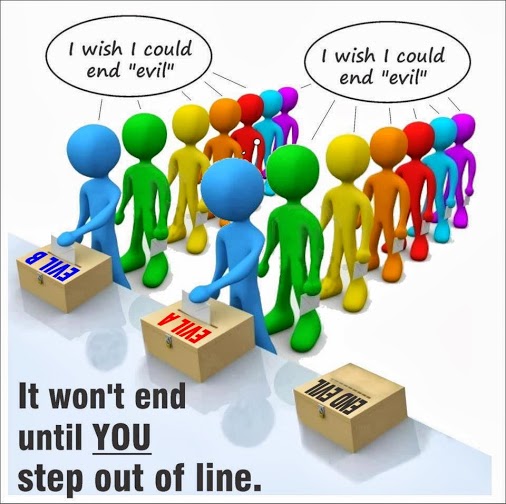
        It’s kind of amazing that something so central to many of the issues we see and read and hear about in the news every day, something on which billions of dollars and countless hours of scheming by political “professionals” are expended every year, continues to be so widely misunderstood. Yes, that description can be applied to government itself, but here I’m simply talking about voting. If you’re a Libertarian, or even just a free-thinking person who’s ever confessed to somebody else that you plan to vote for a candidate who isn’t among the perceived front-runners or those declared viable by mainstream media outlets in a particular race, you’ve probably heard some version of a response like, “Why are you wasting your vote? They can’t win. Be realistic. If we don’t vote for Tweedledee, we’re going to get Tweedledum.”

        The truth that’s overlooked in such thinking is this: When you vote in any election in which many thousands of people or more are voting, you can be virtually certain that your individual vote will NOT change the outcome. Changing the outcome of such an election requires the votes of many other people whose behavior at the ballot box you can’t control. Voting on the wishful premise that your vote might change the outcome of an election is LESS realistic than voting on the basis of thinking a Libertarian might get elected! Libertarians actually do get elected far more often than a single vote changes the outcome of any major election (there are hundreds of Libertarians holding public office around the United States right now). In the very rare instances when a major election is anywhere close to being decided by a single vote, there’s almost certain to be a recount in which the vote totals will change anyway.

         So in terms of how you choose to vote, it really doesn’t matter whether your chosen candidate has a good chance of winning or not, because whether they are likely to win or not, you won’t be changing that outcome with your vote. The popular idea that you’re “throwing away your vote” by voting for a candidate who “can’t win”, as opposed to supposedly “making your vote count” by voting for one who “can win”, has no basis in reality. In fact, mathematically speaking, the fewer votes a candidate receives, the greater the proportional impact that your vote for them will have! To take a simple example, if someone receives only 10 other votes in an election, then your vote for them increases their vote total by 10%. But casting your ballot for someone who receives 1,000 other votes in an election increases their vote total by only a tenth of a percent.

        Nor do you get any special credit, or benefit, for picking the response option that turns out to be most popular among your fellow poll-takers; at best you’ll get the psychological satisfaction of having voted for the winner (if that’s the sort of thing that makes you feel good). The resulting warm fuzzy feeling might typically last you a few days after Election Day. However once the candidate takes office and starts doing stuff you don’t like (which, admit it, happens way more often than not), you’ll be stuck with the embarrassment, shame, and feeling of having been suckered into supporting a bad politician for the rest of their term or beyond.

         So if it’s all but guaranteed your votes won’t change any election outcomes (except maybe at the local level if you live in a very small town), and there’s generally no personal well-being to be gained by voting for candidates who end up getting elected, does this mean voting is a waste of time? Not at all. Imagine you’re part of a crowd of hundreds of people who are trying to roll a huge, heavy fallen log out of the road. When you put your hands on the log and add your energy in pushing, or stop to take a breather, you can’t see any effect – whether you push or slack off seems to make no difference whatsoever in terms of whether the log rolls forward or it doesn’t. Nevertheless you know that at some point when enough people are pushing hard enough, the log will start moving, because you’ve already seen it happen. All you can do is your part. As Mahatma Gandhi once said, “What you do may seem insignificant, but it is vitally important that you do it.”

         Voting can be seen as akin to taking an opinion poll and adding your mark next to one of the response options. If most of the people taking the poll happen to choose the same response option as you do, then the poll results (if it’s a fair poll) will show this option as being the most popular, but that part is beyond your control. When taking public opinion polls, most people seem to recognize that they are simply giving their opinions, not measurably changing the poll results, and consequently give their honest opinions rather than attempting to answer based on how they think others will respond. But for some reason when it comes to elections, a lot of people apparently think they can “game the system” and change the outcome by voting “strategically” based on how they expect others will vote. This imagined “strategic voting” is in reality rank nonsense. Those who believe in it have not properly understood the math or the probabilities involved. Furthermore it is actually undermining democracy, because to the extent that voters cast their ballots based on how they think others will vote rather than voting their own actual preferences, election outcomes will not reflect the true preferences of voters. And when election outcomes don’t reflect the true preferences of the electorate, that means democracy is broken.

          Bottom line: The smart and responsible way to vote in any major election is to vote for the candidates you would most like to see do well, regardless of what you think their chances are of being elected. For me, this almost always means voting Libertarian when that option is on the ballot. Even when our candidates don’t win, adding to Libertarian vote totals helps the party and advances the cause of freedom. Above and beyond this, voting is an act of solidarity with others who believe as you do. Together we can roll the dead log of statism out of the path of human and universal progress. It is always true (assuming the election isn’t rigged) that if enough people vote for a candidate, that person WILL win. Essentially, each of us has a choice: To vote in a manner which may superficially feel clever but actually hurts our own franchise both individually and collectively, or to be part of the solution – a solution which is always possible, and will manifest itself in reality as soon as enough people choose to be part of it.
  • Selective Anger At “Freeloaders”

    Selective Anger At “Freeloaders”

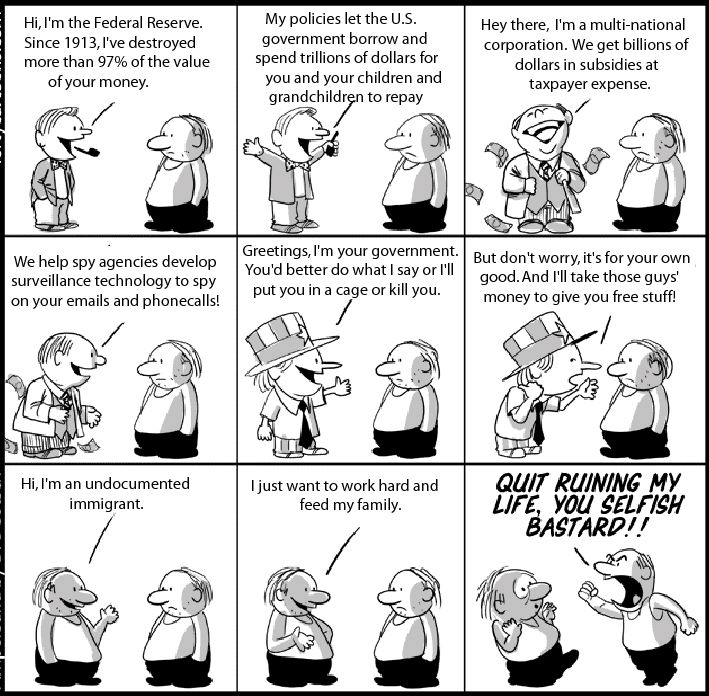
        In my dialogues with defenders of statism, online and off, I routinely encounter people – usually though not always on the political right – who express feelings of anger, disgust, contempt, etc., toward those whom they characterize with terms like “lazy”, “bums”, “freeloaders”, “parasites”, “anti-social”, “welfare queens”, “druggies”, “illegals”, “junkies”, “leeches”, “the homeless”, “non-productive members of society”, etc. Most of the criticisms seem to boil down to resentment that the people who are the objects of their ire are in some way being assisted or provided for by government at the expense of others.

        Are such feelings a step on the path toward libertarian enlightenment, or just narrow-minded self-justification? I’d like to think the former, and in some cases that may be the case, but I often have my doubts. Because from where I sit as a long-time observer of San Francisco politics and local political attitudes, the sad truth is that not just the folks who are often criticized in such terms, but the vast majority of the local population, appear, both from their voting habits and from their own comments, to want to be taken care of by the nanny-state in one way or another.

        It is bitterly ironic, and hypocritical as hell, for anyone who wants government to provide them with “free” elementary schools, “free” libraries, “free” fire protection services, a “free” regulatory bureaucracy of immense scale and complexity that intrudes into everything from air travel to household pets, “free” enforcement of border controls and persecution of people who reside in or attempt to enter the U.S. without government permission, a “free” military whose budget is inching toward $1 trillion with hundreds of bases in other countries, “free” enforcement against people lying on sidewalks or sleeping in tents in the commons, etc., to look down their noses at somebody who wants “free” food stamps, “free” SSI, or “free” housing vouchers as being necessarily a much worse leech or parasite than themselves or their friends.

        Let’s be crystal clear about this:  ALL of these things and more are forms of nanny-state welfare designed to take money stolen from taxpayers to fund services desired by particular constituencies, which members of those constituencies are unwilling to pay for themselves, whether or not the “free” service in question is called “welfare” or not.

        For anyone tempted to feel disgusted, contemptuous, or resentful toward those whom you characterize as wanting to be taken care of by the “nanny-state”, please examine what “free” things you yourself want government to provide at the expense of others. Those who want more welfare than you do when it comes to food stamps or SSI or housing vouchers may in many cases want LESS welfare than you do when it comes to the military-industrial complex, or border controls, or home loans, or government education, etc., and may even want less welfare and a less controlling, less authoritarian government overall!

        Before we judge anyone else too harshly, here’s an illuminating pair of questions for each of us to ask ourselves:

    1) How much theft, and how much coercion, would be required for government to do the things that I want it to do?
    2) How can I reduce the amounts of theft and coercion that I am effectively demanding?

  • Republicans Provide Crutch To Lessen Pain of Taxes on Poor – Democrats Add Armpads

    Republicans Provide Crutch To Lessen Pain of Taxes on Poor – Democrats Add Armpads

    Usually it’s the other way around – heartless Republicans trying to screw the poor, and Democrats trying to “help” them (but without addressing the actual source of the problem, and often making it worse).

    But yesterday’s Examiner (March 4) had a kind of “man bites dog” story – Assembly Bill 503, authored by Republican Assemblyman Tom Lackey of Palmdale and signed into law last year, requires local agencies to offer payment plans to poor people burdened by government fines they cannot afford.

    To give local Democrats their barely-deserved slice of credit, once this GOP-originated crutch became law, SF’s Democrat city Treasurer, Jose Cisneros, added extra padding to make the crutch a little easier to use by implementing a plan that goes further in some respects than what the law requires. Which his spokesperson was not too modest to tell the Examiner:

    As implemented locally by Cisneros, the plan goes “far beyond what was legally mandated”

    (more…)

  • Paying for Parks You Aren’t Allowed to Use

    Paying for Parks You Aren’t Allowed to Use

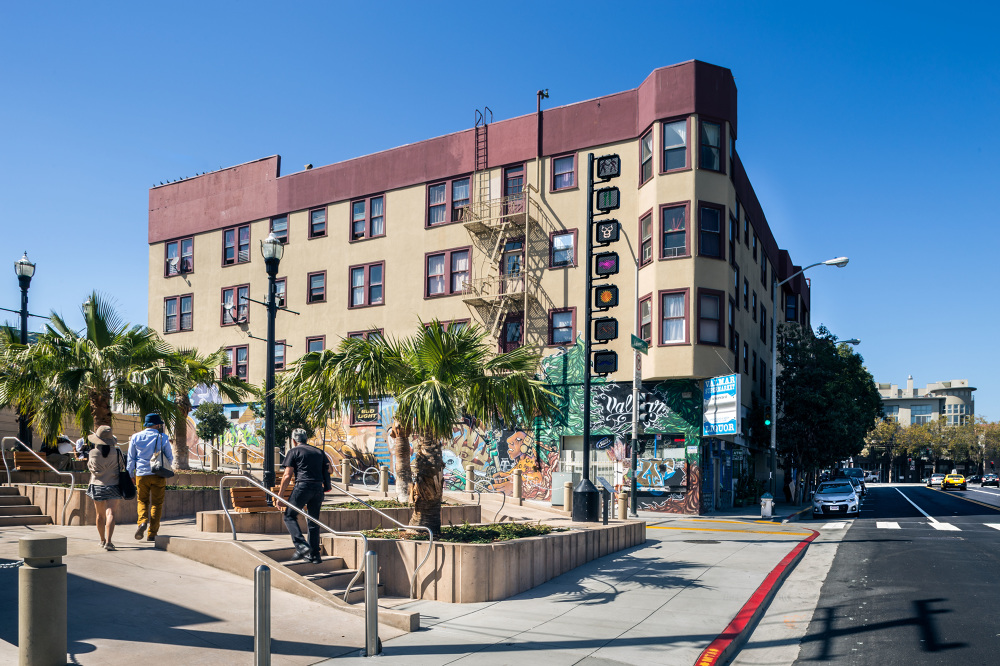
    A public park in San Francisco’s SOMA district has been sitting closed behind a fence for almost all of 2017, with chain link fence segments installed in February replaced with a $145,000 black iron barrier in June.

    Because, you know, if those in power didn’t do things like saying they’re going to use taxpayer money for improving parks, then “improve” them by closing them so you can’t use them, it would create a public health risk – people seeing a well-functioning government might die of shock! Freedom is dangerous.

    The San Francisco Examiner says that District 6 Supervisor Jane Kim is planning a public hearing in January, where she will no doubt have to try and appease the neighborhood bullies who want The State to police who uses a public park even if that means keeping it perpetually closed so that nobody gets to use it. Since she already caved to them by pushing for the appropriation of the stolen funds that paid for the more permanent barrier around the park, they may now believe they can get her to throw away the key.

    For those with a dark sense of humor, the Examiner story’s comment section provided some (beyond that inherent in the news item itself):

    “I live nearby”, wrote one apparently cowering local NIMBY in defense of the status quo. “It is far too dangerous to remove the fence. We agitated for months to get it installed, and the crime that came with the park largely stopped or went elsewhere.”

    Well, yeah, crime usually does go down in a location when there are virtually no potential victims due to the fact of it being closed! If you close the amusment park, you get fewer injuries on the roller coaster too. If you close the roads, you get fewer road accidents.<!–break–>

    “Sure would like to know who those ‘neighbors’ are”, the NIMBY continued. “They must not live around or close to the McCoppin Hub.” Well probably not, if you’re referring to homeless people who used to spend time in the park – it’s a safe bet they can’t afford to live indoors in your neighborhood, so when you neighborly types got the place where they had sought sanctuary closed, it wouldn’t be surprising if they were displaced. (Or they could simply be living a few blocks away in front of the home or business of someone you might actually acknowledge as a neighbor.)

    Yours truly posted the following comment:

    “What insanity. If you think people should be forced to pay for a park that they aren’t allowed to use, please explain how you think this is fair.

    Homeless people are also forced to pay taxes, both directly and indirectly. Taxes are part of the reason homes are so expensive. Is the justification for these taxes to enable people at City Hall to collect six-figure salaries and nice benefits while parks sit closed, surrounded by $145,000 fences built with stolen tax dollars, and thousands of people live on the streets without places to call home?

    How does it feel for some of you to act like little Donald Trumps in your own neighborhood, supporting a wall to keep the “bad hombres” out (while costing everybody else money and freedom at the same time)?”

    The question felt appropriate, given that Donald Trump and his immigration policies are not exactly popular in SOMA, yet someone going only by the inhospitable attitudes expressed by some residents on local land use issues like this might easily guess otherwise.

    I wonder how many of those residents have noticed the resemblance between their own reactions of fear and animosity toward those who are strangers to them, and the xenophobic policies espoused by Trumpian nationalists.
     

  • Guarding le Régime Moderne

    Guarding le Régime Moderne

    In 1798, Thomas Malthus predicted that population growth would lead to mass starvation. If things had continued as they did for thousands of years previously, he might have been right. Fortunately, the advent of the Industrial Revolution dramatically boosted productivity, and gains in productivity haven’t let up since. In recent times, global productivity has increased by an estimated 1.8% per year between 1964 and 2014. With improvements in technology and know-how, a single worker today can typically produce what it would have taken dozens to produce a few hundred years ago in the same amount of time, resulting in much better standards of living for most people than were the norm in Malthus’s era.

    A worker in the United States today earns more in 10 minutes, in terms of buying power, than subsistence workers, such as the English mill workers that Fredrick Engels wrote about in 1844, earned in a 12-hour day. Or to put it another way, “each farmer (in the United States) in 2000 produced on average 12 times as much farm output per hour worked as a farmer did in 1950.” In other words, to produce the same amount of output, less than 10% as many employees are needed in agriculture as was the case half a century ago. And that’s only over the past 50 years. Go back 200 years or more, and the gains are even more dramatic. While agriculture, once the occupation of 90% of Americans, has particularly benefitted from technological changes that enhanced productivity, many other economic sectors have seen similar increases.

    So how have gains in productivity affected government operations – law enforcement, for instance? How much more crime do today’s police departments prevent, with how many fewer officers, compared to their pre-Industrial counterparts?

    (more…)