Author: lpsf

  • N?NNN: Ballot Recommendations (November 2018)

    N?NNN: Ballot Recommendations (November 2018)

    It’s almost election time again, so these are the LPSF’s recommendations and thoughts on all of this fall’s local ballot measures. As always, the LPSF submitted arguments for the “free” official arguments to be printed in the Voters Handbooks, and we “won” the lottery for two of the ballot measures and submitted two paid arguments, all of which will appear in the Voters Handbooks mailed out in early October. As usual, our support of or opposition to a ballot measure hinges on whether it expands or shrinks the amount of governmental control of our lives. Increased taxes, debt, ordinances, bans, and mandates all tend to be the former, so that’s why the LPSF generally opposes most San Francisco ballot measures. We hope things change some day around here so that we support more ballot measures, but for now, you can count on us to be the loyal opposition!

    Prop A (San Francisco Seawall Earthquake Safety Bond). This ballot measure should have been lettered B for Boondoggle. It the voters were to approve this bond, it would be yet another in a long string of government projects destined to have huge cost overruns, take years longer to complete than predicted, and waste mountains of taxpayer money. The Bay Bridge, Central Subway, Transbay Terminal, Oakland Airport Connector, and the granddaddy of them all—the High-Speed Rail. The bond is for $425 million and is a down payment for the estimated total cost of $2-$5 billion. Is it really necessary to spend billions to shore up this wall, which by the way should be called a BAYwall, not a SEAwall, since it is located inside the bay and doesn’t even face the Pacific Ocean? The proponents, as usual, are using scare tactics by making it sound like the whole city will be submerged under water if voters don’t approve the bond. Baloney—it would probably be cheaper to just pump out what little water might flood along the Embarcadero waterfront rather than take on another boondoggle. For that matter, why shouldn’t the property owners who own the waterfront property pay the cost of repairing the BAYwall, since they chose to live there and there’s always some risk when you live close to water? Regardless of one’s thoughts on climate change, our own Starchild (who authored our argument and rebuttal) pointed out how exaggerated the proponents’ claim of sea level rise of 6 feet is by quoting a U.S. Geological Survey that projects sea level rise of just over 2 feet at the most by 2100. That’s a 300% exaggeration rate! Our final word on this is the classic Willie Brown quote which the Department of Elections did not allow us to use his name without his express permission, even though it was printed in the San Francisco Chronicle: “News that the Transbay Terminal is something like $300 million over budget should not come as a shock to anyone. We always knew the initial estimate was way under the real cost. Just like we never had a real cost for the Central Subway or the Bay Bridge…In the world of civic projects, the first budget is really just a down payment. If people knew the real cost from the start, nothing would ever be approved. The idea is to get going. Start digging a hole and make it so big, there’s no alternative to coming up with the money to fill it in.” Need we say more? We recommend a very strong NO on A.

    Prop B (Privacy First Policy). This is a charter amendment for The City to adopt a privacy policy regarding The City’s contractors, lessees, grantees, and other third parties receiving permits, licenses, or other entitlements from The City. At first reading, we found this ballot measure to be on the positive side, even if a bit vague, and we were in favor of supporting it. Of course we support more privacy from government and unscrupulous individuals seeking to conduct identity theft. However, subsequent input from the Society of Professional Journalists, which is the official opponent of Prop B, has us rethinking our support because there may be a downside. While all this privacy business is good for private citizens, when it comes to government and those it awards money to with contracts, agreements, leases, and grants, the public deserves to know about those who get taxpayer money. This measure might end up being the opposite of “sunshine” laws that give the public the right to know how its money is being spent. In other words, it may unintentionally lead to the opposite of transparency and disclosure of governmental hanky panky. We have invited the Society of Professional Journalists and also the YES on B campaign to present both sides of the issue to the LPSF at our September 8 meeting, and we will decide our official position afterwards. I rather think now after hearing the downside that we will end up opposing this measure, since we always want to keep an eye on what government is doing with taxpayer money, and who it’s handing it out to, but I could be wrong. Stay tuned for a brief update coming soon.

    Prop C (Additional Tax on Gross Receipts for Homelessness). The City already extracts a gross receipts tax on businesses of 0.16%-0.65%, depending on the nature of the business, while companies with gross receipts over $1 billion, a thousand or more employees, and with administrative offices located in San Francisco, pay a payroll tax rate of 1.4% instead. Prop C highlights the greed of the politicians—they already have a gross receipts tax (which the LPSF opposed in 2012), they just pushed through another gross receipts tax on commercial rents “for the children” (early childcare) in June, and now they want a new additional tax. The tax would be paid by the big boys—companies with gross receipts of over $50 billion will be taxed an additional 0.175% -0.69%, and for companies that pay the payroll tax instead, it would be an additional 1.5% of payroll expense. Having surpassed the $10 billion budget milestone last year with nary a shred of shame, this year The City is well on its way to an $11.5 billion budget—and asking the voters for more! Of course, it will be the rich, high-tech companies that need to pay “their fair share” and “give back to the community;” we’ve heard these same platitudes one election after another. As for the proceeds, they’re supposed to go towards ending homelessness in San Francisco. According to the San Francisco Chamber of Commerce, The City spends $382 million each year on homelessness, and yet clearly the problem is worse than ever. Did you read about Mayor Breed’s tour of the city streets to check out the unsanitary conditions with the “Poop Patrol” that are prompting people to start calling The City a slum? We won’t hold our breath waiting for The City to fix the situation, but rewarding such poor results with higher taxes will only enrich the homelessness industry that lives off the taxpayers and the misfortune of others and accomplishes so little. By the way, the LPSF is being attacked by Prop C proponents for being in bed with “corporate interests” by opposing the measure. That shows you how desperate the vested interests are getting since everyone knows the LPSF operates out of principle and is beholden to no one, least of all corporations. We recommend a very strong NO on C.

    Prop D (Additional Gross Receipts Tax on Cannabis + Additional Conditions Subjecting Persons to Business Taxes). These two additional extractions are both in addition to current taxes, and since “Gross Receipts Tax” has now become the favorite method of tax collection by City Hall, we might note that this type of tax is based on revenue, not the net income of the business. So, while a company’s revenue might be high, its expenses might also be almost as high, but it will still pay the tax on the higher figure, regardless of its actual evil “profit.” The rates always start low, but once City Hall gets its fangs into your pockets—watch out! There are two parts to this ballot measure, and we question why they aren’t being considered by the voters separately rather than as one lump-sum deal. I guess the politicians figure since it’s a taxing issue, why not just throw in an extra tax for good measure—who will notice? We do.

    Part 1 additional tax is to impose an additional tax on cannabis businesses with gross receipts over $1 billion. Such businesses already pay 0.075% to 0.65%, but that just isn’t enough for tax hungry politicians—they want an additional 2.5% for gross receipts from the retail sale of cannabis from $500,000 to $1 million and then 5% above $1 million. For cannabis businesses other than retail sales, the tax rate would be 1% from $500,000 to $1 million and then 1.5% above $1 million. But wait there’s more—the Board of Supervisors can raise the rates up to a maximum of 7%. If you look at the back scenes leading up to the actual ballot measure, it’s not hard to see where this is all headed: some supervisors wanted the rates at 2% and 3% for non-retail cannabis businesses (rather than 1% and 1.5%) and a maximum rate of 10% (rather than 7%). So, the rates will be increased to the max, and it’s just a matter of time, not if. But wasn’t the whole point of legalization to get rid of the black market so folks could actually buy cannabis in a store and know exactly what they’re getting? With outrageous taxes on the product, that would just push the prices higher and send customers back to the black market. While politicians in some states like Washington and Colorado—and even the City of Berkeley—initially set their tax rates too high and pushed buyers back to the black market, they relented and dropped their rates. San Francisco politicians, unfortunately, are moving in the wrong direction with Prop D. Laughably they actually included a phrase that allows them to lower the cannabis tax rates. When was the last time San Francisco politicians voted to lower any tax?

    Part 2 of this ballot measure capitalizes on the recent Supreme Court ruling allowing jurisdictions to tax without the need for a physical presence (Nexus rule). Prop D expands the conditions under which anyone doing business in The City would now be subject to San Francisco business taxes if your gross receipts exceed $500,000 (not too hard at San Francisco prices). Well, that didn’t take the politicians long—the ruling was announced on June 21, and by July it was already thrown in this “Cannabis Tax” ballot measure as a special treat for anyone providing goods and services to San Francisco residents. While directed mostly at online purchases so common these days, this could also have a significant effect on even services provided to any company located in The City. As always, all this will only add to the increasing costs of everything in San Francisco. San Francisco didn’t become almost the most expensive city in the country without help from greedy San Francisco politicians. Ronald Reagan must have had our politicians in mind when he said, “If it moves, tax it. If it keeps moving, regulate it. If it stops moving, subsidize it.” We recommend a very strong NO on D.

    Prop E (Hotel Tax Allocations to the Arts). The City’s hotel tax rate is currently 14% (8% base tax and 6% tax surcharge) and the taxes go into the General Fund. Prop E would earmark 1.5% of the 8% base tax to “arts and cultural purposes,” such as nonprofit cultural organizations, the Arts Commission, Cultural Districts, and “needs in the arts community.” In other words, special interests. Because this ballot measure is revenue neutral (hotel visitors will continue to pay the same 14%), the LPSF considered not submitting an argument against this one, but our core members felt strongly that earmarking for special interests reduces funding for basic services and, more important, why is The City even funding the arts at all, so we did submit an argument against Prop E. Even the City Controller notes in his analysis that The City already allocates out of the General Fund around $22 million/year, so the arts are already getting significant government funding. The additional allocation would have to come out of basic services the residents rely on. We have an issue with government funding of any art at all—let alone $22 million plus an additional $5 million the first year and an additional $13 million in subsequent years. Why should government bureaucrats be picking and choosing the “winners” for cultural events? Residents and visitors already can and do “vote” with their hard-earned money by choosing performances, movies, and museums that they prefer. If not enough individuals support that artist or group of artists, then probably that “art” shouldn’t exist—at least commercially. Why should visitors to The City be forced to pay for art they may not even care for? While it’s obvious that government funding of the arts is a sacred cow in this city since it’s been around for decades, we find it amusing that Prop E proponents claim that “San Francisco arts help attract tourists here.” In fact, I’ve heard just the opposite from visitors I’ve hosted here who remarked that San Francisco is no cultural mecca and it’s The City’s awesome geography and restaurants that are the main attractions. If anything, government funding lowers the bar for the striving of artistic creativity and excellence because once the organization gets approved for “grants,” it gets funded year after year whether it produces anything of value or not. In the marketplace of arts, if the “customers” aren’t happy with the artist’s latest work, his or her pocketbook will suffer. Success should not be guaranteed for any special individual or group of individuals—including artists. Therefore, we recommend a strong NO vote E.

  • Bonded

    Bonded

    Since outright taxation, even for statists, has its limitations, bond measures have become the preferred method for politicians and vested interests to increase government spending, especially here in California. Since California voters passed Prop 39 in 2000 lowering the threshold for passage from 2/3 to 55% for school bonds, the approval rate for such bonds has soared to 80%. A report from the Little Hoover Commission, a “good government” independent state oversight agency, in 2009 pointed out the increasing problem of more and more long-term debt being approved both statewide and locally. It revisited the issue last year as the problem seems to have worsened as few of their recommendations from 2009 were adopted. As the Commission noted last year, “California voters have been exceedingly supportive of bond measures. In the past decade, voters have approved more than $70 billion in statewide bond financing. They have been equally supportive of local bonds, with some $138 billion in local school facilities bonds enacted since voters reduced the threshold for approving these measures in 2000…But as Californians have put more and more on the tab, a day of reckoning will arrive. When the next recession hits and revenues fall, the payment on the debt remains.” As the Commission noted in both reports, bonds are a long-term commitment to repay debt, which goes to the front of the line when it comes to decisions made each year as to how governments spend taxpayer dollars. These general obligation bonds are guaranteed by the California Constitution and take priority over all government expenses beyond education, which has locked-in funding from Prop 98.

    To put things in perspective, the voters approved $74 billion in debt from 44 bond measures from 1974-2004, but from 2006-2016, they approved approximately $71 billion more from 10 bond measures. The debt almost doubled in just one decade. California’s debt is higher than most large-population states. California’s ranks third highest of the 10 most populated states as measured by debt per capita, debt as a percentage of personal income, and debt as a percentage of GDP. When your state ranks just behind Illinois and New York, that’s a dubious honor indeed.

    School bonds deserve special mention as a huge part of the problem as voters overwhelmingly approve anything that mentions “children.” The prohibition on using public funds for consultants for voter “research” that is subsequently used in election campaigns to pass the bonds is routinely skirted as there is a legal gray area between what is viewed as “information” and “partisan campaigning.” Education Code Section 7054 states, “No school district or community college district funds, services, supplies, or equipment shall be used for the purpose of urging the support or defeat of any ballot measure.” That’s clear enough. But California Attorney General Bill Lockyer ruled in 2005 that it is legal for public funds to be used for consultants to conduct surveys and establish focus groups to assess support or opposition to a bond measure, the public’s awareness of the district’s financial needs, and the overall feasibility of developing a bond measure that could pass. He ruled that all this information gathering is a fair and impartial presentation of relevant facts to aid the voters to reach an informed judgement and is not partisan. Bull—obviously the consultants can use all this taxpayer money to determine the best words and arguments to pass the bond, as they definitely weren’t hired by the school bureaucrats to be “impartial.” One consulting firm that worked on “surveys” before the election even noted, “A finding of measurable strong support portrays a bond measure as something already broadly supported by the community, thus convincing undecided individuals and organizations that the bond measure is worthy of support and discouraging individuals and organizations that might be inclined to oppose it.” In essence the taxpayers pay the consultants to pull the wool over their eyes. Since 18 years of history has now produced an 80% chance of school bonds passing at the 55% voter approval threshold, isn’t it rather obvious the “surveys” aren’t really needed anymore and should no longer be funded by taxpayers? Another way to get around the law is funding campaigns in support of the bonds by companies likely to earn money from the proceeds of the bond sales. Community college foundations often contribute to bond campaigns; the law allows them to spend up to 20% of their disbursements for influencing legislation. In 2004 there was a scandal in Placer County when the college president was accused of making about 40 presentations to groups of perspective donors (including architects and engineering firms) advising them to donate to the foundation, rather than the bond campaign committee, to hide their identities as contributors. Further evidence of the cronyism involved in passing school bonds is the “pay-to-play” hanky panky where leading financial firms donate huge sums of money to successful bond measures. California is noted for firms donating to the campaigns and then not-quite-so-incidentally being hired by the school districts to sell the bonds for a profit. Even a minor reform to remedy this abuse in 2009 by having the Municipal Securities Rulemaking Board (MSRB) prohibit brokers from doing business with government entities if those brokers contributed to bond measure campaigns failed when the MSRB declined to change the rule, citing constitutional First Amendment issues. Then there’s the unethical issue of municipal finance firms supplying pre-election services for “free,” getting awarded the contract after the school bond passes, and then inflating their legitimate fees the district pays in connection with the bond sale to cover their pre-election costs out of the proceeds raised from the bond sale. It’s quite a racket for the insiders. Lastly, there’s the infamous Coalition for Adequate School Housing (C.A.S.H.), an unholy alliance of school districts, county offices, architects, attorneys, consultants, construction managers, financial institutions, modular building manufacturers, contractors, developers, and others in the school facilities industry, that has sponsored or supported over $52 billion in statewide school bonds. This organization lives and breathes school bonds and will fight to the death any possible reform to school bond passage. Its website proudly and shamelessly notes that it successfully fought bills that sought to make school districts supply greater specificity of projects to be funded by bonds, match the term of their bonds with the economic life of the item being purchased, and (heaven forbid) require additional information about tax rate increases on the ballot measure label. Clearly, when it comes to school bonds, it’s a completely stacked game, and we’re amazed if any school bond doesn’t get passed by the voters.

    Yet another disturbing piece of the bond measure puzzle is the illusion of transparency and legitimacy that bond oversight committees bring to the passing of bonds. These committees were established by an act of the state legislature in 2009—in no small part to encourage the voters to approve Prop 39. It worked. Today bond measures routinely sport an “oversight committee” guaranteed to ensure that all is kosher. The Little Hoover Commission was quite scathing in its evaluation of the effectiveness of these oversight committees. The whole point of the committees is to ensure the bonds are spent efficiently and as described in the text of the bond the voters approved. The Commission found the committees to be ineffective and, as some committee members testified, this was by design. One witness told the Commission, “The watchdog has no bite.” Other problems noted were bond oversight committee members were lacking in training and had conflicts of interest, and also the difficulty committee members have obtaining required documents from school districts. One oversight committee member in West Contra Costa County who almost resigned out of frustration described even more problems such as the oversight committee meeting only once a year, being charged with doing their work only after the fact when it’s too late, and oversight members being appointed by the same district that they’re auditing. She added, “We are powerless to effect changes.” Perhaps the most glaring shortcoming of these oversight committees is their emphasis on compliance by focusing only on whether they followed the language in the bond, rather than also taking a look at how effectively taxpayer money was spent. Isn’t that what real oversight is all about? A 2016 report from the Los Angeles County Grand Jury discovered that taxpayers were paying between 25% to 50% too much for poorly designed debt issuances, costing the taxpayers hundreds of millions of dollars of unnecessary expense. Shouldn’t the oversight committee have noticed that something was amiss?

    No discussion of bonds would be complete without mentioning what is likely to become the biggest bond boondoggle in California history—the High-Speed Rail. It was approved by California voters in 2008 for $10 billion. The Little Hoover Commission was not impressed with the lack of accountability and mentioned several times in its report how little information has been made public about the expenditures. The accountability website that Governor Schwarzenegger ordered to be set up in 2006 after the voters approved a $43 billion package had little to say about the High-Speed Rail, and spending data was not readily available on the High-Speed Rail Authority website either. All we can say is $10 billion (to start off with) and where has the money gone?

    A quick perusal of this fall’s state ballot measures shows almost $17 billion in new bonds being presented to the voters in 4 separate ballot measures. If history is any indication, California voters will sadly be burying themselves in even more insurmountable debt.

  • No Shame No Principles

    No Shame No Principles

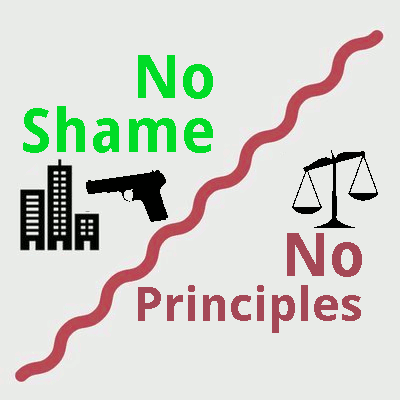
    Proponents of Prop C like to pose that the LPSF doesn’t think they have a plan to address homelessness in The City. In fact, we do believe they have a plan. This is a deflection from our real concern, which is that in order to fund their plans, they feel entitled to dip their fingers into local company coffers to “raise more revenue”. That’s a great euphemism for “stealing”.

    The Libertarian Party is the Party of Principle. When we consider any proposal, we apply common-sense principles in order to gauge whether that proposal is just. Taxing businesses who have not caused the problem in order to fix that problem is unjust.

    We don’t stand for big business, we stand on principle. Our position is not political, it is logical. We are not interested in “protecting corporate profits”, we are interested in protecting rights. I challenge the proponents of C to provide a justification for funding their plan that is not merely an appeal to emotion.

    “They can afford it” is not a sound argument for imposing a tax. NoPlanSF writes “The additional tax would be less than 1% of their gross revenues.” It doesn’t matter if it’s 1% or 50%; it’s 100% not yours. Neither does it matter that corporations are “enjoying many millions more from Trump’s giant corporate tax cut”. If the 8th graders at school cut back on bullying your 6th grade son, does that make it okay for the 7th graders to start shaking him down for lunch money? These kinds of arguments are irrelevant to the actual discussion, just an appeal to emotion by the so-called “progressives” that want you to join their mob.

    As a concerned citizen, you may be conflicted. This proposition won’t cost you anything (you think). After all, you don’t make over $50 million, and homelessness is definitely a serious problem that needs to be addressed. So, isn’t it okay to take a just little bit from the people who have a lot in order to help those who don’t have enough?

    Well, let’s consider another example. If a homeless person asks you for change as you’re walking down the street and you keep walking, are they justified to pull a knife on you and force you to fork over $10? You have a comfortable lifestyle. You can afford it (they only want $10). And yet, you probably are not okay with this scenario. Is it because there is someone more well-off that they could have robbed instead? How about your boss at work— she earns more than you. If they robbed her instead, then it might be okay. Would it? How about her boss?

    When presented with a problem that needs solving, one might be inclined to seek retribution from the source that caused that problem. If someone who can no longer afford to pay their rent loses their home, who is to blame? Of course we feel empathy for this person; they are a human being and deserve to be treated with dignity and respect. It would be uncompassionate of us to let them starve on the street. However, neither is it compassionate to demand someone else provide for them.

    Compassion necessitates voluntary human action. There are many charities in the Bay Area that fund homelessness services, for example Larkin Street Youth Services. This organization provides valuable help that is needed and receives a decent chunk (30%) of their funding through voluntary donations (much of it from corporations, even— imagine that!). This problem can be solved without coercion. No, it’s not as easy; but tough problems have tough solutions.

    Rhetoricians will tout how great their plan is. They’re going to make everything better. All they have to do is demonize the big bad corporations enough for you to not care about their rights or what happens to them. They’ll be fine anyway. Successful businesses are successful for a reason. They will recover that lost revenue in increased prices. And if you hit them too many times, they might just pack up and leave. Then the only big bad guys left in town will be in City Hall.

  • Give Me Your Lunch Money

    Give Me Your Lunch Money

    In the wake of Mountain View’s ban on Facebook serving free food in their new office resurfacing, the bureaucrats in San Francisco City Hall decided they couldn’t be outdone. Supervisors Ahsha Safai and Aaron Peskin are planning to introduce their own proposal for The City to ban industrial kitchens in office buildings for all future developments.

    This measure is designed to save the “failing” restaurant industry in San Francisco by forcing workers out of their offices and into the local restaurants (and of course more of their tax dollars into City Hall). Thankfully our diligent Supervisors were able to pinpoint the real problem that local restaurants are facing— not enough tech business— so they can continue to tax this and every other industry out of existence.

    The tech industry should be comforted to know that this measure won’t affect existing businesses, only future developments— although this would lead one to wonder if this will have any effect on the restaurant industry at all, at least not in the near future. Companies are likely to instead provide catered meals from a single offsite provider, or employees may start bringing their lunch to work. The bigger effect this will have is yet another raised middle finger to tech companies, which apparently have brought nothing but problems to The City. As if there weren’t already enough, entrepreneurs now have another reason to avoid opening offices in San Francisco.

    In a very telling statement, Peskin explains that tech workers “will have to go out and each lunch with the rest of us.” I suppose the board will also lead by example and do their part to help the restaurant industry by closing down the cafeteria in City Hall.

    I have heard proponents of the ban suggest that this is actually good for the tech companies, even. They claim that it will make the company more connected with the community and will increase employee happiness by letting them spend more time outside the office, ultimately helping their business be more successful. If that’s true, then this could be a win-win, and the looting is justified! City Hall should pat themselves on the back.

    What the central planners seem to forget is that companies are driven by profit, and if they can do something to help their bottom line and attract top talent then they will do it voluntarily, without need for a law. Google doesn’t give its employees paid leave specifically to do charitable work because it’s required by law, but because it boosts morale and distinguishes their culture from that of other companies that don’t offer such perks. This is why “government knows best” arguments never hold water. No one has more incentive for a company to succeed than the company itself.

    The do-gooders also seem to ignore that in order to run these office cafeterias, a company needs to employ dozens of kitchen staff, custodians, and security to be able to operate it. Apparently these jobs are less important than the restaurant jobs they claim they are trying to protect.

    Ultimately, handicapping an industry that is doing well to save one that is not is protectionism, and it is bad for everyone. Some of these restaurants will adapt to solve their own problems and some will go out of business— and that’s okay. If supervisors really want to give the restaurant industry a break, they should start by lightening the tax burden so that they can afford to operate, but The City continually increases this burden instead. Government meddling doesn’t solve problems; government meddling is the problem.

    San Francisco residents should prepare for the next “forward thinking” initiative which will make it illegal to have a kitchen in your own home.

  • Uncommon Sense

    Uncommon Sense

    Senator Wiener is at it again.  Teamed up with Assemblymember Phil Ting, they have introduced SB 221, which would ban the sale of all guns or ammunition at the Cow Palace beginning in 2020.  The Cow Palace is state-owned and located in Daly City on the cusp of San Francisco and San Mateo counties, and local officials have tried for years to shut down the guns shows held there.  This is the umpteenth attempt to pass such legislation, and previous attempts were vetoed by both governors Schwarzenegger and Brown, though with every school shooting that occurs, there’s been a greater push for “common sense” gun control.

    The gun control zealots are ecstatic about the “amazing outpouring of student activism around the country against gun violence and in favor of gun safety measures” (Wiener).  Erica Cardoza, a 16-year old gun control activist who lives right across from the Cow Palace is highly regarded as an important leader of the movement and was supported by Wiener and Ting recently at the Bayshore Community Center in Daly City when they announced their bill.  Cardoza proclaimed, “This is a school community—Bayshore Elementary School is right next to the Cow Palace—and it’s crazy to be having a gun show right next to a school…It should be a privilege to own a gun—not just willy-nilly, like you can have whatever you want.  It needs to be responsible.  We have regulations for cars—why can’t we have regulations on guns?”  However, Cardoza noted that she does support the Second Amendment right to bear arms.  Indeed.  Someone should point out to Cardoza that there is a difference between a “right” and a “privilege.”  Furthermore, California already has very restrictive gun regulations, and the shows held at the Cow Palace are always held on the weekends, when school is not in session, so what has the proximity of the school got to do with anything?  The mainstream media has whipped up a frenzy at high schools across the country.  Another young spokesman for the gun control movement, Amirah Tulloch from Jefferson High School, was also present at the Bayshore Community Center press conference and claimed, “The thing we hear from students over and over again regarding gun issues is that they’re afraid.  They’ve shifted from learning environments to places where they’re not even sure they’re going to survive the day.”  After the shooting in Santa Fe, Texas, the Washington Post ran a piece about more people being killed at schools than current military members in 2018.  Sorry Washington Post, but even the SF Weekly—hardly a defender of the Second Amendment—pointed out that there are 50 million kids in government schools and only 1.3 million military service members, so your context is way out of whack.

    The gun control warriors have gone on the offensive against Crossroads of the West, the organization that runs the gun shows at the Cow Palace and across the country.  They urged the Cow Palace’s Board of Directors to investigate whether a decades-old federal firearms conviction of Crossroads founder Bob Templeton is legal grounds to end the current contract, which runs through the end of 2019.  Templeton pleaded guilty in 1980 to unlawfully selling a .38 special revolver out of state.  He was indicted on 16 counts of unlawful firearms sales, lying, and aiding and abetting, but those charges were dropped.  It turns out the contract with the Cow Palace was signed by Templeton’s daughter who has been certified as “kosher” by the Department of Justice’s Department of Firearms, so it doesn’t look like the gun control advocates have a leg to stand on, but that won’t stop them.  While it appears likely the Cow Palace probably won’t sign a new contract with Crossroads, the gun control activists can’t even wait 18 months.  They are even going so far as saying there’s a possible link between Crossroads and the mass shooting in Las Vegas last year that left 58 people dead.  The shooter is accused of illegally purchasing bullets at gun shows in Las Vegas and Phoenix, and the activists are now suggesting that the shooter bought the bullets at shows operated by Crossroads.  It is extremely unlikely of finding out where the fatal bullets were purchased, so this possible link is a stretch, to say the least.

    The Crossroads folks point out that there has never been any significant incident of violence at Cow Palace gun shows.  Most people come there to buy ammunition, not guns, and nobody can just buy a gun and walk away with it.  There is a 10-day waiting period and a background check before the purchaser can pick up the weapon from an authorized dealer.  They also ask why the federal government hasn’t been prosecuting all the people who lie on background checks.  According to the FBI, more than a million people failed their background checks over the last 20 years, but thousands still managed to legally purchase a firearm anyway.  In other words, enforce the gun control laws that are already on the books before adding new restrictions.  Sam Paredes, executive director of Gun Owners of California, noted that Wiener and Ting are only trying to score political points with their voters, “Here we go again…These shows are as safe as a knitting show or a coin show.  But that’s not enough for these politicians.”
     
    We might add a few other things that the Crossroads folks didn’t mention.  First and foremost is that the gun control activists want to completely eradicate all private ownership of guns with total gun confiscation as the obvious goal.  Australia is often mentioned these days as a paradise due to confiscation of over 700,000 guns after the mass shooting at Port Arthur in 1996.  Of course the fable of Nirvana in Australia conveniently leaves out the fact that gun violence has not gone away in Australia and in fact has increased in and around the cities of Melbourne and Victoria.  As always, the law-abiding citizens who aren’t shooting anyone are the first to give up their arms, which has no effect on mass shootings, but certainly the criminals and deranged aren’t turning in theirs.  Then of course there’s the ever-present black market for all the goods the government says you can’t have but people want and get anyway.  Black markets are universal as laws become more restrictive and prevalent.  As California has increased its gun control laws, folks have been increasingly traveling to Nevada to buy their ammunition to avoid the Department of Justice’s ammunition buyer’s registry.  For those interested in government revenue and a (false) sense of security, the Crossroads gun shows at the Cow Palace provide the Cow Palace with $125,000 annually, and at least the folks who purchase guns and ammunition there were vetted and “regulated.”  Most important of all, gun shows provide the citizens with the “teeth” to protect liberty against government tyranny.  All of our other freedoms are important, but without the right to bear arms (and that includes securing ammunition), good luck defending ourselves if our government goes awry.  History is filled with disastrous examples of what can happen when citizens give up their gun rights in the name of security.  

    To help ensure the light of liberty remains aflame, the LPSF will have a table at the next gun show at the Cow Palace on the weekend of September 23-24 alongside our longtime ally the Golden Gate Liberty Revolution.  In past gun shows, we have found the visitors to be friendly and liberty-leaning, if not downright libertarian.  They come with their wives, families, and friends, not just for firearms and ammunition, but also for fishing, other sports-related gear, and survival goods.  They are honest, hard-working, law-abiding (not so easy these days with the proliferation of absurd laws) folks concerned about the state of liberty these days.  If you have never gone to a gun show before, you might check this one out as the gun control fanatics are determined to get rid of them once and for all.  Not that banning gun shows will stop any gun violence, but it will make authoritarian progressives feel good that they have “done something.”

  • Mountains & Extortion

    Mountains & Extortion

    A $5,600 bill from the government for having an illegal chicken coop in the backyard?  A $31,000 fine for doing a minor expansion to your home without a permit?  A $4,200 bill for a Halloween decoration stretched across a road?  Sound too incredible to be true?  Think again.  In the world of government enforcement of “public nuisance” ordinances, nothing is impossible.  The cases cited above all occurred in California in the inland empire cities of Indio and Coachella.

    Talk about making mountains—that is mountains of profit for someone—out of molehills, just look at how some cities treated the “problem” of public nuisances.  Ramona Morales, a 79-year old retired housekeeper and Avon makeup rep who had managed to save enough money over the years to purchase some small properties, became a housing provider.  In 2015 she received two warnings, one criminal citation, and an arrest warrant because one of her tenants kept “illegal” chickens in the backyard.  Ramona made sure the tenants “deported” the chickens, pleaded guilty in court, and explained to the judge that the problem was fixed.  She paid her $225 fine and associated costs.  However, a year later, she received a bill from Silver & Wright LLP, an Orange County legal firm, for $3,000 for the criminal prosecution costs of her case.  The bill came with a letter explaining that the city was entitled—by force of law—to recoup all costs, which happened to include the hourly rates billed by Silver & Wright—and please send a cashier’s check.  Fortunately Ramona did not comply and appealed the bill.  Unfortunately she lost the case, and incredibly Silver & Wright billed her an additional almost $3,000 for the cost of her appeal. 

    Then there was the case of Cesar Garcia, a homeowner in Coachella criminally charged with a minor home expansion without a permit.  He pleaded guilty, brought his home up to government code, and paid the $900 fine.  More than a year later Silver & Wright sent him a bill for $26,000 for their legal costs.  When he protested this outrage, they responded by raising it to $31,000!
            
    A few other outrageous cases round out the story of these two cities contracting out the enforcement part of their public nuisance laws.  Isabel Sanchez, another Coachella resident was criminally prosecuted for her messy yard and presented with a $26,000 bill by Silver & Wright.  She did not pay the bill, Silver & Wright filed a lien on her property, and in the ultimate example of what government force means in action when you get into a scrapple with the government, the city is preparing to seize her home.  In the case of Lew Blackwell, the owner of Investment Development Group, he was prosecuted for overgrown vegetation and garbage on an empty two-acre lot in Indio and billed $7,700 by Silver & Wright for the eyesore.  Peter Nolopp, a retired steelworker was prosecuted for renting land used as a scrapyard—again without a government-sanctioned permit.  He agreed to pay the $1,000 fine and pleaded guilty to the misdemeanor.  Three years later, Silver & Wright sent him a present:  a bill for $24,000. 

    Finally one of our favorite liberty-leaning fighters, the Institute for Justice, got involved and filed a class action lawsuit against this kind of government-sanctioned extortion racket.  Originally only Ramona was part of the lawsuit, but when some of the other cases of abuse came to light, three of the other victims also joined the class action lawsuit against the two cities.  The lawsuit seeks the invalidation of all the convictions, which would result in the refund of all the fines and associated prosecution fees.

    Needless to say, the whole series of events has been a major embarrassment for the two cities and especially Silver & Wright.  Caught with its hand in the cookie jar, Silver & Wright filed a motion to dismiss the lawsuit by referring to the plaintiffs as “pawns” of an “out-of-state special interest group” that is attacking the “clear right of cities under California law to enforce their own municipal codes and utilize legal counsel to do so.”  Gregor Hensude, the outside attorney representing Silver & Wright, claimed the firm’s fees are only used to reimburse the cities they represent.  He proclaimed, “Contrary to recent publicity, code enforcement is not arbitrarily imposed or used to profit.  It is intended to protect communities (my emphasis), neighbors, and occupants forced to live with someone else’s refusal to follow the law, and to put the cost of doing so on the violators.”  Silver & Wright defended their process as legal because they do not keep the prosecution fees that they collect from the defendants.  They returned the money to City Hall as reimbursement for different payments the city pays to Silver & Wright.  To us, this sounds like doubletalk—we smell a rat here.  Somebody was raking in a lot of money and sticking it to the victims—all with the blessings of local officials.  When Libertarians talk about privatizing services that government has taken over throughout the years, this isn’t exactly what we had in mind.  Silver & Wright’s cozy arrangement with the two cities is clearly an example of crony capitalism at its worst. 

    Fortunately, for a change, it looks like this story is going to end on a happy note.  Assemblymembers Chad Hayes and Eduardo Garcia teamed up to sponsor AB 2495, which would prohibit a city, county, or city and county, including an attorney acting on behalf of a city, county, or city and county, from charging a criminal defendant for the costs of investigation, prosecution, or appeal in a criminal case, including but not limited to a criminal violation of a local ordinance.  The bill will prevent local cities and counties from passing the legal costs of minor “crimes” off on the same people they prosecute.  It would also prevent a law firm from selling the services of local ordinance drafting and nuisance abatement prosecution as a package designed to generate exorbitant fees for the most minor of legal violations.  The bill passed on the Assembly floor with not a single politician voting against it, so it bodes well for the rest of the legislative process, and we would expect Governor Brown to sign the bill before the end of this legislative session.  Even the City of Indio has had a change of heart.  Previously the City Manager defended the city’s practice but now is also supporting AB 2495 to “bring uniformity to local code enforcement and further clarify the circumstances under which costs may or may not be recovered for criminal violations of local law.”  The only opposition to the bill is a variety of law enforcement organizations like the Association of Deputy District Attorneys and the California Association of Code Enforcement Officers, and the City of Glendora.  In its argument against the bill, Glendora argued that “by prohibiting a city to recoup its costs expended for criminal code enforcement and nuisance abatement, AB 2495 would indirectly impose these costs onto residents, the great majority of whom approve of and abide by these ordinances that were meant to deter such unlawful activity.”

    Our last word on this miscarriage of justice that apparently will be rectified is on the topic of nuisance laws themselves.  Are they necessary?  It seems like no matter where one lives—even in nice, upscale neighborhoods—there’s always one antisocial neighbor who refuses to keep up their property and poses an eyesore to the neighborhood.  (Of course, if one lives in a tract where specific appearance rules are spelled out in CC&R’s, that’s a different matter because one voluntarily agreed to these rules before buying the house.)  But let’s assume it’s a typical neighborhood where no agreement was signed.  In my last home in Southern California, I lived in Laguna Beach (the poorer section), and sure enough right across the street from my house was a disgraceful eyesore of a property.  The owner let her grandson and his friends live there, and you could always count on a discarded toilet or car battery sitting on the driveway—often for months on end.  We all disliked him and his friends and even complained to the grandmother (when she was around), all to no avail.  You know what we did to alleviate the problem?  Nothing—we just lived with it, and it didn’t kill us either.  Looking back, I’m not sure if the city had a law against such “nuisances,” but we did not run to City Hall and turn our neighbor in.  When you profess to “Live and Let Live,” you have to be consistent in its application and not just pick and choose when you want to “Live and Let Live”—and when you want to call the government for “help.”  Because the flip side of such “help” is just what happened in Indio and Coachella.  Granted, they went overboard into the absurd, but the same system that spawned such abuse could be turned against any property owner when you have laws with no real victim.  Keeping the government out of the fray does not always produce perfectly satisfactory results, but it’s a small price to pay for freedom and true property rights.

  • Underground SF Culture Still Has Its Charms

    Underground SF Culture Still Has Its Charms

    Not too many people have heard of political writer and agitator Voltairine de Cleyre (1866-1912), so I was surprised and delighted when a performer at a “secret garden” party I attended here in San Francisco earlier this month announced that she was going to perform a song written by the 19th century individualist anarchist.


    Left-anarchist singer-songwriter Erica, who goes by Unwoman after the banished women in Canadian sci-fi writer Margaret Atwood’s dystopian “A Handmaid’s Tale”, proceeded to give a beautiful musical rendition of VdC’s haunting poem “Written In Red” on the electric cello, a performance somewhat similar to which you can view here:


    Along with the song by DeCleyre, Unwoman also performed a piece she wrote herself which poignantly addresses the libertarian themes of the temptations of power and the regrets that go with selling one’s soul to the system. As historian A.J.P. Tyler said, “There is nothing more agreeable in life than to make peace with the Establishment – and nothing more corrupting.” Titled “Killing The King”, her song struck me as a possible metaphor for many things, from impeaching a president to opposing unjust power itself. The ethical courtesan’s dilemma is summed up in this couplet: “To use my only power to destroy, or to be Power’s toy”. You can watch the video for the acoustic version of that song here:


    We had a good chat afterward, and I told her I’d love to see her perform these pieces at a libertarian convention. It turns out she has performed with Abney Park, the steampunk and libertarian-leaning group that played at the Roads to Freedom libertarian “unconvention” in Omaha Nebraska in May (see R2FF.org), and identifies with the steampunk genre herself. She has some reservations about the libertarian movement however – perhaps mainly around doubting that the free market will meet the needs of those in need of assistance. But unlike some non-libertarians, she was quite open to hearing about ideas including the Non-Aggression Principle, how people with different views and agendas can come together on the common ground of agreeing not to aggress against each other, and how some of the things that self-identified anarchists on the left (aka anarcho-syndicalists) usually want 

    to do such as abolish all money, abolish all hierarchy, etc., cannot be done without using government-type force, and I felt she was really listening and considering these ideas.


    Of course not all Unwoman’s songs are as politically-themed as these two, but she is clearly an artist who is both talented and very aware of the words she is singing and the ideas entwined with them. As I sometimes say when discussing one of the myriad interesting cultural, tech, spiritual, and other phenomena that have bubbled up in the SF Bay Area,  “Another great San Francisco export!” In fact she has a song with a video filmed in various SF locations. But I’ll let you seek that out for yourself if you so desire, and leave you with her cover version of a song by one of my (and a good number of other people’s) favorite bands, The Smiths:


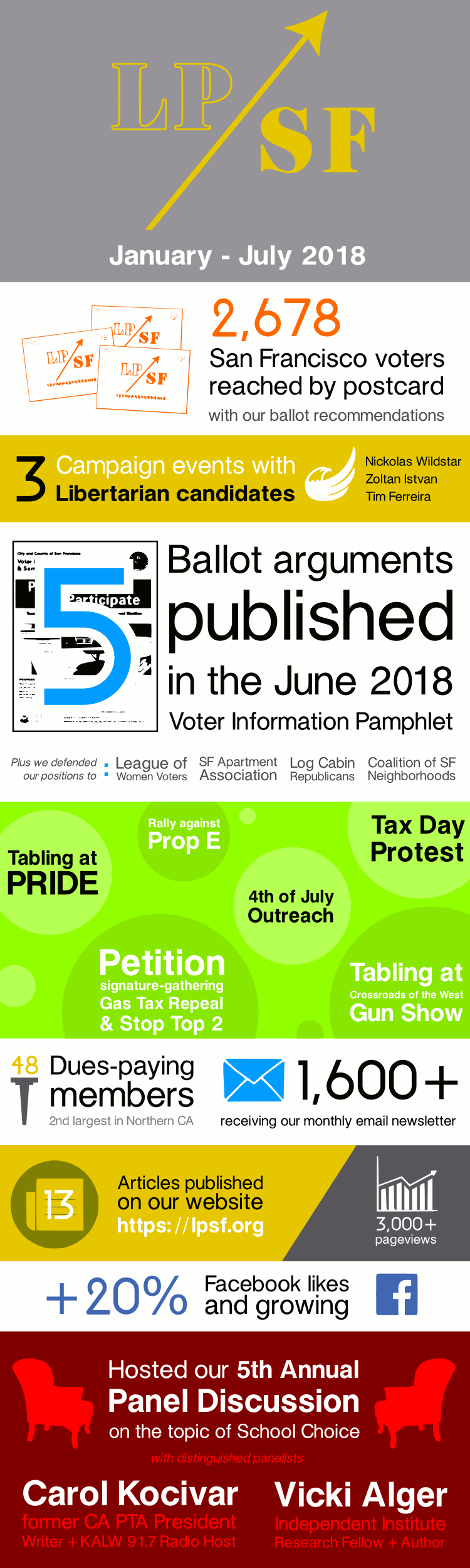
  • January – July 2018: What We’ve Accomplished

    January – July 2018: What We’ve Accomplished

    Infographic

    We’ve really accomplished a lot in the first half of this year! Thank you everyone who continues to put in the time and energy to fight for liberty in San Francisco! It’s an uphill battle, and sometimes it doesn’t feel so rewarding, but it’s important work that wouldn’t happen without our amazing activists and volunteers.

    So, take a few minutes to reflect on the first half of this year and ask yourself: how can we make the rest of the year even better??

    If you’re reading this now and you’re not yet a member– why not? Your $25 annual membership sends a clear sign that you stand on principle and want to see real change. Please consider becoming a member today. We hope to see you.

    For the rest of you, this would be a great time to make a donation to help make the rest of this year and 2019 even bigger and better!

  • Keeping Out The Riff-Raff

    Keeping Out The Riff-Raff

    With the Nimby’s and Yimby’s battling each other over land use rules in tackling The City’s and California’s housing problems, we wonder why so little is being said about another major cause of the high prices—urban growth boundaries (UGB).  UGB’s have been around for decades all along the west coast, so it should be no surprise that the highest cost of housing in the nation tends to be in California, Oregon, and Washington state. Boulder, Colorado has a UGB and not coincidentally very high housing costs too.

    An urban growth boundary is a policy that limits growth by establishing a line where a city or metropolitan area will not expand into for development purposes.  Not all entities take the same approach to stopping growth—some are worse than others, though none are good. Communities that do not want to grow will size their UGB to the current municipality’s boundary, which prevents any future expansion of the city.  Other UGB’s are a little more flexible and provide an amount of undeveloped land for development to meet future city growth estimates, which allows for “controlled and orderly growth.” In Oregon, state law mandates that regional bodies draw metropolitan-scale UGB’s for all cities.  In California, there is no state mandate (a good thing), but many cities have enacted their own disastrous homemade policies to stop growth.

    San Jose is a perfect example of government planning gone terribly awry.  Starting in 1971, under Mayor Norman Mineta’s (later became US Secretary of Transportation) administration, the city conjured up a land-use plan that called for limiting growth not only in the 136 square miles in its city limits but another 200 square miles in its “sphere of influence” with the help of Santa Clara County.  The boundary prohibited subdivisions to the east and south of San Jose, while west of the boundary were other cities, which were either surrounded by other cities or had their own boundaries. When the bureaucrats drew the UGB around San Jose, they expected moderate growth in the next 15 years. Of course, no one could have predicted the birth of Silicon Valley—so much for central planners and their special “knowledge”—and the mad rush of workers for high-paying tech jobs who moved to the San Jose area.  As the city refused to expand the UGB to allow more development to accommodate all the new workers, the obvious occurred: a dramatic increase in land prices and housing costs. Housing prices almost doubled between 1985 and 1990 and then doubled again between 1996 and 2001. Meanwhile San Jose’s density, which had dropped to less than 3,300 people per square mile before the UGB scheme began, increased to 5,000 people per square mile in San Jose and almost 6,000 people per square mile in the San Jose urban area.  To make matters worse, San Jose’s officials wrote a new General Plan in 1994 that kept the UGB just as it was with no expansion despite the rapidly rising home prices. They also classified Coyote Valley and South Almaden as “urban reserves” and refused to allow development in those areas. Even though Cisco Systems wanted to build a new factory in Coyote Valley, which would have allowed for less commuting, and homebuilders offered to pay for all the infrastructure needed to support residential housing, San Jose still did not allow the development.  Is it any wonder that San Jose’s housing prices rank as highest in the nation?

    Davis, California, just west of Sacramento, is another good example of how an urban growth boundary impacted housing prices.  In 2000 Davis voters approved by 54% adopting an urban growth boundary to mitigate “greater traffic problems, overcrowded schools and other associated problems.”  Measure J established the UGB by requiring a public vote by the city’s residents for any conversion of agricultural designated land into developed land. At least the measure required going back to the voters in 10 years to be renewed or ended.  Unfortunately Measure R in 2010 passed by an even wider margin of 77%. It thus became an ordinance that any time the city’s land use map is amended to change land designated from agricultural or open space into urban use or urban reserve use—the voters must approve it.    Two large areas in Davis’ 1999 Land use Map called Covell Center and Nishi Properties that were earmarked for development would also need voter approval. The Covell project was submitted to the voters in 2005 and 59% voted no. Then the Wildhorse Ranch project to develop land within Davis city limits which had an agricultural designation went to the voters in 2009 and failed at the ballot by a 75/25 margin.  Not only was Davis determined to limit its own growth—it also went to extraordinary efforts to limit growth of nearby cities. When the cities of Dixon and Woodland considered new residential and commercial development to provide jobs to UC Davis graduates, additional shopping options, and lower housing prices than Davis, the voters in Davis approved a $24 annual tax to purchase development rights for up to 2,200 acres of agricultural land to contain Dixon and Woodland.  Furthermore, Davis sued to stop any development outside its city limits but within reasonable distance in its “sphere of influence.” When a developer tried to develop an area called Kidwell near UC Davis, David successfully sued to stop the project. Since then, the city has been very active in the easement purchasing business. Is it any wonder that housing prices in Davis have gone through the roof while nearby cities are much lower?

    Housing figures as of December 2014:  San Francisco-741,200; Davis-580,900; Folsom-440,500; Dixon-344,900; Winters-322,200; Woodland-280,400; West Sacramento-280,000; and Sacramento-265,600.

    One ironic trend that has occurred over the years that UGB’s have been around is that UGB’s adopted through initiative and direct democracy are generally more restrictive than those adopted by politicians and bureaucrats.  In the case of Davis, even before the voters get to weigh in, the change in land use must have a project plan that outlines all the land use components and proposed public and recreation facilities. Once the project plan is established, it can’t be changed without a public vote.  Then it must be shown that the project is in compliance with all California environmental, planning, and zoning laws. Then the City Council must approve the change in land use, and finally the voters must approve the change by a majority vote. Small wonder that one study of 65 UGB’s in California found that 27% of the municipality-adopted UGB’s had been modified in some way to accommodate some growth, but in the 15 UGB’s that were approved by voters, not one had changed at all.  The biggest beneficiaries are people who owned land before the UGB’s were drawn, and they’re not about to allow a drop in their home values.

    The equity issue is perhaps the worse consequence of UGB’s.  Clearly, limiting the amount of land that can be built on benefits relatively affluent property owners at the expense of renters and low-income families.  This has contributed to the wealth inequality we hear so much about these days, as the higher housing prices prevents first-time buyers from moving on up. Plus living in dense, crowded, dirty, crime-ridden cities—even with high-paying jobs—isn’t necessarily a higher standard of living.

    Fortunately, it doesn’t have to be this way.  Did you know that only 5.1% of the land in California is developed?  In the 5 counties that make up the San Francisco-Oakland urban area, only 34% has been urbanized.  Since 20% is government-owned land, that still leaves 45% that could be developed but, due to UGB’s and other governmental restrictions, has been taken out of circulation.  If UGB’s were eliminated, new communities would pop up all over the west coast that could accommodate everyone’s taste—from those who prefer bustling cities to those who prefer suburban or rural lifestyles.  Expanding out from 5.1% to 10% would dramatically slash housing prices, and still there would be plenty of open space left to enjoy the natural beauty of the state’s forests, lakes, mountains, and farm land. It’s not necessary to cram everyone into crowded high-priced cities or gated communities that have closed the doors behind them—there’s plenty of room for everyone.

  • Divorce—San Francisco Style

    Divorce—San Francisco Style

    Last weekend the LPSF hosted a booth at the San Francisco Pride 2018 Fair.  We’ve become a regular exhibitor (not literally!) at the fair for many years, and liberty-leaning folks always love to see us there each year with our brochures, posters, buttons, World’s Smallest Political Quiz, Spinning Wheel of Crazy San Francisco Laws, and other tricks of the outreach trade.  This year folks may have noticed that we were there under our own Libertarian Party of San Francisco banner, rather than Outright Libertarians, which we had used for the last 14 years. The general public probably didn’t even notice the subtle difference because to the average person, once you’ve seen one Libertarian, you’ve seen them all.

    Well, not exactly.  We’ve taken Outright to task for their conspicuous silence on the Jack Phillips case and the recent Supreme Court ruling.  As you probably know, Jack Phillips is the owner of Masterpiece Bakery in Lakewood, Colorado who was fined by the Colorado Civil Rights Commission in 2012 for refusing to bake a wedding cake for David Mullins and Charlie Craig who were planning their wedding.  He offered to make them other baked goods but not the cake because it violated his Christian faith, but they stormed out and left. Then they filed a complaint of discrimination with the Colorado Civil Rights Commission, which ruled in their favor and ordered Phillips to re-educate his staff (most of whom were his family members) and report to the government for two years all the cakes that he declined to create and the reasons why.  Phillips then took his case to the Colorado Court of Appeals and argued that the Colorado Civil Rights Commission had violated his constitutional right to freedom of speech and free exercise of religion. Eventually the Supreme Court of the US ruled on the case that the Colorado Civil Rights Commission had not applied the law correctly and ruled in Phillips’ favor. Supreme Court Justice Anthony Kennedy wrote the majority ruling that “the law must be applied in a manner that is neutral toward religion.”  The Colorado Commission’s consideration of Phillips’ case was “compromised” by comments by one of the seven commissioners who disparaged Phillips’ faith as “despicable” and comparable to comments made by those who sought to justify slavery on religious grounds. The Colorado Commission had previously allowed three different bakers to refuse to put anti-gay messages on cakes they were preparing. Since this was a very narrow ruling of the law, and though it’s a partial victory for folks concerned about the constitutional guarantee of freedom of religion, the issue has hardly been put to rest as other similar cases will undoubtedly end up in the courts again.  David Mullins proclaimed, “The case is about more than us, and it’s not about cakes. It’s about the right of gay people to receive equal service.”

    “Equal service”—what does it mean and does it matter who is performing the service?  To Libertarians, it makes a world of difference who provides the service. If it’s a service provided by government—and we prefer as few of those as possible—then service must be provided to all “customers” without discrimination.  This includes all government roads, schools, housing, sidewalks, marriage licenses, and all the endless amount of services the government has taken over. Because the taxpayers all pay for the services in one way or another, it only makes sense and fulfills our sense of fairness that equal access must apply to all.  However, when it comes to the voluntary sector, this is where Libertarians part company with gay activists. Gay activists want to use the force of government to punish those opposed to the gay lifestyle. Whether those who don’t want to bake the cakes or provide the flower services—or issue the marriage licenses—no one can really know if their denial of services is truly religious or simply bigotry masked by religious freedom.  Should it matter if they are really bigots or not?

    Yes and no.  We should find it abhorrent in this day and age that people are still judged as part of groupthink, rather than as individuals.  Libertarianism, if nothing else, is all about individual rights, not the rights of groups, though if individuals choose to associate in groups with other individuals voluntarily, that’s still an extension of individual rights.  However, in the real world, we all discriminate in our private lives with whom we associate, and there’s no compelling reason for that right of association to disappear when people voluntarily offer their goods and services for sale.

    Most voluntary businesses these days are looking for more customers, not less, but if a business chooses to forego some profits—for whatever good or bad reasons it chooses—why is it necessary for the government to intervene?  Are there not dozens—if not hundreds in a major city—of bakers, florists, and photographers who would be more than willing to pick up the slack and offer their services? Why was it necessary for the gay couple to get their cake made from someone who didn’t want to bake it?  Isn’t that forced labor? Weren’t there other ways to affect change of a business that they felt was unfair and uncivil like negative word of mouth, a social media campaign, a boycott, even picketing in front of the store?

    Now come the What If’s when it comes to private discrimination.  What if a gay couple is driving across Utah and wants to stop for food and lodging and no one wants to serve the couple because they’re gay?  (I was actually asked this question one year at our Pride booth.) I’m not so sure that the predominately Mormon state is as anti-gay as folks suppose; I personally know one gay Libertarian who was elected mayor of a small town in Utah.  More to the point, the couple knew they were heading into Mormon territory before they headed out, and they should have come prepared with a lunch and sleeping bags because no one should ever be forced to serve another. What if a racist business owner doesn’t want to serve a black customer in his restaurant?  Free markets and competition offer built-in incentives against discrimination. Unless all the restaurants in town have made a pact not to serve blacks, the racist’s loss is another business owner’s gain. What if an emergency vehicle comes to tend an accident victim and they discover the victim is the wrong color and refuse to treat him?  (I heard of this happening in South Africa years ago.) The answer is the medical professional has taken the Hippocratic Oath and is bound by that, so if he fails to live up to it, he should be expelled from his professional organization. Considering the huge commotion, expense, and public image nightmare over the recent Starbuck’s incident in Philadelphia, it is safe to say today that businesses that exert blatant bigotry or outrageous treatment of customers will pay a price.  However, individual business owners may choose to pay the price, so that should be their choice, and the heavy hand of government is unnecessary, as there will always be another business standing by to serve the customer—and earn a few extra bucks. If not, we have to ask what barriers has government put up that prevented other potential business owners from opening up their own shops to serve shunned customers?

    Why has discrimination based on groupthink persisted over the years?  While things have definitely improved for some groups, still some bigotry exists.  One of the reasons could be government enforcement of anti-discrimination legislation.  Of course, it is human nature to be wary of different cultures, but markets and free-dealing and voluntary trading among people do a lot more to break down barriers than the heavy hand of government.  Remember the massive flight to the suburbs in the 70’s when the busing of children and desegregation started? Forty years later, have things changed that much in the schools? Not really. Schools in the suburbs tend to mostly white, and inner-city schools tend to be attended by non-white kids.  All that fighting, hate, and expense—and not much has changed. People do not like to be forced to change their attitudes, and most of all, they don’t like change forced in their faces. Governmental enforcement of anti-discrimination laws and preferences for favored groups (at the moment) only lead to backlash, which takes many years to dissipate.  Does anyone really think that Mullins and Craig running to the Colorado Civil Rights Commission to force him to respect them would make him more tolerant or approving of gays? Not likely now—or ever. He might have come around eventually, but dealing with government bureaucrats probably turned him away from forced tolerance forever.

    Our final thought on the issue brings us back to our dispute with Outright.  We understand their unease with standing with what appears to be bigotry, but the principle at stake here is what goes on in the voluntary sector is none of the government’s business.  Individuals have—or should have—the right to serve or not serve in their own business for whatever reason they choose. Period. The same ruling that allowed Phillips to refuse to bake the cake should apply to a black baker refusing to bake a cake with Nazi dogma or the recent case in Seattle where a gay coffee shop owner ordered religious folks passing out literature that he found offensive out of his business.  A press release from Outright posing the other side of the coin could have shown their disdain for Phillips’ choice and still upheld Libertarians’ reverence for freedom of association and property rights. We still hope that they will come around and defend all individuals’ freedoms, not just the ones they prefer, and denounce all government coercion to legislate morality. Until then, we’ll do the job for them.