Author: lpsf

  • November 2019 Ballot Recommendations

    November 2019 Ballot Recommendations

    A B C D E F
    NO YES NO NO NO

    Candidates

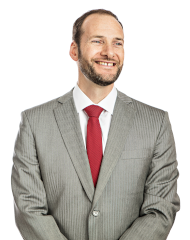
    District Attorney: Chesa Boudin, endorsed on October 12 by the LPSF

    The most criminal justice reform oriented candidate for district attorney, and the only one who has a background of trying to keep people out of jail rather than trying to lock them up, Chesa Boudin wants to end money bail, mass incarceration, the “War on Drugs”, and the criminalization of sex work. Find out more about Chesa at https://www.chesaboudin.com/.


    Measures

    NO on AAffordable Housing Bond
    Issues $600M in bonds (repaid by property taxes) to fund “affordable housing” programs which don’t work. This will end up costing taxpayers $1.5B and puts more power in the hands of government without solving the underlying cause of high housing costs in San Francisco– artificially short supply.

    (more…)

  • Libertarians Condemn Raid on Independent Journalist, Support Press Freedom and Government Transparency

    Responding to press reports about a joint SFPD-FBI raid on Bryan Carmody, a local journalist, today, the Executive Committee of the Libertarian Party of San Francisco, as authorized by its members, passed a resolution in support of journalism, freedom of the press, journalist shield laws, and government transparency.
     
    This resolution follows a statement by Libertarian National Committee Chair Nicholas Sarwark on April 11th calling for the dismissal of charges against Wikileaks founder, Julian Assange, who was dragged out of the Equadorian Embassy in London to face extradition to the US and possible torture and execution for his reporting on war crimes. National Libertarian Party Platform Plank 1.2 states “We support full freedom of expression and oppose government censorship, regulation, or control of communications, media, and technology.”
     
    Said LPSF Treasurer and independent journalist, Thomas Busse, who proposed the motion “This comes in the context of a massive wave of deplatforming, online censorship and self-censorship, and in the age of the internet, we are all journalists. We should never become complacent in our freedoms – including freedom of the press. Although there are major problems with American media due to consolidation and gatekeeping, some of the most vital work is being done by freelancers and smaller local news outlets. The raid on Mr. Carmody should be a wakeup call that the authorities presume it is somehow OK to attack the press and civil liberties here in San Francisco, and we need to stand firm in opposition.”
     
    The full text of the resolution:
     

    Resolution Condemning the Raid on Journalist Bryan Carmody’s Home and Office
    in Connection with the Leak of the Adachi Police Report

    14 May, 2019

    Whereas independent voices responsive to the people are needed in a democracy to inform the voters of abuses of power by those vested with authority;

    Whereas California government code Section 54950 states, “the people in delegating authority, do not give their public servants the right to decide what is good for them to know and what is good for them not to know. The people insist on remaining informed so that they may retain control over the instruments they have created”;

    Whereas the California Constitution’s Sunshine Amendment, The California Journalist Shield Law, and the San Francisco Sunshine Ordinance establish principles of transparency in government and freedom of the press;

    Whereas the circumstances surrounding the death of San Francisco public defender Jeff Adachi are a State and local affair outside the scope of the delegated powers of the Federal constitution;

    Whereas the United States Supreme Court found in Pruneyard Shopping Center v. Robins that the California Constitution can establish broader rights and freedoms than enshrined by the first Amendment in the Federal Constitution;

    Whereas secret grand juries, knockless searches on journalists, the seizure of their business and personal property, judge and venue shopping, and law enforcement threats create a chilling effect on freedom of the press in their service to the public;

    Whereas law enforcement at all levels of government have a long and dark history of infringing on civil liberties through entrapment by process crimes such as “obstruction of justice”, and

    Whereas in an age of internet publishing We are all journalists,

    It is Resolved by the Libertarian Party of San Francisco to express its severe concern over press reports regarding SFPD and Federal raids on journalist Bryan Carmody and the seizure of the tools needed to earn his living;

    It is Further Resolved a copy of this resolution shall be sent to the Society of Professional Journalists, Northern California, the Federal Bureau of Investigation, the US Department of Justice, the San Francisco Police Department, the Office of the Mayor, and to news outlets in Northern California.

    Mover: Thomas Busse, LPSF Secretary, secretary@LPSF.org
    Seconders: Nick Smith, LPSF Chair, chair@LPSF.org

  • San Francisco Libertarians File an Election Contest to Invalidate November’s Proposition A Election Due To Violations of New Law

    “The only stable state is the one in which all men are equal before the law.”
    – Aristotle
     

    There has been an ongoing problem of collusion between government officials and municipal bond advisors who often actually write the bond bills for profit. And then deceptively work with government to sell them to an unsuspecting public. To address this issue, the California State Assembly passed AB-195 which was approved by Governor Jerry Brown and on January 1, 2018 became Law. Sections of that law governs the way local governments can present bond measures on ballots:

    1. Measure shall be a true and impartial synopsis of the purpose of the proposed measure,
    2. and shall be in language that is neither argumentative nor likely to create prejudice for or against the measure.
    3. If the proposed measure imposes a tax or raises the rate of a tax, the ballot shall include in the statement of the measure to be voted on the amount of money to be raised annually and the rate and duration of the tax to be levied.

    Section 18401 of the California Elections Code says election officials who allow non-compliant ballots to be put before the public are criminally liable.

    As this complaint clearly shows, Proposition A was enormously non-compliant. The Libertarian Party of San Francisco (LPSF) was designated official Opponent of Proposition A by the SF Dept. of Elections. LPSF members called attention to these issues before the Ballot Simplification Committee. They were ignored.

    (more…)

  • July – December 2018: We are Growing

    July – December 2018: We are Growing

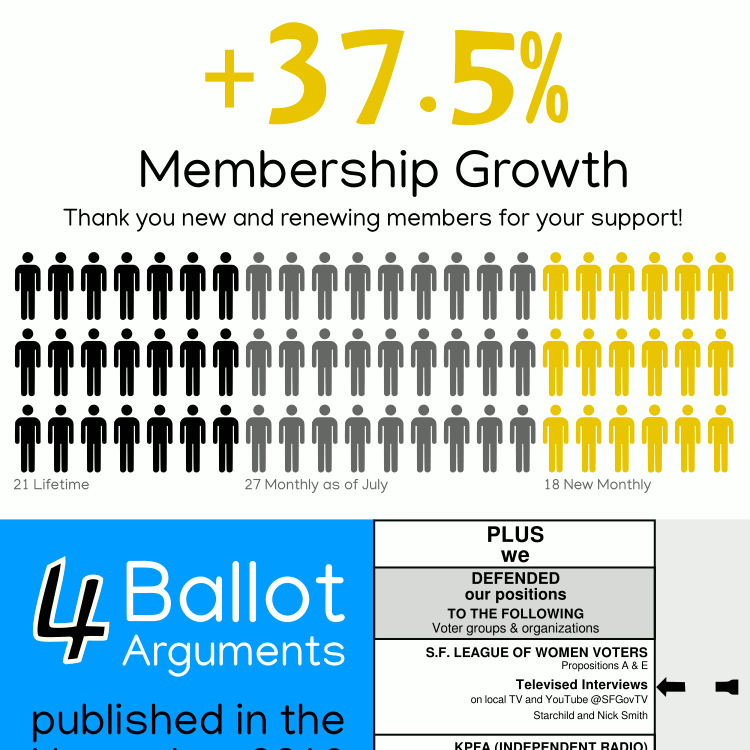
    Infographic

    Here is a quick highlight reel of what that the LPSF has accomplished in the second half of 2018. Looking at all this together, it’s clear that we are growing fast and accomplishing quite a lot with little resources. I’m very proud of the work that we’ve done and the progress we are making. THANK YOU again to all of our members, donors, activists, speakers, volunteers and friends. Without your support, this wouldn’t be possible– and with your continued support, 2019 will be even better!

    I hope to see you at our annual convention on January 19th, where we will elect officers, hear from interesting speakers, and make a plan for the year ahead.
    RSVP for the LPSF Convention

    If you can, please consider making a donation to support us, or join as a member to help the upward trend continue!

  • Looking Back

    Looking Back

    This will be my final regular article for the LPSF Newsletter, and for a change, I’m going to go with a normal title and not one of my eclectic ones that often had folks scratching their heads. I have voted with my feet and moved to New Hampshire to be part of the Free State Project, an effort to convince 20,000 Libertarians to move to the “Live Free or Die” state to help push it in a more liberty-oriented direction. I’ve already jumped into activism here and joined the New Hampshire Liberty Alliance, which reviews the bills written by state legislators and fights against the statist ones and supports pro-freedom ones, and also my local “Porcupines” group. Apparently I arrived just in the nick of time as the state turned blue during the election last month, no Libertarians were elected or re-elected, and the New Hampshire Libertarian Party lost ballot access. They even tried to enact a state income tax here recently (heaven forbid), but fortunately that failed. I plan to send a report from New Hampshire from time to time to report on how liberty is fairing here, so you may see an occasional article from me. Lots of work to be done here!

    I attended my first LPSF meeting in October of 2010 and got active immediately, and even with the numerous disappointments the LPSF withstood over the years, I never regretted getting involved. Not for a minute. I couldn’t imagine going back to being a bystander again and letting our liberties slip through our fingers. In the immortal words of Marcy Berry, “I’m not going down without a fight!”

    Eight years of political activism encompassed a variety of activities: working on the political campaigns of Ron Paul, John Dennis, Jeff Adachi, and Joel Engardio; writing and submitting ballot measure arguments at the Department of Elections; tabling at gun shows; giving public comment at Plan Bay Area hearings; manning a booth at Pride every year; keeping the peace at LPSF meetings when personalities occasionally clashed; attending local community group meetings and presenting LPSF ballot measure positions; tabling at JSA conventions; marching occasionally in rallies; helping to plan our annual panel discussions; and of course working with other liberty groups like the Golden Gate Liberty Revolution and the Nine County Coalition. A few grand (and some not so grand) experiences stick out as I recall the last eight years.

    Perhaps the happiest moment was watching the pictures that George and Catherine showed me after the Pink Pistols marched in the Pride Parade about five years ago. I wanted to march with them, but I was manning our own booth at the Pride Fair that day, so I had to miss it. Amazingly, the parade watchers were applauding and cheering on folks who were openly supporting gun rights—not exactly something that would normally be welcomed in San Francisco. Of course, I wouldn’t be so silly to think that the crowds were cheering for the “Pistols” part as much as the “Pink” part, but still they were cheering, not throwing tomatoes. For once, it actually made me proud to be a San Francisco resident, and I would call it San Francisco’s finest moment.

    Another event that lingers was when Marcy and I tabled at the Valencia “Sunday Streets” to promote our 1st Annual Panel Discussion. A rude and rather unpleasant guy came up to our table and asked dismissingly, “Are you part of the Ayn Rand Group?” looking to pick a fight with us. Indeed, it did get rocky for a while as he was an avowed and unapologetic statist, but we happened to get on the subject of Rand Paul, who had recently denounced the US Government’s use of drones to kill innocent people overseas, and the guy totally supported Rand for his efforts. In the course of a turbulent discussion, he had gone from foe to friend. The one thing I’ve experienced first hand over the years is that, being a Libertarian, no matter how many issues you might disagree with someone, you’ll always find some common ground with the other person, regardless of how staunch their politics are.

    Another good memory is when the LPSF was invited by the Noe Valley Democratic Club to present the “No” side on four separate ballot measures several years ago. Our Outreach Director Starchild was doing presentation duty that day for us. Without any necessary preparation or worry, it was amazing to watch Starchild effortlessly present all the good, common sense reasons for the group to recommend “No” votes to its members. How he managed to pull it off with no notes or props at all and do all four measures in one broad swoop—I’ll never know. I guess that’s why they call it the gift of gab. Of course, this was clearly a hostile group without any liberty leanings at all, but everything was completely civil, and mostly the audience sat quietly and listened politely. I remember very clearly that he chastised people who support ballot measures and laws that hurt working people and those on the lower economic scale the most but purport to help them. He was taking a sincere poke at the hypocrisy of those who feel they’re “helping” the poor, but he did it in a completely honest and forthright way. I’m sure they didn’t appreciate that bit thrown in! I admire him for pointing it out in no uncertain terms but presenting it without an ounce of acrimony. Of course, we heard afterwards that they recommended a “Yes” vote on each ballot measure. No surprise at all—you do your best and then move on.

    One of the more unpleasant memories of my activism was a presentation before the Raoul Wallenberg Jewish Democratic Club a few years ago on four different ballot measures. I was invited to present the usual contrarian viewpoint and didn’t expect to sway them, but I gave it a shot anyway. I was asked to show up at 11:00 to present, and it was an invitation by the group’s leader (I didn’t invite myself). They kept me waiting for four hours in a hot, sweaty, fly-filled meeting room before I could present. Whenever one of the candidates running for office dropped in, they kept on putting them up next before anyone opposing any of the ballot measures was allowed to present. Having to listen to four straight hours of candidates joyously promoting groupthink identity politics was a sickening experience, to say the least. If you’re a woman, score one extra point. If you’re a woman “of color,” score two extra points. If you’re a woman “of color” and gay, score three extra points. If you’re a woman “of color” who’s gay and has children in government schools, score four extra points. Ad nauseum. Finally, they ran out of candidates popping in at the last moment, and I was given ten minutes to run through the four ballot measures. Unfortunately, they kept on interrupting me with rude questions and comments almost the entire ten minutes, and I’m not sure I got through all the ballot measures, but I think I did. To her credit, the transgender person (score five extra points) in charge who invited me did try to apologize for the ungraciousness of her colleagues as I was leaving, but I never returned to that group again and unsubscribed immediately. Shameful that those who care so much about the down and out couldn’t extend common courtesy to a guest. Well, it can’t always be sunshine and roses, but I have to say this was a rare occurrence in my activist years.

    On the flip side of things, some of my best conversations over the years were listening to immigrants who stopped by our tabling events. I remember a guy from Africa ruminating about the trending statism in America. He argued avidly for more freedom—and there was little where he came from—and asked why people here are giving the government more control over their lives. Another time, at a liberty summit, I listened to a candidate running for office speak so passionately about why he was running and what life was like growing up back in Russia that a colleague that who rarely contributes to political campaigns was moved to contribute for once. Another time, a Hispanic couple that stopped at our table (who I had shamefully assumed would not be interested in politics or philosophy at all) turned out to be very interested in what Libertarians had to offer. Though they didn’t know much about libertarianism, they definitely had the independent spirit that defined America in the past, and we had a great conversation. Most memorable of all was hearing Lily Tang Williams, who ran for the US Senate in Colorado, speak at two LP conventions. She grew up during the Cultural Revolution and had plenty to say about what life was like growing up in the Mao Zedong years. Her stories of the micromanagement of everyday life that would be inconceivable to most of us made me teary-eyed, and at the same time her delivery was so down-to-earth that there were plenty of laughs too. She told us of her dream to come to America to get away from such tyranny and why she fights for liberty here so America doesn’t become what she was lucky to escape from. If my activist years have illustrated anything to me, it is that immigrants are our most valuable import, and they’re the best freedom fighters we’ve got.

    Ever attended a San Francisco Board of Supervisors weekly meeting? I only attended one over the eight years, and it proved memorable too—but not in the best sense of the word. The LPSF and a few other liberty folks decided to attend this particular meeting because the Board of Supervisors was going to vote on a resolution against the NDAA (National Defense Authorization Act) forbidding San Francisco government officials from helping federal officials enforce this direct assault on all our liberties. The chamber was packed, and I was pleased that so many folks had shown up to speak for liberty. Alas, I was wrong. As item by item was discussed and voted on, it became obvious after a few hours of business that most of the folks had come to speak for their particular issue only. They came to grovel to the Board of Supervisors so the supervisors would vote favorably on their permit or application—and then promptly left. By early evening, when the Board of Supervisors finally got to the NDAA issue, the room was mostly empty. It was just us liberty folks and a few from the left concerned about civil liberties who got up and encouraged the supervisors to support the resolution. To their credit, the Board of Supervisors did vote unanimously in favor of the resolution. What was also interesting was how an elected representative of the voters gets “elected” to a non-elected position. That day the supervisors were “electing” Scott Wiener to one of the regional boards (Metropolitan Transportation Commission). He was asked to leave the room, they took a quick vote on “electing” him to the MTC, and every supervisor voted “Yes.” He was called back in to the chamber and congratulated, and that was that. The whole thing took 5-10 minutes—and that’s how a politician elected for one job becomes “elected” to perform another one. Also of note was David Chiu’s remark to Carmen Chu, who was leaving the Board of Supervisors that day to become the County Tax Assessor, “You collect the money, and we’ll figure out how to spend it.” Of course, it was made tongue-in-cheek, but with a bloated (and growing like the blob) budget, he really did mean it. Worst of all, during one part of the meeting, the Board of Supervisors went around the table checking in with each supervisor to see what they were up to that week. Each supervisor got up and announced breathlessly what new legislation or resolution they were working on. It seemed like a big competition to outdo each other to demonstrate how much they were doing to “help the people.” And trust me—they weren’t looking for ways to get government off people’s backs, but the opposite. It was sickening to watch this circus played out. When politicians become full-time mischief makers, this is what it looks like in action.

    I don’t think I could close out my LPSF activism memories without mentioning fighting Plan Bay Area and the growth of regional government. Most memorable were two different hearings I attended in the early years before the plan was adopted in 2013. This was in the first go-round when they held actual public hearings, rather than the more recent versions of Plan Bay Area where public comment is no longer allowed and planned “workshops” are “presented” to the public where input is “invited.” The public hearing in Oakland was so different from one held at the Hotel Whitcomb in San Francisco. At the San Francisco hearing, the audience was quiet and respectful of those running the meeting, they were a younger crowd, and they seemed in total agreement with Eric Mar and the others in charge. Us few liberty folks were the only ones who spoke against Plan Bay Area. One young woman who supported the plan commented that people wait for buses and public transportation all over the world, that’s just how it is, and no reason for it to be any different for Bay Area residents. In other words, just grit your teeth and bear it. Another public speaker advised the central planners, “If you want to get them out of their cars, just take away their parking.” Indeed, the SFMTA has been doing this increasingly for years—and traffic has worsened. Contrasting this civilized meeting was the hearing in Oakland, which was well attended but the crowd was decidedly older. They were so rowdy—carrying signs, they clapped, hissed, and booed throughout the hearing and generally gave the regional folks a really hard time. While I myself don’t stoop to such low tactics (other than clapping), I have to say I totally enjoyed every minute of the show! The audience was so disrespectful of the authoritarians—it was a blast! Small wonder the planners moved away from the public hearing format where folks could actually get up and give the know-it-all’s a piece of their mind.

    I have to say I am proud and happy to have worked with such a great bunch of people who devote big chunks of their free time working to ensure that some aspects of liberty remain intact in The People’s Republic of San Francisco. A heartfelt thanks especially to Nick, Starchild, Rebecca, Marcy, Francoise, Michael Denny, Phil, Les, and Jawj for being great colleagues and friends to me. I will truly miss them as we shared so many memorable times over the years fighting the statist mentality. Who could forget the epic philosophical debates between Starchild and Phil breaking bread after our meetings when we often closed the restaurant down? How about our last Tax Day rally at Civic Center about six years ago when the winds were so strong that each leg of our canopy had to be held down by a different person? (We switched to panel discussions indoors after that fiasco.) How about the debate at the Commonwealth Club over the first sugary beverage tax ballot measure where Starchild held his own against the stacked team of Nanny Stater Scott Wiener and Authoritarian Dr. Lustig? What about the time at Pride when a completely naked man (except for zories) came up to our booth and wanted to take the World’s Smallest Political Quiz and no one wanted to deal with him and I got stuck with it? And what about all the times over the years that I got hopelessly lost driving to activist events with my colleagues? How about the time the Department of Elections refused to print out argument against Prop B, an increase in the parcel tax for CCSF, and the Voters Handbook falsely stated that no argument had been submitted against it? (I sought the help of the SF Ethics Commission, the City Attorney, and the Secretary of State—all of them useless.) And could Starchild and Marcy ever forget the crazy, chaotic times at the Department of Elections years ago when the lottery allowed us to submit scores of ballot measure arguments against each measure and we were madly filling out cover sheets until the very last minute?

    Indeed, it’s been a great run working with this small band of real freedom fighters. Thanks for the memories!
  • Throwing the Baby Out with the Bath Water

    Throwing the Baby Out with the Bath Water

    Why do government bureaucrats often throw common sense out the window with inflexible, illogical rules?  A perfect example comes from Southern California where the Los Angeles Unified School District (LAUSD), which is the second largest in the nation, has started enforcing a policy it’s had for years but has largely been ignoring.  Now that enforcement began earlier this school year, parents are rightly up in arms.

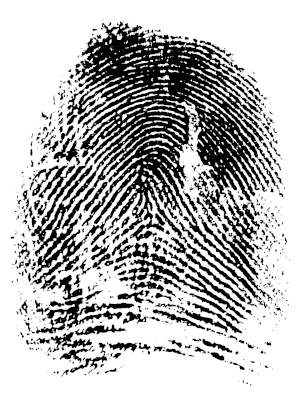
    For years the school district required volunteers “who had a lot of contact with students” to be fingerprinted, but only “at the discretion of the principal.”  Rarely was any parent volunteer ever fingerprinted, yet none of the children seem to be any the worse for it.  But this year, only six weeks before the start of school, the school district suddenly announced that all volunteers who have any contact with students must be fingerprinted.  Never mind that many parents had already been volunteering in the classroom for years without incident—fingerprinting required anyway, no exceptions.

    Adding to the bureaucratic chaos was a process that involved several steps for parents that included: 1) the appointment for fingerprinting must be made in the school office by the office staff; 2) the fingerprinting must only be done at one of only 7 sites available in a huge sprawling area like Los Angeles; 3) the parent must pick up the badge in person at the school once cleared; and 4) the parent must pay a $56.00 fee charged by the FBI and US Department of Justice for the fingerprinting.  Needless to say, all these burdensome steps caused many parents to think twice before volunteering this year and threw school programs run entirely by parents like math, science, and gardening activities and festivals into a complete quandary.  While virtually all parents were not opposed to the idea of fingerprinting to keep dangerous adults out of the classroom, many questioned why the school district made it so hard for parents to complete the process.

    First of all, why announce the edict only 6 weeks before the start of the school year?  Prudent planning and organization need to be done in advance, not on the fly, so cutting off the supply of volunteers at the last minute messed up the teachers’ schedules for volunteer-heavy programs.  Second, why insist that office staff make the appointments for the parents themselves, and even if so, why insist the parents schlepp over to the school just to request the appointment?  Many families have both parents working these days, and requiring a ridiculous extra trip to the school during the day when most parents are working is just plain silly.  Furthermore, with all the administrative burden that federal, state, and local laws require of school staff—and teachers—these days, why foist extra, unnecessary work on short-handed administrative staff?  Then there’s the issue of so few sites available for the fingerprinting.  To expect parents—and often ones with few means or spare time available—to drive clear across town in a very large city with legendary traffic problems is really pushing it for the school board.  If the school district was using its noodle, it should have either opened up more fingerprinting sites closer to other schools—even if temporarily—or brought in mobile live-scans to school sites.  As for paying for the $56.00 fee, while paying for a service rendered is not an unreasonable requirement, many parents of children attending government schools—especially in the LAUSD where over 80% of the students come from low-income households—simply do not have extra money to throw around.  Lastly, the whole process of fingerprinting requires the parent to present a Social Security number and a California driver’s license or ID card, which would obviously be another roadblock for undocumented parents, especially in the LAUSD where 25% of the students have at least one undocumented parent.

    It should be rather obvious that parental involvement in their children’s education makes all the difference between successful and failing schools.  Throwing more taxpayer money at government schools does little to improve the outcome unless parents are involved.  Even though it’s primarily the teachers who do the teaching, parental involvement gives teachers the support and reinforcement they need to succeed in their jobs.  When my son went to Clarendon Elementary School years ago, it was an actual requirement that parents volunteer—if not in the classroom, then at least at school events or in some other way.  It’s no surprise then that Clarendon was—and still is according to one of my neighbors—one of the most sought-after schools in The City’s lottery assignment system.  For independent religious schools, similarly many require so many volunteer hours to be put in by parents—or pay additional tuition.

    For the LAUSD to make it so difficult and put up so many barriers against free voluntary labor, is it any wonder government schools are graduating students so poorly that community colleges have become remedial schools?  Shouldn’t the folks in charge be making it easier to get more help from parents?  Why antagonize and frustrate those the school district needs the most?  Why expect students to turn out as responsible citizens of the world when the adults in charge show such poor judgment?

  • Small Steps Toward Justice

    Small Steps Toward Justice

    In September, Governor Jerry Brown signed AB 1793, Cannabis convictions: resentencing. The bill amends Prop 64 (2016), the Adult Use of Marijuana Act and requires the state to erase or reduce prior sentences for marijuana possession. Assemblymember Rob Bonta, who sponsored the bill, stated “Long after paying their debt to society, people shouldn’t continue to face the collateral consequences, like being denied a job or housing, because they have an outdated conviction on their record.” AB 1793 lets people who committed victimless crimes move on with their lives.

    None of this could have happened without the passage of Prop 64. Libertarians have long been against the drug war, so it might surprise you that the executive committee of the Libertarian Party of California unanimously endorsed No on Prop 64.

    I personally had voted yes on Prop 64 and when I heard AB 1793 had a chance of being passed, I reached out to members of the state party to hear why they voted no.

    I heard a range of answers including: “It wasn’t a well written law,” “Too many regulations,” “Taxes too high.” One person even said they only purchased black market marijuana to protest Prop 64.

    As a libertarian I usually vote No on all ballot measures. Most propositions aren’t well written and some of them shouldn’t even be on the ballot in the first place. It’s expensive to gather signatures to get a proposition on the ballot, so they’re all funded by “special interests.” Even if you agree with the proposition in principle, there are good reasons to vote No.

    Prop 64 was a special case where I had to vote yes. If voters waited for a better written law, it would have taken years for one to appear on the ballot and many more people would be in jail or stuck with marijuana convictions. Justice for victims and future victims of the drug war far outweigh the negatives of regulations and taxation.

    Proponents of Prop 64 wanted to regulate marijuana like alcohol. Just think about all the laws regarding alcohol today: You have to be a certain age. You can only buy it at certain times of the day. You must purchase a very expensive and limited license in order to sell it. There are limits to how much alcohol a drink can contain. Some states control sales through state owned liquor stores. There are even “dry” counties where alcohol is completely prohibited. Despite all the laws regulating alcohol, I have never heard of someone wishing to go back to Prohibition.

    Voting Yes on Prop 64 was the moral thing to do. Prop 64 reduced penalties for just about every marijuana-related crime and arrests are way, way down. Now with the passage of AB 1793, even more people will benefit from having their convictions wiped away. It’s unrealistic to think there will ever be a law that will reach the standards of some too-principled members of the Libertarian Party. The Libertarian should have put aside their distaste or regulations and taxation in support of justice.

  • November 2018 Ballot Recommendations

    November 2018 Ballot Recommendations

    These are our recommendations for the local + state measures on the November ballot.
    Have questions about our recommendations? Email ballot@LPSF.org.

    A B C D E 1 2 3 4 5 6 7 8 10 11 12
    NO NO NO NO NO NO NO NO NO YES YES NO NO NO NO


    John Dennis

    John Dennis for District 2 Supervisor
    District 2 is the Presidio, Marina, Cow Hollow, parts of the Richmond (click here to find out your district)

    The Libertarian Party of San Francisco has endorsed John Dennis at our August 2018 meeting. Read our interview with John Dennis and find out more at JohnDennis.com.

    Lisa Remmer

    Lisa Remmer for Congress
    California’s 12th District, includes most of San Francisco (view map)

    Although Lisa is not running as a Libertarian, she is a member of the Libertarian Party of San Francisco. She addressed our membership and we were generally happy to recommend her, especially over Nancy Pelosi. We cannot officially endorse Lisa Remmer because she is running as a Republican in a partisan race, but we think she is an obvious choice. Remmer4Congress.com


    Click “Read More” for explanations


    (more…)

  • A Libertarian at City Hall?

    A Libertarian at City Hall?

    Could a man raised in the densest Democratic county in America and now living in the bluest city in the country end up becoming Libertarians’ best chance to get a real freedom-loving politician into San Francisco City Hall?  Unlikely as it seems, yes, it’s actually possible this November. The lone Republican candidate for District 2 Supervisor, John Dennis is waging an enthusiastic campaign this fall to get a seat at the table. District 2, which covers primarily the Marina District, Pacific Heights, and Cow Hollow, is undeniably the wealthiest district in The City and probably the most conservative.  The other candidates are Catherine Stefani, appointed by Mark Farrell when Mayor Lee passed away; Nick Josefowitz, BART Board Member for District 24; and Schuler Shula, a relative newcomer to politics.

    (I interviewed John for this article at his home in District 2 earlier this month. I’ve known John since the Ron Paul 2012 campaign days.)

    John hails from Jersey City, New Jersey and grew up in Curries Woods, a government-owned and operated housing project.  As often happens when government owns property and no one really cares about it, gradually it deteriorates into a slum. Curries Woods followed this familiar pattern, and after 30 years, things had become so run down and dangerous that all but two of its seven buildings were razed to the ground.  John recalled the earlier years of his upbringing there to be “fun” at the time, but apparently his parents felt differently and moved out of the project when he was 13. His family background is working class, as his father was a longshoreman and his mother was a City Hall clerk. She also served as Democratic Party Committeewoman (forbidden term these days) and was a “practical” Democrat.  Just as most people stick with the political values they learned at home, John says he became a Democrat by “osmosis.”

    That all changed when John went to Fordham University in the Bronx.  Studying for a business degree, John became involved in student government and was elected Student Body President.  He began to take an interest in the outside political world and discovered Ayn Rand in his senior year and “devoured” her writings all summer long.  He took a course taught by Father Jim Sadowsky, a “Libertarian Jesuit” who hung around with the likes of Murray Rothbard and Walter Block and was of the anarcho-capitalist persuasion, and that solidified libertarianism in John’s political psyche.  Father Sadowsky’s teachings were heavy on ethics, free markets, and especially the principles of contract law.

    John wasn’t politically active for many years, though he did help out a few times during Ron Paul’s presidential bid as the Libertarian Party candidate in 1988.  His work for an ergonomic furniture company took him to Chicago and eventually to San Francisco in 1991. He remembers very vividly what sparked his political interest again.  He was in Columbia, South Carolina in May of 2007 on a business trip and noticed signs out announcing the upcoming debate between Ron Paul and Rudy Giuliani. He decided to watch the debate, and as fate would have it, that debate had the “Giuliani Moment” when Giuliani, at that time the frontrunner as the GOP candidate for president, exploded at Ron Paul for saying that the US government’s foreign policy of interventionism was the reason for the 9/11 attack and demanded that Ron Paul retract his statement and Ron Paul refused to back down.  That was the beginning of the end of Giuliani’s run—and the ascent of Ron Paul as a serious contender for president as a peace candidate. After that debate, since John himself is opposed to the US government’s involvement in overseas wars, he was hooked (politically) and worked on the Ron Paul campaign extensively becoming a precinct captain in the Iowa caucus helping Ron Paul tie with Huckabee in Iowa and coming in second in the Nevada caucus. John became so involved in the 2008 campaign that, as often happens in the political world, sooner or later someone suggested running for office himself.  The rest is local history as John ran against Pelosi in 2010, 2012, and 2014. Despite his anti-military and pro-civil liberty stances which should have put Pelosi to shame as a representative in Congress for “San Francisco values,” sadly John was unable to crack through the Democratic stranglehold on San Francisco voters.

    This time around, things may be different.  This being a local, non-partisan election, District 2 voters may actually be looking at the effectiveness of current government programs, rather than just voting with their political hearts.  Local government is more about the nuts and bolts of government that people see in action every day rather than what goes on in Sacramento and Washington, D.C. We wonder if District 2 taxpayers are content with the government services they pay City Hall to perform and if they’re getting good value for their money spent.  It remains to be seen if there’s enough dissatisfaction with San Francisco’s government to propel a Libertarian Republican to City Hall.

    John’s emphasis in his campaign this time is homelessness, property crime, and housing.  He says libertarian values are easier to expound when it’s a federal election, rather than a local one.  Since the federal government does so many things unauthorized by The Constitution, it’s pretty easy to use it as a guide and apply libertarian principles; it’s harder, though not impossible, with local issues.  According to the San Francisco Chamber of Commerce, The City spends $382 million per year on the homelessness problem, and by all accounts, things are getting worse, not better. When Mayor Breed walks the city with the “Poop Patrol,” and a major medical association that has been holding its annual convention in San Francisco since the 1980’s cancels its convention here and will hold it elsewhere due to safety concerns for its members, you know something is amiss.  Johns says The City should be looking at which programs work and which ones don’t—and start cutting funding to those nonprofits with nothing to show for the taxpayer funds received. He is the only candidate talking about Homeward Bound—a homelessness program funded by the taxpayers that I never even heard about until this campaign—where The City arranges with the homeless person’s family back home to take him or her back and The City pays for the person’s travel costs back home.  Helping the old-fashioned, way which is expecting a person’s family to take responsibility for its members rather than tossing them away for “society” to take care of. Of course this program won’t work for everyone, but it is a step in the right direction. Spending taxpayer dollars—definitely a libertarian value that should resonate well with District 2 voters. Rather than just throwing more money at the problem like the current Prop C, which the voters will decide on in November which is just another gross receipts tax and this time for the homelessness industry, Homeward Bound actually shows some positive results.  On property crime and the car break-in’s problem, John lauds Prop 47’s goal of releasing felons guilty of victimless crimes but says its shortcoming was the inclusion of the $950 limit downgrading property crimes from felonies to misdemeanors which has fueled the car break-in problem. He would like to see beefed up police patrols to deter the problem. Again, giving the taxpayers police protection they pay for is perfectly in line with the libertarian value of giving the taxpayers tangible results for services they expect and pay for. Since John is currently working in the housing development industry, he has seen firsthand The City’s onerous approval system and says it is completely dysfunctional and needs immediate reform.  Bureaucratic delays and uncertainties currently cause housing projects to take years instead of months to get approved, all the while increasing the costs which of course get passed on to renters and buyers.  He says the constant reworking of architectural plans again and again to satisfy the bureaucrats increases the costs and restricts the housing supply needlessly.  He would like to see the approval process speeded up to 6-9 months for final approval for all housing.

    When asked about whether he would be accepting public financing for his campaign that The City offers candidates that have received more than $10,000 in contributions (he qualifies), unlike some of the other District 2 candidates, John has chosen not to accept any government financing.  He said with public financing, the taxpayers end up supporting candidates they don’t even like—or worse still, candidates whose values are completely different from theirs. He said accepting any public financing is akin to “dividing up the loot.” Wouldn’t an attitude like that be refreshing for a change at City Hall?

  • First They Came For Your Boardroom

    First They Came For Your Boardroom

    Unprecedented Power Grab By California’s State Legislature

    Statism in California is not on the march, it’s rampaging.
    On August 30, the State Senate passed SB-826, which would compel corporations to appoint specified numbers of women to their boards.
    Here me loud and clear, please, men and women alike:
    There is nothing wrong, and everything right, with a company choosing to appoint a woman or women to its board.
    But there is nothing right, and everything wrong, with using government power to force a company to put any person on its board (or in its management or anywhere else in the company). It is tyranny, plain and simple.
    As a matter of pure political philosophy, this is a gross assault on freedom writ large, including economic and associational freedom.
    As a constitutional matter, the Equal Protection Clause of the United States Constitution provides as follows:
    “No State shall … deny to any person within its jurisdiction the equal protection of the laws. “
    A quota requiring a company to discriminate in favor of one sex in the awarding of board positions automatically requires the company to discriminate against the other sex with respect to those positions, this violating the constitutional guarantee of equal protection.
    The bill also violates the freedom of association, which the United States Supreme Court has ruled is inherent in the First Amendment.
    Please note that there is no limiting principle in the bill, for it has already transgressed the constitutional guarantees intended to limit governmental infringement of our freedoms. When a barrier to government overreach has been destroyed, the time arrives to play slippery slope. 
    By the logic of this bill, government could exert control over economic affairs in just about  any manner imaginable, including quotas in the boardroom for persons of every skin shade, national origin, religion, sexual orientation, and so on. And on. And on again. And obviously, any all-women boards could be forced to add men to their boards by the logic of the bill. Nor is there any principled reason why the high-and-mighty in Sacramento could not impose quotas for representation in management positions or in the workforce at large
    This seems a difference in kind from all manner of incremental increases in the power of the California state government.
    It appears that Governor Brown has not yet signed the bill, though the buzz goes that he plans to. If you feel as I do, Paul Revere this to the max: contact the governor to urge a veto, and ask your freedom-loving friends to do likewise.